Community building relies heavily on the creation of safe, welcoming spaces where individuals from diverse backgrounds can gather to share, learn, and grow alongside like-minded people. Through ongoing outreach initiatives involving the wider community, larger agencies, charitable organizations, and civic groups, community networks such as Muslim Mamas continually strive to extend this invitation far beyond the boundaries of the Muslim faith. There is a profound richness to be found in widening our perspectives, making a deliberate effort to understand those who maintain different traditions, and fostering meaningful human connections that build bridges between disparate neighborhoods and cultural groups.
For individuals who do not practice Islam, the prospect of stepping inside a mosque can occasionally feel unfamiliar or even mildly intimidating. Yet, visitors are invariably met with genuine warmth and hospitality. A mosque serves primarily as a place of worship, spiritual reflection, education, and community gathering for Muslims, but its doors are fundamentally open to people of all faiths, beliefs, and cultural backgrounds. Understanding the basic etiquettes and practical considerations of visiting a mosque helps ensure that any journey across the threshold results in a positive, respectful, and culturally enriching experience.
Understanding when and why Muslims frequent the mosque reveals a rich architectural and cultural diversity spanning communities across the United Kingdom. Mosques take many forms: some are grand, purpose-built structures featuring traditional domes and minarets that mirror edifices found across historically Muslim nations. Others occupy converted Christian churches, former secular community centers, or residential houses that present a more understated exterior and possess fewer specialized facilities. Regardless of physical appearance, the majority of mosques remain open daily to accommodate the five prescribed prayers, while smaller or resource-limited facilities might open specifically for morning or evening services. The traditional Arabic term for these houses of worship is masjid, a word visitors will frequently encounter.

Islamic tradition dictates that adherents face toward Mecca when performing their daily prayers five times a day. While the mosque stands ready for individual worship throughout the day, communal prayer is strongly encouraged, particularly for the midday gathering and most notably for the congregational Friday midday service. Prayer spaces within these buildings are traditionally segregated by gender. However, spatial constraints mean that some smaller mosques cannot consistently maintain a dedicated area for women. Because Islamic jurisprudence places a communal obligation on men to attend congregational prayers where feasible, male prayer spaces are often prioritized. Women are warmly welcomed to participate in communal worship, but they retain the flexibility to perform their prayers in other appropriate settings.
Fridays hold special significance, as Muslims gather in large numbers for the midday prayer and weekly sermon, known as the Jum’ah Prayer. Beyond purely liturgical functions, mosques frequently operate as vibrant community hubs. They regularly host Islamic and Qur’an educational classes tailored for children, adults, and individuals who are newly discovering the faith. Furthermore, these institutions serve as venues for social gatherings, cultural festivals celebrating Ramadan and Eid, life-cycle ceremonies including weddings and funerals, and various charitable outreach programs.
Leadership within a mosque typically rests with an Imam, who acts as the spiritual leader and community guide. However, not every mosque employs a resident Imam. Some facilities rely on visiting scholars or invite knowledgeable members of the local congregation to lead prayers and teach from the Qur’an, the holy book of Islam. Operational management is frequently overseen by a board of trustees, administrative committees, and dedicated maintenance staff who ensure the building and its associated community services run smoothly.
Visitors planning to attend a mosque should pay careful attention to standards of modesty in dress. Both men and women are expected to wear loose-fitting attire that adequately covers their arms and legs, meaning shorts and sleeveless shirts are generally considered inappropriate for all attendees. Female visitors are also advised to carry a headscarf. While not every mosque strictly enforces head coverings for non-Muslim visitors—particularly outside the dedicated prayer halls—wearing one serves as a visible sign of respect. For those who inadvertently arrive without a scarf, most mosques keep spare garments on hand to lend to guests. Wearing makeup is entirely acceptable, and children are permitted to wear comfortable, everyday clothing. Because visitors are required to remove their footwear before entering carpeted prayer areas, wearing clean socks or tights is strongly recommended. Most mosques provide designated shoe racks and storage shelves near the entrance where personal belongings can be safely stowed.

Navigating social interactions inside a mosque is straightforward, as communities pride themselves on hospitality and openness. Visitors are encouraged to ask questions, and congregants are typically eager to share their knowledge and cultural traditions. Greetings can be offered using the traditional Islamic phrase "Assalamu ’alaykum," which translates to "peace be upon you." Even if pronunciation is imperfect, the effort is met with appreciation, though a standard English greeting and polite inquiry remain entirely appropriate.
When greeting others, visitors may shake hands with individuals of the same gender. When interacting across genders, however, guests should follow the cue of the person they are addressing. While some community members are comfortable shaking hands, others prefer physical distancing for personal or religious reasons. In such instances, a universally understood and respectful alternative involves placing one’s right hand over the heart accompanied by a slight nod, a gesture that consistently brings smiles and communicates genuine goodwill. Perfect adherence to every protocol is never expected; sincere respect, attentiveness, and an open mind are more than sufficient.
Entering the main prayer space requires a few basic observances. Upon arrival, hosts will direct visitors on where to remove and store their footwear. Mobile devices should be silenced or switched off entirely to maintain the tranquil atmosphere of the hall. Conversation should be kept to a minimum once inside the prayer area, and absolute silence is maintained during active prayer services.
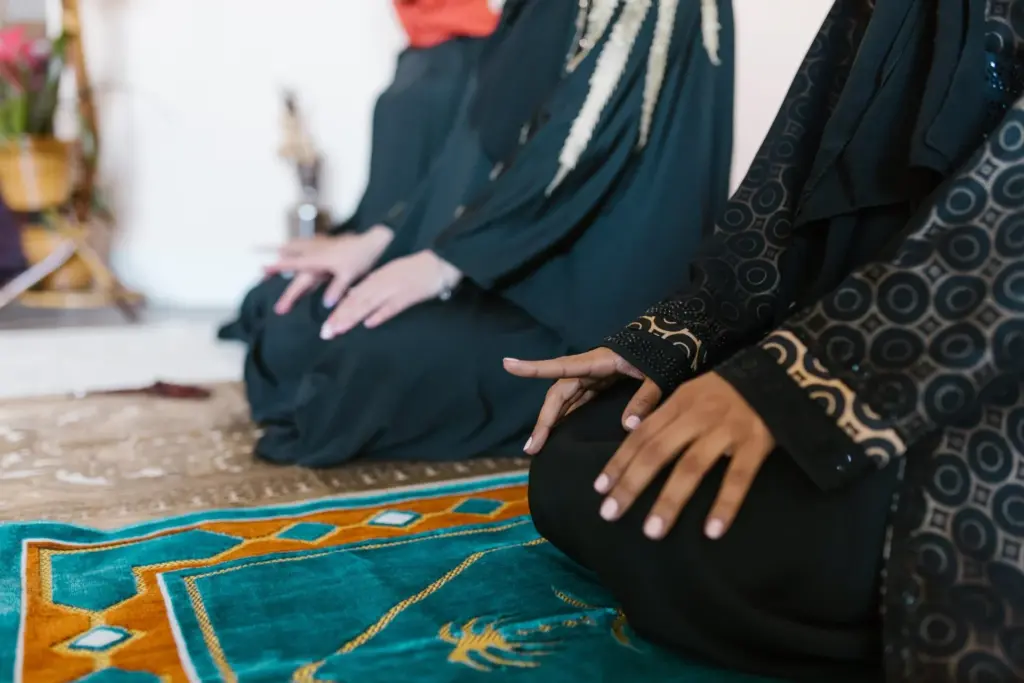
First-time visitors will often observe ritual washing, known as ablution, performed by congregants before they enter the prayer hall. Specialized washing facilities are often available for individuals to cleanse their faces, arms, hands, and feet, though visitors are never expected to complete this ritual themselves. Unlike traditional Western places of worship, mosque prayer halls do not contain pews or chairs; instead, congregants sit directly on plush carpets or rugs, though a limited number of chairs may be provided for the elderly or those with mobility issues.

Men and women enter through separate doors and occupy distinct sections of the prayer hall, separated either by distance, differing floor levels, or physical partitions. Families visiting with young children generally keep them close by, regardless of the child’s gender. During communal prayer, worshippers stand, bow, prostrate, and sit in precise unison. Observers are not expected to participate in these physical movements and may watch quietly from the sidelines. Because it is considered culturally disruptive to walk directly in front of someone who is engaged in prayer, hosts may seat visitors near the back of the hall to ensure an unobstructed and respectful view of the proceedings.
Ultimately, spending time within a mosque offers an enlightening window into a rich religious and cultural tradition. Rather than worrying excessively about making protocol errors, visitors are encouraged to embrace the opportunity to forge genuine human connections across cultural divides, frequently discovering far more shared values than anticipated. By approaching the experience with curiosity, respect, and hospitality, outsiders can participate in an inclusive exchange that fosters deeper understanding between diverse communities.