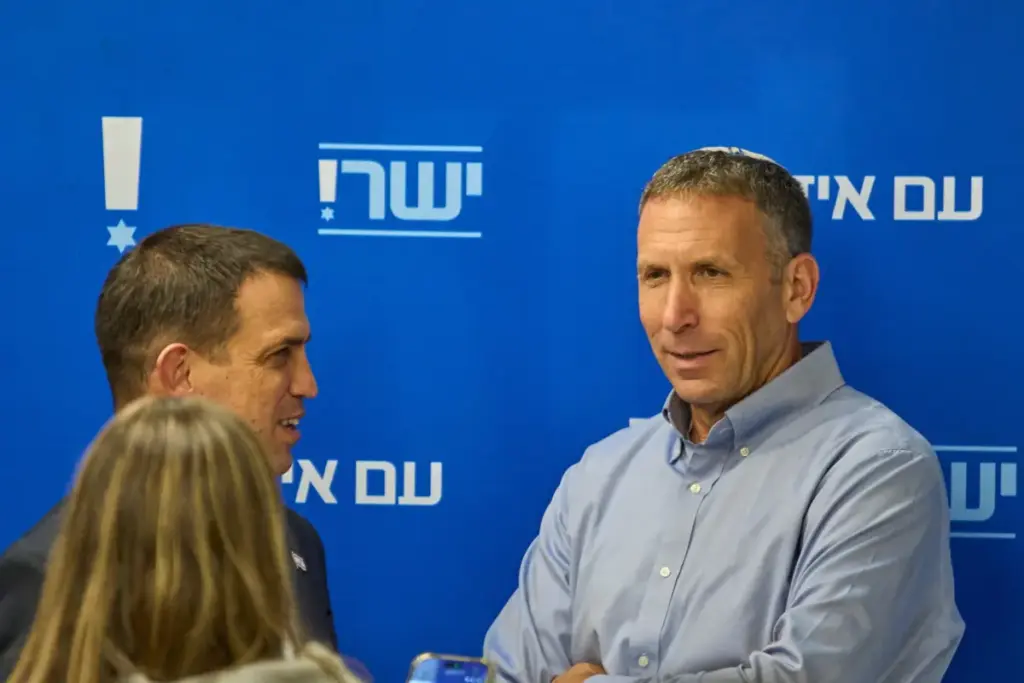
Israeli lawmakers have elected Matan Kahana as the new parliament speaker, marking a significant step towards reversing domestic policies from the outgoing government led by veteran Prime Minister Benjamin Netanyahu.
Kahana, a key political ally of Gadi Eisenkot—the party leader currently tasked with forming the next government and replacing Netanyahu—was voted into the influential post on Tuesday. He secured 66 votes in the 120-member Knesset chamber, defeating Likud’s candidate Ofir Katz, who received 52 votes following a stormy and contentious debate that stretched over seven hours.
The election of the Knesset speaker is widely viewed as a pivotal office within Israel’s parliamentary system. The position holds the authority to set the timetable for parliamentary business, giving the speaker the power to speed up or delay debates and crucial votes on proposed legislation. This institutional leverage gives Eisenkot’s bloc an immediate mechanism to advance its agenda even before a governing coalition is officially finalized.
"I will be a Knesset speaker for everyone, irrespective of race, religion or gender," said Kahana during his inauguration speech immediately after the vote concluded.
Kahana, a 54-year-old former special forces soldier and member of Eisenkot’s Yashar party, is expected to start the process as early as Wednesday to dismantle much of Netanyahu’s domestic agenda, particularly regarding controversial reforms to the country’s judiciary. Kahana succeeds Amir Ohana, a close Netanyahu ally who had held the position since 2022.
The high-stakes parliamentary vote took place weeks after the October 27 parliamentary elections, an inconclusive contest in which neither Eisenkot nor Netanyahu secured a governing majority in the Knesset. Since the election results were confirmed, the two rival political blocs have traded barbs and engaged in protracted political maneuvering.
Eisenkot’s wide-ranging political bloc secured 48 seats in the election, while Netanyahu’s Likud-led bloc finished with 53 seats. Notably, two Arab-majority electoral slates won an unprecedented 19 seats, propelled by widespread public anger over the policies of Netanyahu’s hard-right government. On Tuesday, those two Arab lists ultimately cast their votes for Eisenkot’s candidate, Kahana, ensuring his victory as parliament speaker with only one Arab Knesset member absent from the session.
Ahead of the speaker vote, representatives from Netanyahu’s and Eisenkot’s parties met on Sunday to discuss the theoretical possibility of forming a unity government. However, political observers noted that the meeting appeared to be largely a formality, as both leaders publicly maintained that they alone should rightfully serve as prime minister.
Netanyahu, Israel’s longest-serving prime minister who has spent three decades in and out of power, has repeatedly emphasized the need for a unity government while framing his arguments around pressing national security concerns. According to reports, Netanyahu has also been urging US President Donald Trump to resume a hardline military posture and pressure Iran, leveraging the external threat from Tehran to reinforce his arguments for political continuity.
Sweeping Reforms
With Kahana now at the helm of the Knesset and assuming Eisenkot retains the crucial backing of the Arab-Israeli parties, the opposition bloc holds a formidable opportunity to deal serious legislative blows to Netanyahu’s policy legacy even before a new government is officially formed.
Eisenkot has stated publicly that he intends to rescind sweeping legislative reforms designed to reduce the independence of the Israeli judiciary. These reforms were heavily advanced by Netanyahu, whose political maneuvers have been closely scrutinized against the backdrop of ongoing corruption charges. If Netanyahu loses power and subsequent political protections, those legal challenges could potentially land him in prison.
Furthermore, Eisenkot has vowed to quickly establish an official state commission of inquiry to investigate the profound security failures that allowed Hamas to launch its devastating attack on October 7, 2023. Netanyahu, who has built his decades-long political brand on the core promise of ensuring Israel’s national security, has consistently resisted calls for an independent, legally empowered probe. Instead, the outgoing prime minister has proposed alternative investigative frameworks whose members would be chosen directly by politicians.
Kahana brings a distinct background to his new role. A deeply observant Jew, Kahana fits into Eisenkot’s broader strategy of building a politically diverse coalition that ranges from secular liberals to religious conservatives. During his tenure in a short-lived, non-Netanyahu government in 2021 and 2022, Kahana served as the minister for religious services. In that capacity, he frequently clashed with ultra-Orthodox political factions by attempting to decentralize and reduce the entrenched power of the Chief Rabbinate.