RIYADH/SANAA — Saudi-led coalition forces fighting Yemen’s Houthi movement have reported that the Iran-backed group fired a ballistic missile at the Saudi capital of Riyadh at dawn, marking a significant and alarming escalation in hostilities. The missile was successfully intercepted and destroyed by the Gulf monarchy’s air defense systems before it could reach its intended target, averting what could have been a catastrophic strike on a heavily populated metropolitan area.
The brazen attack on Riyadh was accompanied by a coordinated barrage targeting multiple other regions across the kingdom. According to coalition forces spokesman Major-General Turki al-Maliki, who released a statement on X on Saturday, the Houthis also attempted to strike civilians and critical civilian infrastructure in Bisha, Taif, Farasan, and Yanbu. All of these secondary attacks were successfully thwarted by the kingdom’s air defense network, preventing widespread damage or potential loss of life.
The series of attempted strikes prompted Saudi authorities to issue a string of emergency alerts across the kingdom overnight on Friday, warning residents of an imminent "hostile aerial threat." For the residents of Riyadh, it was the first time an air raid alert had been sounded in the capital since an escalation in fighting with the Houthis in Yemen began in July.
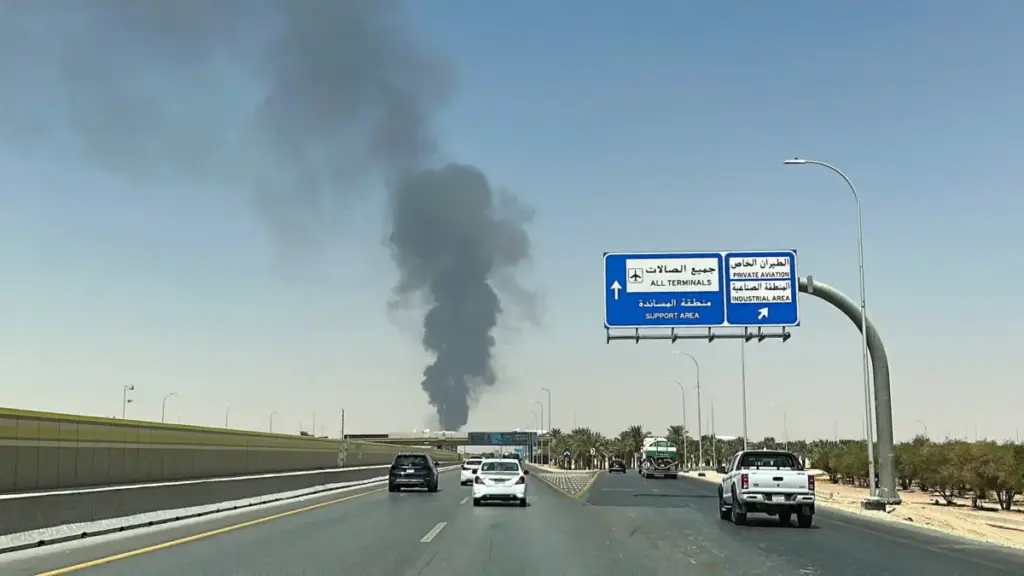
By Saturday morning, at least one heavy explosion echoed across Riyadh. Residents living near the city’s international airport reported seeing a large plume of black smoke rising into the morning sky shortly after the blast. Despite the dramatic scenes and the activation of emergency protocols, Saudi authorities quickly moved to reassure the public, reporting no casualties or material damage resulting from the intercepted missile or the subsequent debris.
Major-General al-Maliki condemned the attacks, emphasizing that the Houthis are deliberately escalating their aggressive attempts to target innocent civilians and vital civilian infrastructure within the capital and across other strategic provinces. He strongly reaffirmed the coalition command’s inherent right to take all "appropriate" and necessary military actions to deter the Houthis and protect the nation’s security, operating strictly in accordance with international humanitarian law.
Houthi Claims and Regional Impact
Earlier on Saturday, Houthi fighters in Yemen openly claimed responsibility for the coordinated assault, boasting that they had successfully targeted "sensitive" sites in Riyadh as well as a vital Saudi Aramco oil facility located in the western coastal industrial city of Yanbu. The claims were detailed in an official statement broadcast and shared by Houthi military spokesman Yahya Saree.
According to Saree, the multi-pronged operation utilized a combination of advanced weaponry, including cruise missiles, ballistic missiles, and a fleet of explosive-laden drones, designed to overwhelm or bypass early-warning radar systems. The explicit targeting of energy infrastructure such as Aramco facilities has historically been a key tactic employed by the group to disrupt global energy markets and exert maximum economic pressure on Riyadh and its international allies.
The renewed cross-border aerial campaign underscores a dangerous deterioration in regional security, reversing months of relative quiet that followed a landmark United Nations-brokered truce agreed upon in April 2022. Analysts note that the initiative and momentum of the current conflict appear to be dictated largely by the insurgent group’s operational decisions.
Yasmeen al-Eryani, executive director for knowledge production at the Sana’a Center for Strategic Studies, a prominent regional think tank, offered insights into the strategic dynamics driving the current flare-up.
"You could see that the Houthis are determining the timelines and the levels of the escalation," al-Eryani told Al Jazeera in an interview analyzing the latest security developments. "So, depending on the current situation, it seems that the Houthis are the ones in control," she added, highlighting the persistent challenges faced by the Saudi-led coalition in trying to establish long-term deterrence.
Heavy Ground Clashes on the Yemeni Frontlines
While the skies above Saudi Arabia witnessed high-tech missile defense operations, the war on the ground inside Yemen continued to exact a heavy toll in blood and stability. The armed forces of the Saudi-backed, internationally recognized Yemeni government announced on Saturday that their frontline fighters had successfully thwarted a determined Houthi infiltration attempt in the al-Fuliahan sector, located in the strategic southern Marib province.
According to military reports from the internationally recognized government, the defensive operation resulted in the deaths of at least 12 Houthi fighters, with several others sustaining injuries during the intense firefight. However, the victory came at a cost, reflecting the brutal nature of the ongoing territorial contest. The Yemeni army also disclosed that 13 of its own soldiers had been killed over the course of two days of fierce, unyielding clashes with Houthi forces in the southwestern provinces of Taiz and Lahj.
These violent flashpoints are part of a broader, sweeping military escalation that erupted across Yemen in early July. Fighting has intensified dramatically in Marib, Taiz, Lahj, al-Jawf, and al-Bayda, marking the most violent and concentrated phase of the conflict since the relative calm established by the April 2022 truce began to fray earlier this year. The breakdown of the truce has dashed hopes for a swift diplomatic settlement, plunging millions of Yemenis back into the shadow of active warfare and humanitarian distress.
Military Realities and Strategic Limitations
For the coalition and the internationally recognized government, military options on the ground remain severely constrained by Yemen’s rugged and unforgiving geography. Al-Eryani explained to Al Jazeera that traditional military strategies against the Houthis are profoundly limited because the vast majority of the ongoing fighting takes place in remote, high-altitude mountainous terrain. These areas are exceptionally difficult for opposing conventional forces to access, conquer, and permanently hold against entrenched guerrilla fighters.
Given these formidable topographical obstacles, al-Eryani suggested that successfully containing the group and mitigating its offensive capabilities may currently represent a more realistic and achievable objective than attempting to achieve a decisive military defeat.
"Without controlling the peaks that are parallel to the coast, you will not be able to control the coast," al-Eryani noted, emphasizing that tactical dominance over Yemen’s mountainous spine remains the ultimate key to shifting the military balance of power.
As diplomatic channels strain under the weight of these new attacks and ground offensives, the immediate priority for regional security forces remains the defense of civilian populations and critical infrastructure against an increasingly sophisticated and determined adversary.