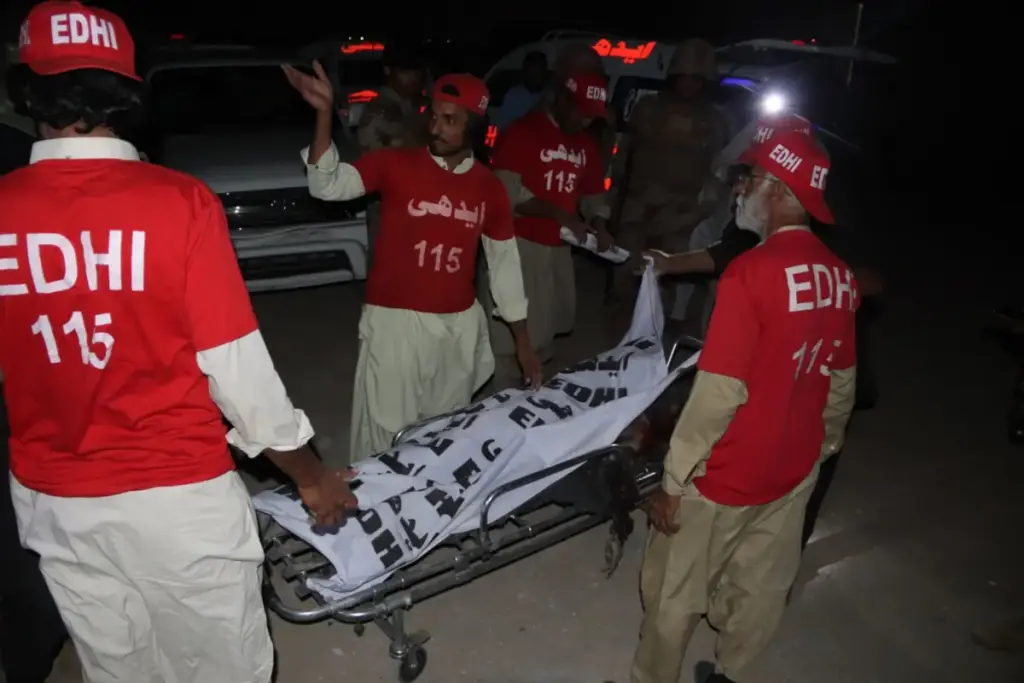
At least 21 people, including 16 police officers and five civilians, were killed and more than 70 others wounded in a devastating suicide bombing that targeted a police compound in northwestern Pakistan during Friday prayers, local media reported, citing official sources.
The catastrophic casualties occurred when an explosives-laden vehicle rammed directly into the Old Police Lines gate in the Kohat district of the Khyber Pakhtunkhwa province, a senior police official said, according to local broadcaster Geo News. The force of the explosion inflicted severe structural damage upon the surrounding area, leaving a deep crater just outside the mosque located within the heavily secured police compound.
Tahir Ali Shah, the top official at Kohat District Hospital, confirmed earlier that 15 bodies were brought to the healthcare facility in the immediate aftermath of the blast, alongside a large influx of wounded individuals requiring urgent medical attention. Local medical teams struggled to cope with the sudden surge of casualties as emergency responders worked tirelessly to transport the injured from the volatile scene.
In addition to the civilian and police casualties, authorities confirmed that six "terrorists," including the suicide bomber himself, were also killed in the explosion and the subsequent chaos. In a formal statement released to the media, police officials stated that a comprehensive clearance operation was actively underway at the site to ensure the compound was secure and to rule out the presence of any secondary explosive devices or hidden attackers.
The security situation in the area escalated further during the unfolding tragedy. According to the Khyber Pakhtunkhwa police inspector general, a separate suicide blast took place simultaneously at a special branch police building during an exchange of gunfire between security personnel and hostile elements.
In the wake of the carnage, national leaders swiftly condemned the violence. President Asif Ali Zardari expressed deep regret over the loss of civilian lives and the casualties sustained by law enforcement personnel in the Kohat blast. Taking to the social media platform X, formerly known as Twitter, the president emphasized that the complete elimination of "Fitna al-Khawarij"—a term used by Islamabad to designate the Tehreek-e-Taliban Pakistan (TTP) group—and all other associated terrorists is an absolute and urgent necessity for the preservation of national security.
Separately, in a concurrent development highlighting the widespread nature of the security challenges facing the country, seven militants were killed by Pakistani security forces during two distinct operations conducted in the southwestern Balochistan province, state-run Radio Pakistan reported.
The city of Kohat is situated in the restive northwestern province of Khyber Pakhtunkhwa, located near the porous Afghan border, a region that has long faced intense security pressures. The sheer force of Friday’s blast severely impacted the urban landscape, damaging nearby structures and infrastructure in the vicinity of the police compound.
Distressing scenes emerged from the aftermath of the attack. Television footage broadcasted by Pakistani network Geo showed panicked citizens fleeing the scene in utter confusion and terror, while lifeless bodies lay scattered on the ground amid the wreckage. Furthermore, verified videos circulating on social media platforms depicted a heavily damaged building facade with shattered windows, alongside footage of local residents and rescue workers clearing away heavy piles of rubble in a desperate search for survivors.
As investigations commenced, there was no immediate claim of responsibility for the devastating assault. However, security analysts note that both a regional affiliate of the Daesh terrorist group and the Pakistani Taliban are intensely active in the region, regularly carrying out coordinated attacks against security forces and government infrastructure.
Violence has experienced a sharp and concerning surge in Pakistan’s remote regions near the Afghan border over recent years, compounding the challenges faced by law enforcement agencies tasked with maintaining public order and safety.
This latest tragedy follows a series of high-profile security incidents in the province. In early August, 14 people were tragically killed in a suicide attack staged outside a police station in the Swat Valley, which is also located within the Khyber Pakhtunkhwa province. At the time of that attack, hundreds of local citizens had gathered outside the station to peacefully demonstrate against the escalating wave of violence plaguing the region. That incident itself followed a series of targeted assaults against police officers and installations in the months prior, underscoring a persistent and deeply entrenched security crisis that continues to claim lives across the northwestern frontier.