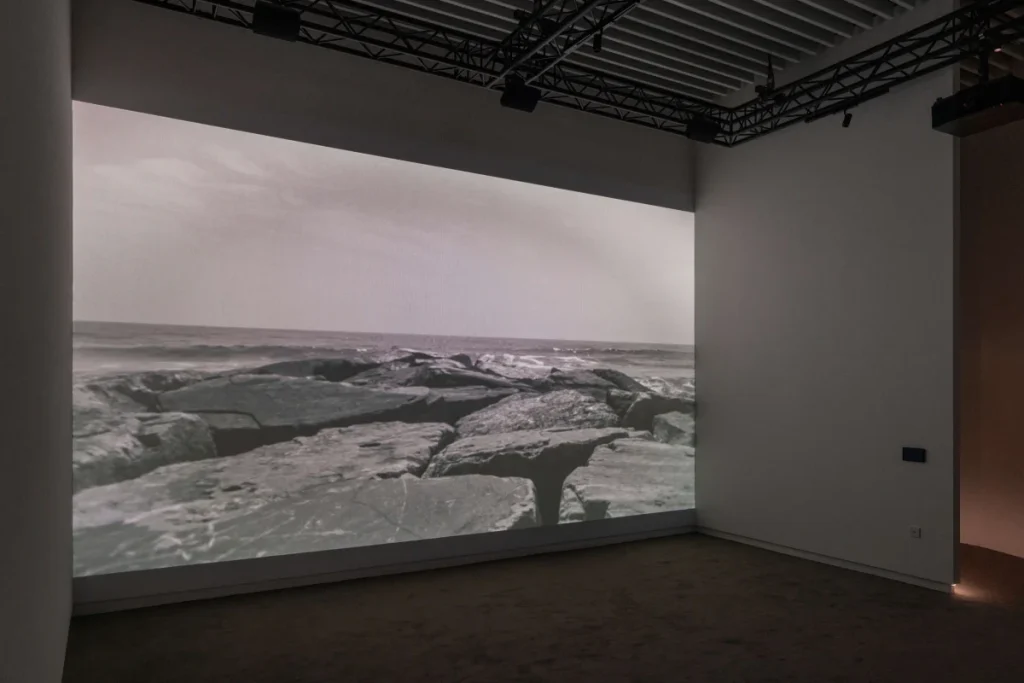
Renowned American visual artist Carrie Mae Weems has unveiled The Long Goodbye, a powerful new film created for the New Work: Making East London season at the newly opened V&A East Museum. Presented in the Film Room of the museum’s Why We Make galleries, the ambitious moving-image work brings together archival footage, music, dance, portraiture, and performance to examine how bodies of water have fundamentally shaped human history, migration, and the vibrant multicultural fabric of east London and beyond.
Commissioned as part of the museum’s inaugural programming, The Long Goodbye traces the sweeping currents and soft tides of the oceans that have enabled transatlantic migration both voluntarily and by force. Weems’s latest creation explores how immigrants, navigating vast expanses of water across centuries, have continually forged new identities and artistic forms. By celebrating the cultural diversity that underpins contemporary global cities, the film argues that water and networks of migration act as vital fuel for worldwide creativity, transcending fear and historical adversity.
To mark the launch of the project, Weems reflected in an exclusive interview on the deep-seated questions of power, memory, and representation that have guided her decades-long artistic practice. She also discussed the personal experiences, extensive research, and crucial community conversations—most notably her engagement with the V&A East Youth Collective—that informed the making of the film.
Defining a Practice Rooted in Power and Voice
Discussing the guiding principles of her career, Weems explained that her work moves fluidly between photography, video, performance, and installation. While she utilizes installation to untangle complex ideas and photography for its immediate descriptive power, video allows her to command time, bringing together language, text, music, and imagery into a unified whole.
"No matter the form, I feel that I have always been dealing with the same fundamental questions: who holds power, how power operates, and how privilege shapes the lives of those who have been offered very little," Weems said. "The question of how to manage and challenge power has been central to both my life and my work. I am also interested in the power of voice: how it can be used to empower people who have been disenfranchised, and those who have been made to feel that they have lost everything."
Her artistic approach has long been shaped by a sense of sheer necessity. Early in her career, Weems recognized a glaring absence of visceral, complex representation for Black people, women, and marginalized communities. There was a critical space that needed to be filled and stories that had yet to be properly told. Confronted by persistent cultural stereotypes, she set out to break through traditional boundaries and develop an aesthetic that allowed Black individuals to see themselves in a comprehensive and nuanced light.
Throughout her journey, Weems has drawn inspiration from foundational figures in photography and cultural critique, citing master photographer Roy DeCarava and his seminal work The Sweet Flypaper of Life as enduring influences. She also acknowledges the profound impact of the historic Kamoinge Workshop, as well as the intellectual legacies of Alain Locke and Henry Louis Gates Jr., alongside documentary photography pioneers Robert Frank and Dorothea Lange.
Navigating the Afterlife of Slavery and the Transatlantic Experience
Describing the complex layers of her V&A East Museum commission, Weems emphasized that her fundamental concern centers on how to navigate the afterlife and the lingering ghosts of slavery while affirming human dignity. Achieving this, she noted, requires an extraordinary level of compassion, love, and vulnerability.
"This commission was a way of allowing me to explore and think about the transatlantic in another kind of way," Weems explained. "What does it mean to come across all of these oceans and to land in these territories of empire, whether that empire was in Britain, the United States or Europe? Ultimately, it means that the waters have been troubled. And yet, the thing that is important to me is not only to look at the troubled water, but to consider what springs from it."
What springs from those troubled waters, according to the artist, is an extraordinary wellspring of ingenuity and possibility. Using languages, systems, and mediums not originally meant for them, Black and brown communities have cultivated entirely new ways of communicating through music, dance, film, and photography. The V&A East project provided Weems with a unique platform to explore these dynamics, opening a specialized door of consideration regarding how water shapes human origin, movement, and immigration.
The Immigrant Experience, Sacrifice, and Love
At the core of The Long Goodbye is the universal human experience of leaving home to build anew. Weems drew upon her own life—leaving her family, siblings, and everything familiar to travel and make a way in the world—as a personal barometer for understanding the intensity of migration.

Her research extended far beyond the studio, drawing from daily interactions with immigrant taxi drivers from across Africa, India, Bangladesh, and Peru who navigate grueling schedules in cities like New York, often separated from their families for years at a time. For Weems, these sacrifices are driven by profound love and desperation, rendering it impossible to discuss the immigrant experience without placing love at the center of the narrative.
This perspective aligns with her view of the artist’s role in society. Invoking the insights of writer James Baldwin, Weems noted that artists are present to illuminate the things societies fear and feel most ashamed of. Confronting these difficult historical and contemporary truths is essential for bringing audiences toward a deeper awareness of shared humanity.
Research, Collaboration, and Community Healing
Developing the commission involved an extensive process of reading, thinking, and collaboration. Initially conceptualized around physical objects like suitcases, boxes, books, and globes, the project evolved following impactful meetings with the V&A East Youth Collective. Hearing the young participants share their notions of migration—including family histories tied to Ireland, Ukraine, and Poland—broadened Weems’s scope and highlighted the universal complexity of displacement.
Her research also led her to examine forms of correspondence used by migrants to stay connected to their homelands, from historical letters and remittances to modern voice recordings. Furthermore, Weems was deeply struck by the practices of groups like the Polar Bear Club, a community of predominantly Black swimmers who gather every summer morning to bathe, sing spirituals, and find collective healing by the water.
"The research always starts with reading and thinking, calling on my own experience and my own understanding, because that is first and foremost essential, and then being in conversation with as many people as I can about their own particular experiences," she said. "My hope is that the best work is transformative, that it brings you to another level and place of understanding."
Echoes Across the Diaspora and Present Political Realities
Refining her focus for a London-based audience, Weems realized the importance of speaking from the specific intersection she shares with East London rather than attempting to impersonate a local perspective. She recognized that East London shares deep structural and experiential parallels with regions like East Harlem, East Los Angeles, and East St. Louis, where communities arrive under similar conditions and face comparable socioeconomic realities.
This realization reinforced her interest in the echoes that link the global diaspora across different lands and cultures. Rather than viewing these locations as isolated silos, Weems is drawn to examining shared human conditions, particularly during a volatile contemporary political climate.
Addressing the current sociopolitical landscape in the West, Weems observed that established systems of privilege and white male power are facing disruption and, consequently, eliciting strong, defensive responses. From immigration crackdowns and state enforcement agencies operating in schools and communities to the banning of books, she described the current era as both brutal and desperate, yet ripe for profound artistic imagination.
A Debt of Gratitude to Post-War Migrants
Looking forward, Weems intends to continue exploring the theme of movement and migration, with a particular focus on the historical relationship between the United Kingdom and global migration. She emphasized the vital contributions of the millions of people who traveled to the UK following the Second World War to help rebuild the nation.
"These great nations were built through migration," Weems stated. "People came to the UK after the war to assist England in rebuilding… To then refuse to continue welcoming those people with open arms, or to fail to give them the credit they deserve, is not fair and it is not right. The country owes a debt of gratitude to those families who sacrificed so that the nation could endure and become what it is today."
Through The Long Goodbye, Weems hopes audiences will re-examine their relationship to England and recognize the profound cultural gifts offered by the Black, brown, and Asian populations that form an integral part of its society. Ultimately, she views her artistic practice as an offering of clarity, designed to help viewers see their own complexities and shared humanity reflected back to them.