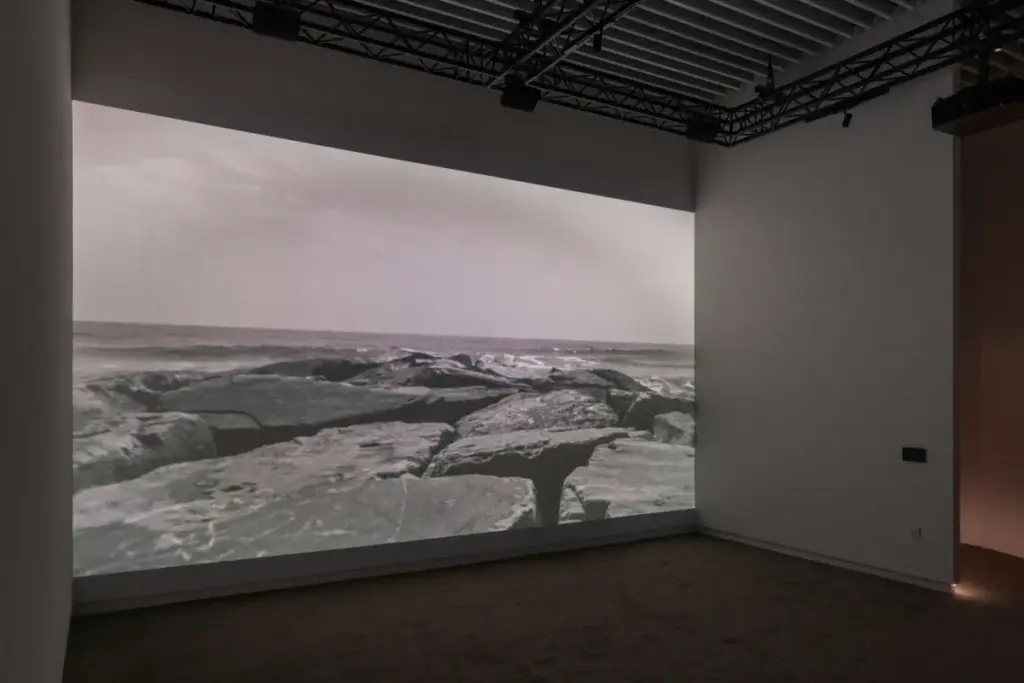
Renowned visual artist Carrie Mae Weems has expanded her celebrated exploration of power, history, and representation with a powerful new commission for the V&A East Museum. Titled The Long Goodbye, the new film is presented in the Film Room of the Why We Make galleries as part of the museum’s inaugural season showcase, New Work: Making East London.
Combining archival footage, music, dance, portraiture, and performance, The Long Goodbye traces how bodies of water—from sweeping ocean currents to soft, relentless tides—have shaped human history. The work reflects on how water has enabled transatlantic migration while continuing to impact communities in east London and far beyond. Through her multidisciplinary approach, Weems explores the creation of new identities and artistic forms by immigrants who have relocated across oceans, both voluntarily and by force. Ultimately, the piece celebrates the cultural diversity that connects and underpins the foundations of contemporary cities, arguing that water and networks of migration serve as the fundamental fuel of global creativity, transcending fear and adversity.
In a comprehensive interview reflecting on the launch of the project, Weems discusses the foundational questions of power, memory, and representation that have guided her artistic practice for decades. She also shares the personal experiences, deep research, and collaborative conversations—including critical engagement with the V&A East Youth Collective—that informed the creation of The Long Goodbye.
Carrie Mae Weems on Her Artistic Practice and Guiding Ideas
Describing her multidisciplinary background, Weems explains that she works primarily with photography and video, alongside performance and installation. She values installation as a medium to work through complex ideas and concepts, while relying on photography for its immediacy and descriptive power. Video, meanwhile, allows her to engage directly with time, bringing together language, text, music, and image in a unified sensory experience.
No matter the medium, Weems feels her work has consistently circled back to the same fundamental questions: who holds power, how power operates, and how privilege shapes the lives of those who have been offered very little. Managing and challenging power has remained a central pillar of both her life and her creative output. Furthermore, she emphasizes the profound power of the human voice—specifically how it can be utilized to empower people who have been disenfranchised and those who have been made to feel that they have lost everything.
Shaping Influences and the Quest for Visceral Representation
When asked about the experiences that shaped her approach, Weems points directly to necessity. Necessity shapes her practice as a person, a creative, and an individual actively engaged with the world. Early in her career, she recognized a distinct lack of visceral representation surrounding the bodies, people, and ideas she deemed essential. She saw a space for African Americans—a space for her community—that urgently needed to be filled with untold stories. There was a specific aesthetic, a range, and a set of possibilities and conditions that required a far more complicated and dynamic exploration.
Very early on, Weems was deeply aware of cultural stereotypes and the damaging ways those stereotypes affected Black people and women. Addressing this imbalance became an immediate priority, driving her to find ways to break through and develop a new path—one that would allow marginalized communities to see themselves in a far more comprehensive, complex, and nuanced light.
As a photographer, Weems acknowledges legendary influences such as Roy DeCarava, whose seminal photobook The Sweet Flypaper of Life remains a constant reference point near her workspace. She also cites the Kamoinge Workshop—which included founding figures like DeCarava alongside Beuford Smith, Frank Stewart, Shawn Walker, and Ming Smith—as profoundly influential on her early thinking. Additional intellectual touchstones include Alain Locke and his work surrounding the New Negro movement, Henry Louis Gates Jr., Robert Frank, and Dorothea Lange.
The V&A East Commission and the Afterlife of Slavery
Reflecting on her commission for the V&A East Museum, Weems describes the project as both complicated and deeply exciting. At the core of her energy and concern is an inquiry into how to reflect upon and navigate the afterlife and ghosts of slavery, while simultaneously negotiating ideas around intrinsic human dignity. Navigating these heavy truths requires an extraordinary level of compassion, love, and vulnerability as the work examines the complex conditions placed upon Black and brown people for centuries.
The commission provided Weems with a unique platform to examine the transatlantic experience from a fresh perspective. She considered the profound implications of crossing vast oceans to land in territories of empire, whether in Britain, the United States, or Europe. While these waters are undeniably troubled, Weems is equally focused on what springs forth from that turbulence: an extraordinary level of ingenuity, resilience, and possibility. Using languages and tools not originally meant for them, Black and brown people have developed entirely new modes of communication through music, dance, film, and photography, restaging themselves with narratives rooted in love, compassion, hope, and the future.

The project at V&A East has opened a special door of consideration for Weems, setting the stage for future explorations into the bodies of water that shape human origins, migration patterns, and the immigrant experience. Her goal remains subtle, impactful, and deeply nuanced.
Migration, Leaving Home, and the Immigrant Experience
The starting point for the new series of work centered on the concept of migration—what it means to leave home, seek another environment, build anew, and begin again. Recognizing that migration touches everyone in some form, Weems used her own experiences of leaving family, friends, and everything familiar to travel abroad as a barometer for the emotional intensity of relocation.
Through casual conversations with immigrants encountered in daily life—taxi drivers hailing from Africa, India, Bangladesh, and Peru—Weems explored the immense sacrifices made in pursuit of a better life. Working grueling hours while separated from loved ones for years at a time, immigrants act out of deep love and desperation. Weems maintains that it is impossible to discuss the immigrant experience honestly without placing love at the center of the narrative.
Research, Collaboration, and Community Healing
The research process for The Long Goodbye evolved significantly over time. Initially envisioning an installation featuring physical objects like suitcases, boxes, books, and globes, Weems shifted her focus as structural and spatial realities became clear. Crucial to this evolution were meetings with the V&A East Youth Collective, whose photographs and perspectives on migration—including stories of Irish, Ukrainian, and Polish immigrants in the UK—broadened her scope.
Weems also drew inspiration from unconventional sources, such as the Polar Bear Club, a community group of primarily Black swimmers who gather every morning during the summer at designated waters to heal and remember through song. Struck by this daily act of collective remembrance, Weems integrated ideas of long-distance correspondence, voice messages, and the historical letters sent home by migrants sharing news of their safety.
Finding Common Ground in East London
Visiting London allowed Weems to appreciate the extraordinary character of the city, though she quickly recognized the importance of speaking from her own intersection with East London rather than pretending to claim the city as her native home. She noted deep parallels between East London and other urban centers like East Harlem, East Los Angeles, and East St. Louis, where marginalized populations arrive under similar conditions and face comparable realities. Rather than viewing these locations as isolated silos, Weems prefers to examine the shared human conditions and echoes across the diaspora that link communities globally.
Addressing the current political climate, Weems points to a volatile and brutal period in the West, where established systems of white privilege and male power are being fiercely protected in the face of widespread disruption and hostility toward migrants. Despite these challenges, she views the present moment as a time for immense imagination and resilience.
A Lasting Legacy and the True Meaning of Love
Looking forward, Weems plans to delve even deeper into the history of migration in the United Kingdom, noting the vital contributions made by workers who arrived after the Second World War to help rebuild the nation. She argues that modern society owes a profound debt of gratitude to those families and hopes her work encourages audiences to rethink their relationships with the diverse populations that enrich British culture today.
Ultimately, Weems hopes The Long Goodbye offers viewers a moment of profound self-reflection. Drawing on her personal definition of love—not as an abstract romance, but as a rare encounter where another person allows you to see the true breadth and complexity of your own identity—she hopes her art acts as a mirror, illuminating who we are and where we stand in the world today.