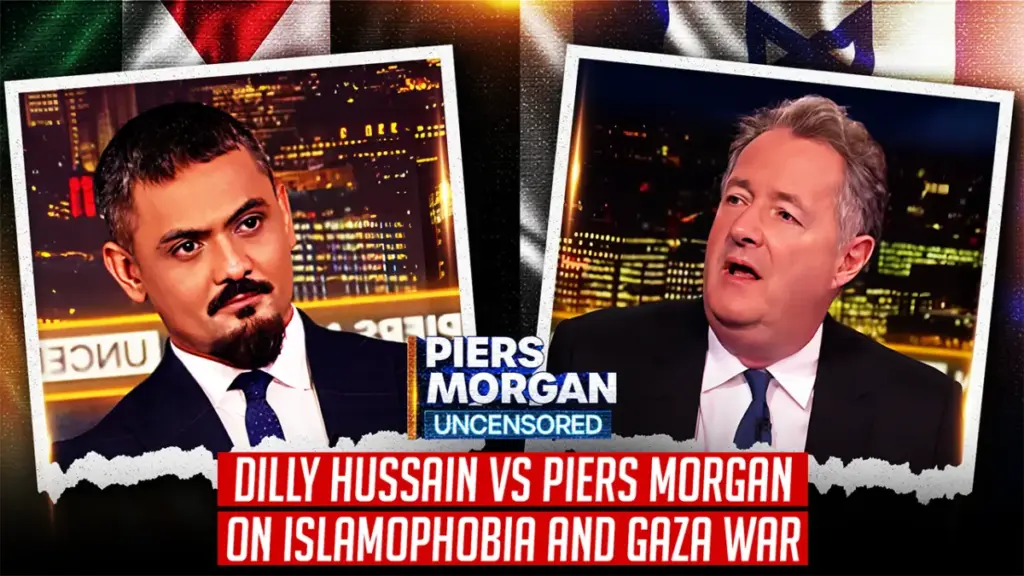
LONDON — In a high-stakes and widely discussed media encounter, 5Pillars deputy editor Dilly Hussain went head-to-head with prominent broadcaster Piers Morgan, challenging him directly over accusations of anti-Islam commentary and pronounced pro-Israel bias in his coverage of international conflicts.

The tense exchange, which took place on Thursday, 14th December, brought to the forefront long-standing criticisms from Muslim communities and media observers regarding how mainstream television networks and high-profile presenters frame narratives concerning Islam, Muslims, and the geopolitical struggles in the Middle East. As digital media platforms and independent news outlets continue to scrutinize the mainstream media’s accountability, the confrontation quickly captured widespread public attention, triggering extensive online discourse and solidifying its place as a significant moment in contemporary British media commentary.
At the core of the discussion was a direct evaluation of Morgan’s journalistic approach, interviewing style, and editorial stance on major global events, particularly the ongoing crises impacting Palestinian civilians and the broader Muslim world. Hussain, representing 5Pillars—recognized as the largest English-language Muslim news site across Europe, Australia, and the Americas—challenged Morgan on whether his public commentary and line of questioning cross the line from robust debate into anti-Islam rhetoric.

Throughout the intense back-and-forth, Hussain pressed the broadcaster on the tone and framing typically applied to Muslim guests and Islamic viewpoints on his platform. The debate touched upon sensitive questions of media fairness, accountability, and the social responsibilities of high-profile journalists who wield immense influence in shaping public perception. Central to Hussain’s critique was the assertion that mainstream media outlets frequently hold Muslim commentators and community representatives to disproportionate standards of scrutiny while offering less resistance to narratives that marginalize or demonize Islamic identity.
The encounter also delved deeply into the complexities of media reporting on international affairs, with particular emphasis on the Israeli-Palestinian conflict. Hussain scrutinized Morgan’s editorial selections, querying the balance and empathy afforded to Palestinian victims versus other populations caught in global conflicts. The debate underscored a growing frustration among British Muslims and media critics who argue that mainstream broadcasting platforms often fail to provide a balanced, objective representation of Middle Eastern geopolitics, frequently leaning toward a pro-Israel framework that sidelines Palestinian suffering and systemic injustices.

Piers Morgan, known for his combative interviewing style and robust defense of his journalistic record, responded directly to the challenges, defending his career-long commitment to rigorous debate and hard-hitting questioning. The exchange highlighted the broader, ongoing friction between independent digital platforms like 5Pillars and mainstream legacy media figures. In recent years, independent Muslim media outlets have increasingly stepped into the spotlight to challenge dominant media narratives, offering alternative perspectives and holding mainstream broadcasters accountable for perceived biases.
The debate has since reverberated across social media networks, accompanied by heightened public discussion and activist campaigns, including online movements utilizing hashtags such as #boycottpiersmorgan. For audiences tracking the intersection of media ethics, representation, and geopolitical reporting, the clash between Hussain and Morgan serves as a striking case study in the power dynamics of modern television broadcasting. As digital platforms continue to democratize access to commentary and critique, interactions of this nature demonstrate the growing appetite for direct, unfiltered confrontation of media figures over editorial impartiality and social responsibility.