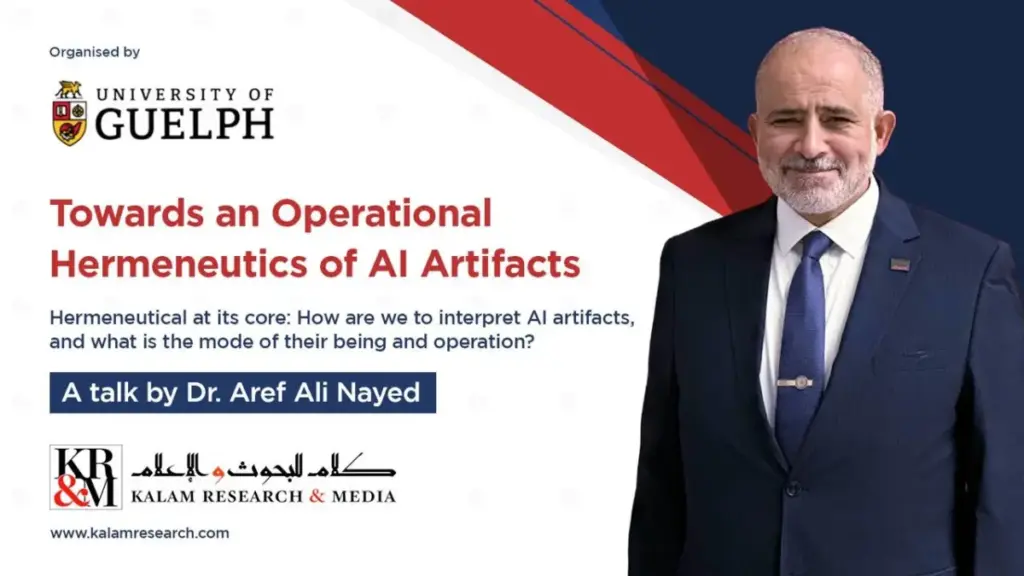
Dr. Aref Ali Nayed, Chairman of Kalam Research & Media (KRM), recently delivered a significant academic lecture at the University of Guelph, exploring the intricate intersection of hermeneutics, artificial intelligence, and the ethical governance of emerging technologies. The presentation brought together philosophical inquiry and contemporary technological challenges, offering fresh perspectives on how humanity interacts with machine-generated systems.
The comprehensive lecture examined how Operational Hermeneutics—a robust intellectual framework originally developed by Dr. Nayed in the 1990s during his time at the University of Guelph—provides essential tools for understanding and ethically engaging with AI-generated artifacts. As artificial intelligence systems become increasingly sophisticated, Dr. Nayed discussed how these technologies function far beyond mere computational tools, operating instead as operational artifacts that actively interpret, generate meaning, and shape human understanding in profound ways.
A Homecoming of Ideas: The Roots of Operational Hermeneutics
The University of Guelph holds deep significance in Dr. Nayed’s intellectual journey and academic career. It was on this Canadian campus that he initially formulated the foundational concepts of Operational Hermeneutics during his doctoral research. His return to Guelph represents a powerful homecoming of ideas, bringing decades of intellectual refinement back to their birthplace. Today, these foundational theories are being directly applied to contemporary challenges surrounding AI ethics, proving the remarkable foresight and enduring relevance of the framework.
The lecture was a core component of Dr. Nayed’s broader engagement with the Centre for Advancing Responsible and Ethical Artificial Intelligence (CARE-AI) at the University of Guelph. This high-level visit further strengthened the ongoing collaboration between Kalam Research & Media and prominent Canadian AI research institutions, all of which share a dedicated focus on developing robust ethical frameworks for the governance and deployment of artificial intelligence.
Broadening the Horizon: Academic Publications and Institutional Partnerships
Expanding upon the central themes addressed during his lecture, Dr. Nayed recently published a comprehensive academic monograph titled “Towards an Operational Hermeneutics of AI Artifacts.” This important publication examines how machine-generated outputs must be understood as operational artifacts that require rigorous hermeneutical engagement. Furthermore, the paper proposes innovative frameworks for interpreting complex machine-generated content while directly addressing the critical ethical dimensions of human-AI interaction.
This academic outreach aligns closely with KRM’s broader network of collaborations. In addition to the University of Guelph and CARE-AI, KRM maintains active partnerships with leading Canadian artificial intelligence institutions, including the Vector Institute for Artificial Intelligence and the Canadian Institute for Advanced Research (CIFAR). These collaborative networks foster an environment where rigorous humanistic inquiry meets cutting-edge technological development.
Pioneering Research in Artificial Understanding
While conventional artificial intelligence research has historically remained heavily focused on optimizing machine performance, data processing speeds, and algorithmic efficiency, Kalam Research & Media has charted a distinct path. KRM has pioneered dedicated research into Artificial Understanding (AU)—a groundbreaking approach that asks fundamental questions about comprehension, meaning, interpretation, and intentionality within artificial systems.
Grounded firmly in the principles of Operational Hermeneutics, KRM’s Artificial Understanding research program seeks to bridge the widening gap between technical capability and genuine comprehension. By investigating how artificial systems process and construct meaning, the research aims to ensure that future technological advancements remain aligned with human values, ethical standards, and deep interpretive traditions. Through ongoing lectures, academic publications, and strategic institutional partnerships, Dr. Nayed and Kalam Research & Media continue to shape the global dialogue on responsible technology and the future of human-machine interaction.