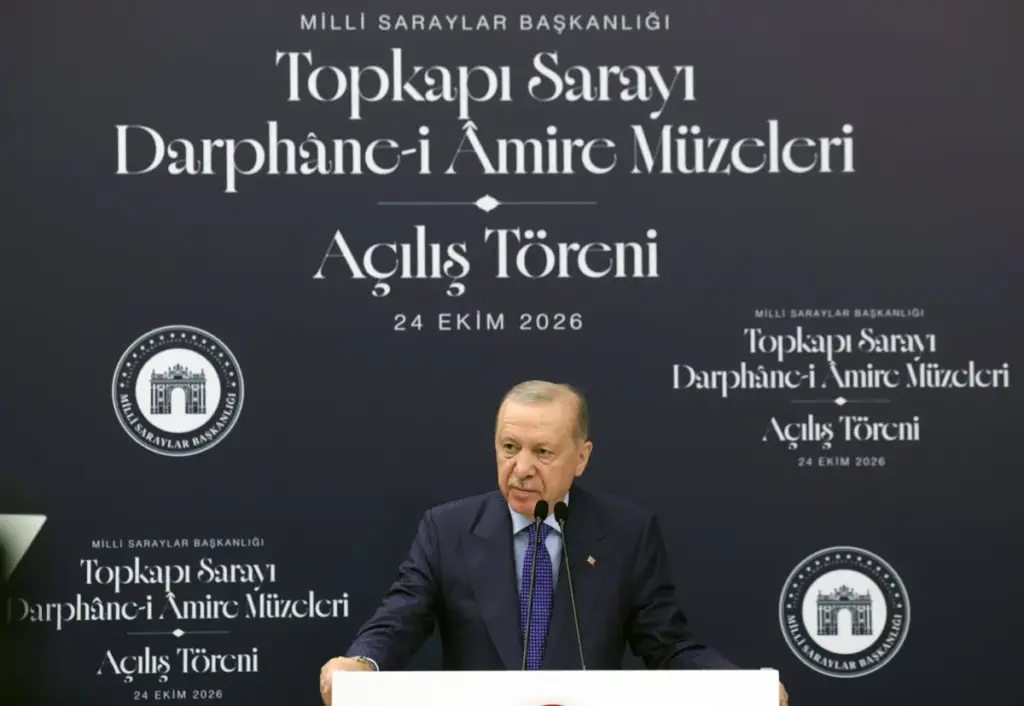
ISTANBUL — In a major milestone for Turkey’s cultural heritage sector, President Recep Tayyip Erdoğan officially inaugurated five new museums at Istanbul’s historic Topkapı Palace on Saturday. The grand opening follows a meticulous, multi-year restoration of the sprawling Darphane-i Amire complex, a historic Ottoman imperial mint. The ambitious project has successfully transformed seven distinct historical buildings—comprising 46 expansive halls across 17,000 square meters—into a world-class museum district.
The revitalization effort has made an extraordinary trove of 10,500 artifacts accessible to the public for the very first time. Among the most notable highlights of the newly opened spaces is a dedicated exhibition of more than 2,000 rare examples of Islamic calligraphy. Previously kept carefully secured in museum storage facilities due to preservation requirements, these masterworks are now on permanent display across 12 newly curated halls, offering scholars, art enthusiasts, and everyday visitors an unprecedented glimpse into the sophisticated artistic traditions of the Islamic world.
The unveiling significantly broadens the scope of historical and cultural treasures available to view at Topkapı Palace, which stands as one of the most prominent, enduring landmarks of the Ottoman Empire. Speaking before an assemblage of dignitaries, officials, and cultural figures at the opening ceremony, President Erdoğan emphasized that the newly minted museum district represents an exceptional achievement that could serve as an international benchmark for heritage preservation. Notably, the complex also houses the first arms museum established during the Ottoman period, further cementing its historical importance.
Reflecting on the intrinsic value of the collections housed within the palace walls, Erdoğan offered a poetic assessment of the nation’s artistic legacy. "Every part of this treasure reflects a distinct body of knowledge, a refined intuition and an independent understanding of aesthetics, bringing science and wisdom together in a remarkable synthesis," he stated.
At the same time, the Turkish leader stressed that safeguarding the nation’s vast cultural assets goes far beyond the physical restoration of historic masonry and the mere display of antique objects. The true significance of these endeavors, he argued, lies in protecting the intangible knowledge, wisdom, and traditions that these artifacts represent, and successfully passing that deep cultural literacy on to future generations.
"Of course, these works are important and valuable. They are treasures of our cultural heritage," Erdoğan said. "But what matters most is preserving this accumulated legacy with a strong sense of awareness, enriching it further and passing it on fully to the generations that follow us."
Describing Topkapı Palace itself as a peerless architectural masterpiece, the president underscored that Turkey possesses an extraordinary, multifaceted cultural legacy that has been uniquely shaped by centuries of rich history, groundbreaking architecture, visionary art, and enduring literature.
Erdoğan Criticizes Past Cultural Policies and Westernization Approaches
While celebrating the triumphant opening of the new museum district, President Erdoğan used the platform of the inaugural ceremony to deliver pointed criticisms of historical approaches to Westernization in Turkey. He accused previous political administrations of severely neglecting the country’s authentic historical and cultural identity in the name of modernization.
To illustrate his point, Erdoğan highlighted several controversial episodes from Turkey’s past, referencing the former use of the historic Yıldız Palace as an entertainment venue and casino. He also lamented the documented sale of rare, irreplaceable historical manuscripts to foreign buyers as scrap paper, alongside the regrettable conversion of various historic mosques into grain warehouses and, in certain instances, animal stables.
According to the president, such practices were not isolated administrative oversights, but rather the reflection of systemic government policies deliberately designed to distance the Turkish people from their historical roots and their foundational national and spiritual values.
"We were subjected to a policy of stripping people of their identity, one that sought Westernization only in clothing, denied our history and culture, and alienated people from their national and spiritual values," Erdoğan remarked. He cautioned that even today, certain segments of society continue to reject the country’s profound historical inheritance and actively challenge its multifaceted cultural identity.
Positioning his own administration as a steadfast guardian of Turkey’s heritage, Erdoğan noted that his government has steadfastly defended the nation’s legacy for over two decades. "For 24 years, we have not given representatives of this mentality an opportunity," he declared. "God willing, we will not give them one in the future either."
Furthermore, Erdoğan noted that the newly opened museums serve as a definitive, tangible response to critics who had previously questioned the necessity, scope, and intent of the extensive restoration project.
Recalling the origins of the initiative, the president revealed that work on the Darphane-i Amire complex began precisely seven years ago amid widespread public speculation and allegations that the historic site was being quietly prepared to serve as a private presidential office or residential complex. Dismissing those claims as entirely baseless, Erdoğan noted that the successful completion of the restoration has instead yielded a premier international cultural destination for the public.
"We are working to protect Istanbul’s cultural heritage, keep it alive and pass it on to future generations," he affirmed.
More Than 10,000 Artifacts to Go on Display
The grand opening marks a monumental expansion of the physical and artistic footprint accessible to visitors at Topkapı Palace. Prior to this weekend’s inauguration, the palace’s active inventory stood at approximately 7,500 exhibited works. The addition of the 10,500 newly accessioned artifacts housed within the Darphane-i Amire complex dramatically elevates the institution’s capacity, further strengthening its esteemed position among the most prestigious museums in the world.
The crown jewel of this expansion is undoubtedly the massive collection of Islamic calligraphy. By organizing more than 2,000 previously unseen manuscripts and panels across 12 specialized halls, curators have unlocked a vast archival holding that remained hidden from the public eye for generations.
The historic Darphane-i Amire complex itself—whose name directly translates to the Imperial Mint—has undergone a delicate, highly technical spatial reorganization. Architects and preservationists worked hand-in-hand to ensure that the rigorous demands of modern museum standards, climate control, and visitor flow were seamlessly integrated into the historic fabric of the Ottoman-era buildings without compromising their architectural integrity.
This landmark undertaking forms an integral part of a broader, nationwide governmental initiative aimed at restoring neglected Ottoman-era architectural landmarks and ensuring that their invaluable cultural collections are systematically brought out of storage and made accessible to researchers, tourists, and citizens alike.
Edirne Palace Restoration Also Underway
Looking beyond the borders of Istanbul, President Erdoğan used his address to spotlight other major heritage preservation projects currently underway across the country, drawing special attention to the ongoing restoration of Edirne Palace, another monumental Ottoman imperial complex.
Erdoğan reminded the audience that Edirne Palace was utilized by Ottoman sultans alongside Topkapı Palace for approximately 300 years, serving as a vital political and administrative center during the empire’s rise. He reaffirmed the government’s unwavering commitment to reviving the historic site and restoring the complex to its former historical prominence.
Looking forward to the timeline of the project, the president announced that the comprehensive restoration work at Edirne Palace is expected to be fully completed next year. He described the historic site—officially known as Edirne Saray-ı Cedid-i Amire—as a monumental landmark that, once finished, will rank among Turkey’s most impressive and visually stunning historical monuments.
Erdoğan concluded by noting that the meticulous revival of Edirne Palace will provide a significant boost to the country’s ongoing nationwide efforts to protect its irreplaceable architectural heritage and continually enrich its vibrant cultural landscape for the years to come.