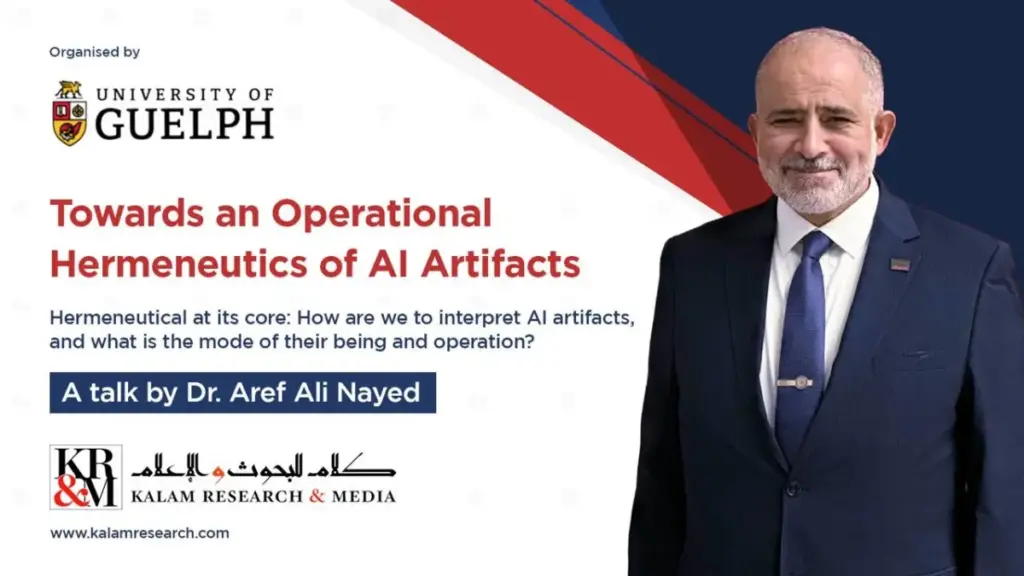
Dr. Aref Ali Nayed, Chairman of Kalam Research & Media (KRM), recently delivered a prominent academic lecture at the University of Guelph, offering profound insights into the intersection of hermeneutics, artificial intelligence, and the ethical governance of emerging technologies. The visit marked a significant moment not only for contemporary discussions surrounding machine learning and artificial intelligence, but also for Dr. Nayed personally, as it served as a conceptual homecoming to the very institution where he laid the foundational stones of his scholarly framework decades ago.
About the Lecture
During his comprehensive presentation, Dr. Nayed examined how Operational Hermeneutics—a theoretical and practical framework that he originally developed during the 1990s while conducting doctoral research at the University of Guelph—provides essential tools for understanding and ethically engaging with AI-generated artifacts. As artificial intelligence systems rapidly evolve from simple data processors into complex generators of text, imagery, and code, society faces unprecedented interpretive challenges. Dr. Nayed discussed at length how modern AI systems function fundamentally as operational artifacts that actively interpret data, generate meaning, and shape human understanding in ways that demand rigorous philosophical and ethical scrutiny.
The lecture addressed a broad spectrum of critical themes central to the philosophy of technology. Rather than viewing artificial intelligence purely through the lens of computational efficiency or raw processing power, Dr. Nayed emphasized the necessity of evaluating what machine outputs actually signify. By applying the principles of operational hermeneutics, scholars, developers, and policymakers can better navigate the complex layers of meaning embedded within machine-generated content, ensuring that technology remains aligned with human values and societal well-being.
Watch the Full Lecture
For those unable to attend the event in person, the complete lecture has been made publicly available. The video recording captures the depth of Dr. Nayed’s discourse, offering viewers an opportunity to engage directly with his nuanced analysis of artificial intelligence, human interpretation, and ethical governance.
Watch the full lecture on YouTube
Related Initiatives
This academic lecture was not an isolated event, but rather a core component of Dr. Nayed’s broader, ongoing engagement with the Centre for Advancing Responsible and Ethical Artificial Intelligence (CARE-AI) at the University of Guelph. His visit successfully reinforced and strengthened the collaborative ties between Kalam Research & Media and leading Canadian AI research institutions. These partnerships are increasingly vital as the global research community races to establish robust, comprehensive ethical frameworks capable of governing the rapid advancement of artificial intelligence technologies.
The ongoing dialogue between KRM and CARE-AI highlights a shared commitment to fostering responsible innovation. By bridging traditional philosophical inquiry with cutting-edge computer science, these institutions aim to address the profound societal implications of automated decision-making systems, algorithmic bias, and the erosion of human agency in digital spaces.
Readers interested in learning more about the scope of this institutional engagement can explore the detailed coverage of Dr. Nayed’s visit to the research center here.
Further Reading
To complement the themes explored during his lecture at the University of Guelph, Dr. Nayed has recently published a comprehensive academic monograph that expands significantly upon the core arguments presented to the academic community.
Titled “Towards an Operational Hermeneutics of AI Artifacts,” the publication takes a deep dive into the ways AI-generated outputs must be understood not merely as neutral tools, but as operational artifacts that inherently require structured hermeneutical engagement. The paper proposes innovative new frameworks designed to help researchers, philosophers, and technologists accurately interpret machine-generated content while directly confronting the complex ethical dimensions of human-AI interaction.
The publication serves as an essential resource for scholars seeking to move beyond surface-level critiques of technology and engage in rigorous, theoretically grounded analysis of artificial intelligence. The full monograph is publicly accessible through the Kalam Research & Media platform and can be read here.
About the University of Guelph Partnership
The University of Guelph occupies a unique and deeply meaningful place in Dr. Nayed’s intellectual trajectory. It was within the halls of this Canadian institution during the 1990s that he first formulated the core concepts of Operational Hermeneutics during his doctoral studies. His return to Guelph represents a powerful homecoming of ideas, bringing decades of intellectual refinement, practical application, and global experience back to their academic birthplace. Today, those same foundational concepts are finding renewed relevance as they are applied to the most pressing technological challenges of the twenty-first century.
This partnership between Kalam Research & Media and the University of Guelph, alongside its CARE-AI initiative, operates as part of a much larger, interconnected network of collaborations linking KRM with premier Canadian AI research institutions. These broader networks frequently involve joint initiatives and dialogues with renowned centers of excellence, including the Vector Institute for Artificial Intelligence and the Canadian Institute for Advanced Research (CIFAR), ensuring a multidisciplinary approach to the future of technology governance.
KRM’s Artificial Understanding Research
While conventional research and development in the technology sector remain overwhelmingly focused on maximizing machine performance, computational speed, and data throughput, Kalam Research & Media has charted a distinctly different course. KRM has pioneered dedicated research into Artificial Understanding (AU)—a transformative and specialized approach that asks fundamental, existential questions about comprehension, meaning, and true interpretation within artificial systems.
The AU research program, deeply rooted in the traditions of Operational Hermeneutics, pursues several key aims designed to redefine how humanity conceptualizes machine intelligence. Rather than accepting simulated fluency or statistical correlation as genuine comprehension, KRM’s research interrogates the boundaries between processing information and truly understanding it.
Those interested in delving deeper into this innovative field of study can find extensive resources and project overviews by learning more about KRM’s Artificial Understanding program. Through continued academic lectures, institutional partnerships, and foundational theoretical research, Kalam Research & Media remains at the forefront of the global conversation on ethics, interpretation, and the future of human-technology relations.