During a curatorial research fellowship at the Victoria and Albert (V&A) Museum in London, a deep dive into the institution’s vast and historic collection of photographs naturally reveals countless depictions of human labor. Yet, amidst centuries of documented human enterprise, one particular visual narrative has continually drawn the focus of researchers: photographs of women working.
The fascination with these specific images extends far beyond the mere documentation of employment. Much of the intrigue lies in the geography of the work itself. When modern society envisions a workplace, the imagination typically conjures settings explicitly engineered for economic productivity—a bustling factory floor, a specialized workshop, or a row of corporate offices. While these archetypal environments certainly appear across historical photographic archives, the reality of women’s labor captured through the lens has rarely been confined to such rigid spatial boundaries.
Instead, women’s work has historically spilled over into domestic interiors, open fields, public streets, bustling marketplaces, and the seamless rhythms of everyday life. These are spaces that lack the clear-cut architectural definitions of traditional workspaces, challenging modern preconceptions of where and how labor actually takes place.

Of course, historical documentation is not monolithic. In certain images—particularly those captured within early industrial contexts—the nature of the labor is immediately apparent. Heavy machinery dominates the field of vision, and the surrounding infrastructure leaves no doubt that the subjects are industrial workers performing designated tasks.
In other compositions, however, the revelation of labor requires a more deliberate, unhurried gaze. Upon closer observation, the presence of work emerges through subtle visual cues: the precise positioning of a hand, the incline of a torso, a nearby tool resting against a wall, raw materials scattered close by, or a fleeting commercial exchange unfolding directly in front of the camera lens.
The photographic selections emerging from this curatorial fellowship move fluidly between these contrasting ways of seeing people at work. Rather than attempting to compile an exhaustive catalogue of every form of labor performed by women historically, the collection provokes a much more fundamental philosophical inquiry: how do we actually identify work within a photographic frame?

The Quiet Labor of the Everyday
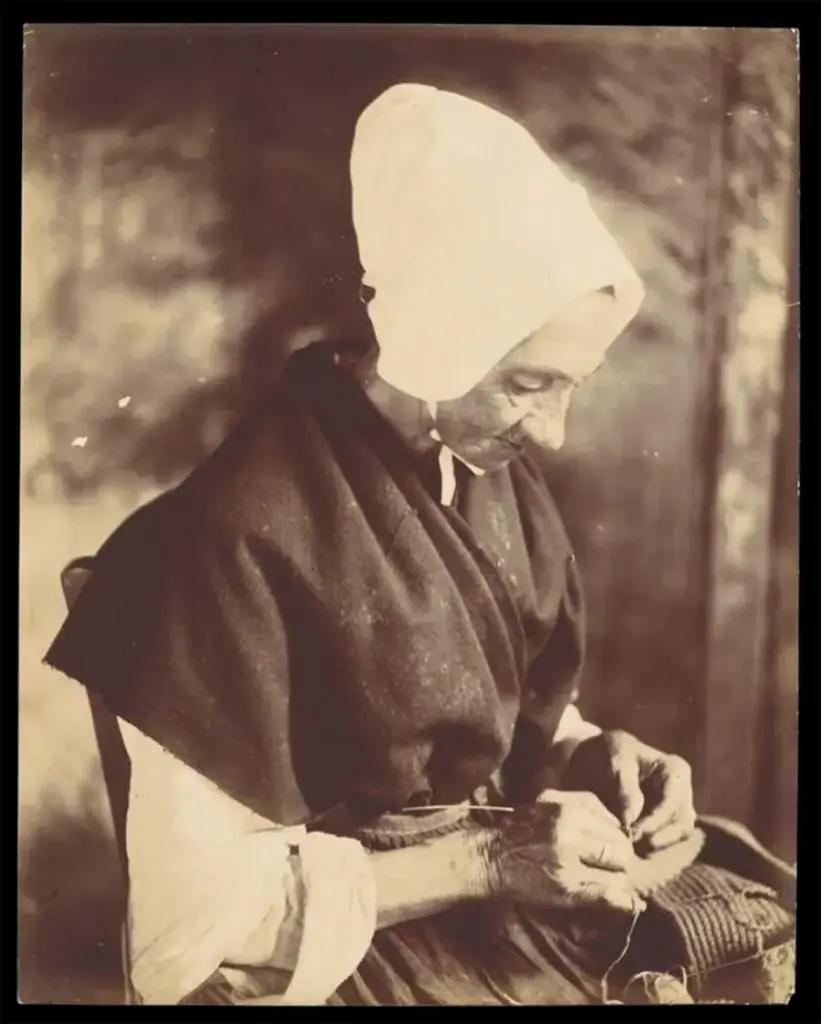
Émile Fréchon’s c. 1900 photograph, Elderly woman weaving, serves as a prime example of an image that initially demands a slower, more contemplative style of looking. In this photograph, there are no towering industrial machines or distinct architectural markers signaling a formal workshop environment. Instead, the viewer comes to understand the labor entirely through the subject’s physical engagement. The dexterity of her hands, the arrangement of the material resting before her, and the concentrated posture of her body draw the eye irresistibly toward the active process of weaving.
It is an inherently quiet image. Because of its understated nature, it encourages the viewer to look more slowly and deeply. The work does not appear detached from daily existence; rather, it sits comfortably and quietly within it. Even though the surrounding space is entirely ordinary rather than a designated commercial setting, the labor itself remains profoundly skilled, disciplined, and focused.
A strikingly similar phenomenon is visible in George Bunzl’s mid-century photograph, Mexico – Girl Spinning, captured around 1965. Textile arts such as spinning, sewing, and weaving are historically comprised of minute, highly repetitive physical movements. Because these actions are performed with such frequency and over such extended durations, they can easily blur into the background of domestic life, becoming ordinary and subsequently overlooked by broader society.

While the finished textile often becomes the tangible object that museums collect, display, and admire, a photograph possesses the unique capacity to redirect our attention away from the inanimate product and back toward the human agent, the physical gesture, and the unseen process behind its creation.
Labor in the Field and the Public Sphere
Moving beyond domestic interiors, Fréchon’s lens also documented women laboring out in the open environment in works such as Two women dig up potatoes, possibly in the Pas de Calais, captured around 1900. In this rural composition, the open field itself functions as the primary workplace. The bodies of the two women are bowed deeply toward the damp earth, and it is entirely through their physical posture and synchronized movement that the viewer recognizes the strenuous nature of agricultural labor. Here, work is communicated purely through kinetic action.
A different spatial dynamic entirely unfolds in Pamela Bone’s Flower Seller Udaipur, photographed between 1981 and 1992. This image transports the viewer into the vibrant public sphere, where labor is enacted through interpersonal exchange. While the archival title immediately informs the viewer that the subject is a flower seller, the visual composition provides vital contextual clues through human interaction. Two figures lean intently toward one another, their hands meeting near the absolute center of the frame, bridged by the organic material of flowers and plants passing between them. In this public encounter, the workplace is not demarcated by walls or signs; it materializes momentarily through a human transaction.

The Contrast of Industrial Spaces
In sharp contrast to these fluid, open-air, and domestic environments stands Eric Freeborn’s c. 1937–38 photograph, Women at work in a factory. When discussing the visual history of labor, Freeborn’s industrial interior feels simultaneously vastly different from pastoral scenes yet deeply familiar to the modern eye. Massive industrial machinery immediately commands the entire scene, leaving no ambiguity for the viewer. There is no need to search for hidden signs of a workplace; the heavy industrial apparatus announces immediately that this is a formalized site of production and that women are an integral part of its machinery.
Encountering these diverse photographs highlights just how differently human labor can manifest within visual culture. A towering factory machine makes one specific type of industrial toil instantly recognizable, while a wooden spindle, a scrap of cloth, an open agricultural field, or a quiet market exchange requires the viewer to pay closer attention to decode the work taking place.
Ultimately, the minute details captured by these photographers—hands at work, bodily postures, specialized tools, raw materials, repetitive movements, and the varied spaces inhabited by women—serve as powerful visual storytellers. These micro-actions communicate the reality of labor long before any descriptive museum caption is read. Together, these historical images stand as a persistent reminder that work does not always wear a uniform or occupy a designated architectural setting. Often, labor sits quietly within the fabric of everyday life, easily overlooked by a passing glance, yet foundational to human history.