As the Victoria and Albert Museum’s (V&A) acclaimed Make Good programme approaches its sixth iteration, it offers a compelling opportunity to reflect on five years of innovative displays, symposia, acquisitions, and the diverse spectrum of ideas they have explored. At the very heart of the Make Good initiative is a dedicated focus on bioregional design—an approach championed by leading contemporary contributors such as Material Cultures, Atelier Luma, and Cooking Sections. Through their work, these contemporary designers and researchers argue passionately for a design philosophy that is inherently sustainable, circular, and firmly anchored in the specific realities of the local environment.
While "bioregioning" has emerged as a relatively modern term within contemporary design practice, it is not a descriptor traditionally applied to the vast holdings of the V&A’s historical and contemporary collections. The museum certainly holds an abundance of objects crafted from local materials, yet the exact timeline of when the V&A began to actively engage with the broader, more systemic themes of bioregionalism warrants a closer look. This raises fundamental questions about our material culture: Do we possess historical and modern objects that demonstrate designers and manufacturers grappling with the complex challenges of scaling production while maintaining an unwavering commitment to ecological sustainability and a deep connection to their own locale? To find out, a closer examination of the museum’s galleries reveals a rich, interconnected narrative spanning over a century.
Orkney Tradition and the Power of Driftwood
Situated just a few paces away from the designated Make Good plinth in the Dr Susan Weber Furniture Gallery lies a striking display of traditional chairs crafted by the Orkney joiner David Kirkness between 1890 and 1900. Orkney, a remote archipelago located off Scotland’s rugged northern coast, gave rise to a highly distinctive style of furniture design around the beginning of the 19th century. These chairs were meticulously optimized to withstand a harsh, unforgiving climate, characterized by high backs and often featuring an integrated hood designed to provide maximum protection against cold household draughts.
Because the islands possessed very few trees, local craftspeople and householders had to ingeniously improvise, turning to the straw yielded by locally grown black oats as an alternative material for both roof construction and furniture making. Intricate coils of this straw were bound tightly together using a durable cord fashioned from local bent-grass, which was then skillfully woven into sturdy stools and chairs. When structural wooden elements were absolutely required, makers gathered driftwood washed ashore from the island’s beaches—serving as a striking, historical example of localized resourcefulness, material reuse, and circular economy principles long before those terms became mainstream.

By the early 1880s, however, this unique regional tradition of chair-making might well have faded into obscurity had it not been for the decisive intervention of David Kirkness. His primary commercial and operational innovation was to refine the diverse variety of traditional local designs down into four standardized, highly marketable models. Built around an efficient workshop operation that provided sustainable employment for local craftspeople and home-based outworkers, the Kirkness business successfully generated orders not only from local Orcadians but also from mainland Britain and the wider British Commonwealth. As production was scaled up to meet this broader demand, the traditional driftwood elements unfortunately had to be replaced by a more consistent and reliable commercial timber supply sourced mainly from Aberdeen, yet the enterprise remained firmly and proudly rooted in the islands. Today, this remarkable craft tradition is kept alive by contemporary Orkney makers such as Kevin Gauld, whose innovative Brodgar chair—created in collaboration with designer Gareth Neal—stands proudly on display in the museum alongside its historical predecessors.
Maderón and the Industrial Valorization of Almond Shells
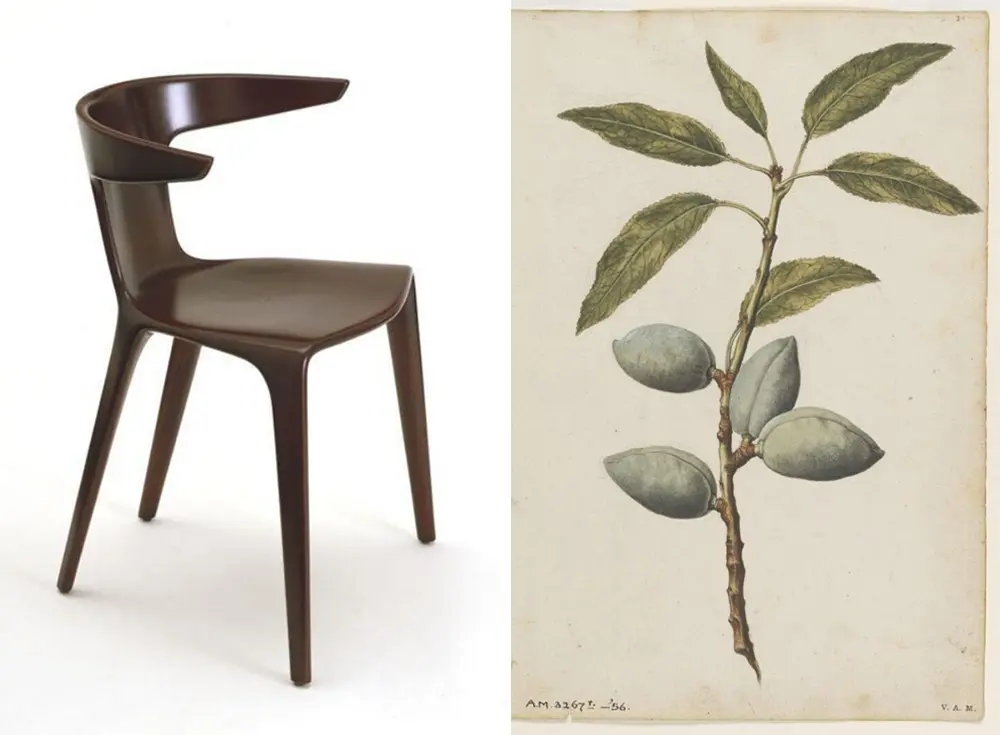
Moving from the windswept shores of Scotland to the agricultural landscapes of Spain, the pursuit of localized, sustainable materials took a radically different turn in 1980. Silio Cardona, a Spanish chemical engineer working within his family’s traditional funeral business, grew increasingly troubled by the ecological toll of felling mature trees simply to manufacture wooden coffins destined to be buried underground. Simultaneously, Cardona became acutely aware of a massive logistical and environmental challenge facing the nation: approximately 300,000 tons of almond shells were being discarded annually by Spain’s thriving agricultural harvesting industry. A significant portion of this agricultural processing took place directly in his local region of Catalonia, where colossal, unsightly mounds of discarded husks were blighted across the local landscape.
Driven by a vision to develop a sustainable alternative he termed "plastic wood," Cardona began experimenting by mixing finely powdered almond shells with various types of synthetic resins. Following extensive trial and error, the resulting formula yielded a remarkably versatile, mouldable, yet structurally strong composite material, which he officially trademarked as Maderón.
Energetically championed and promoted by prominent design journalist Ramón Úbeda, the newly developed material was quickly adopted not by the conservative funeral industry for which it was originally conceived, but rather by adventurous contemporary furniture designers. In the early 1990s, Barcelona-based architect Alberto Lievore received a commission to design the interior of a local nightspot named the Rothko bar, and he chose Maderón to fabricate the venue’s bespoke furniture. When the resulting "Rothko chair" was subsequently put into commercial production, industry analysts noted that it successfully reduced manufacturing costs by an impressive 50 percent relative to an earlier wooden prototype.

Unfortunately, just as the innovative material was gathering serious international momentum—with exciting discussions of a high-profile collaboration with industrial designer Philippe Starck already underway—tragedy struck when Cardona was killed in a sudden road accident. Not only had Maderón lost its visionary creator, but Cardona had also neglected to document or share its precise chemical "recipe," and all subsequent attempts by researchers and manufacturers to replicate the exact compound proved unsuccessful. It marked a poignant and abrupt end to a deeply individualistic pursuit of regionalism and material reuse.
Ecological Design and the Legacy of the C3 Chair
In 1996, the Rothko chair found a temporary home at the V&A as part of a forward-thinking exhibition titled Green Furniture: Ecological Design, which offered a rigorous institutional examination of environmentally conscious contemporary furniture production. Notably, that same display featured another pioneering chair with deep historical roots stretching back to the early 1980s: David Colwell’s innovative C3 model.
At first glance, the C3 chair represented a dramatic visual and technical departure from Colwell’s earlier, highly acclaimed work in advanced plastics. His 1968 Contour chair, conceived as part of his graduation collection, had been celebrated at the time as a shining exemplar of "Space Age" modernity. Yet, despite its futuristic aesthetic, it was manufactured using relatively low-tech equipment and demonstrated a craft-like, profound respect for the material properties of Perspex, a newly developed product from ICI.
However, as public and ecological scrutiny surrounding the widespread use of synthetic plastics intensified, Colwell shifted his focus toward another inherently strong, mouldable natural material: steam-bent wood. Ash timber proved particularly well-suited to this specialized technique, especially when utilized while freshly harvested, or "green." Launched commercially in 1982, Colwell’s C3 chair ingeniously made use of locally sourced thinnings—the adolescent trees systematically felled in sustainably managed woodlands specifically to promote new canopy growth, forest health, and overall biodiversity. Strikingly similar ecological principles continue to drive the contemporary work of modern Make Good contributor Sebastian Cox.

Reflecting on this briefest of historical surveys within the museum’s holdings yields two vital realizations. Firstly, the foundational principles and material realities of bioregional design can already be traced seamlessly across the V&A’s extensive Furniture and Woodwork Collection. Secondly, the institution has been actively acquiring, preserving, and displaying objects explicitly chosen for their profound ecological significance for at least three decades.
The Make Good programme thus sits comfortably within a well-established institutional tradition of showcasing sustainable, place-based design at the V&A. As the ongoing initiative continues to evolve, future iterations will look to draw these vital historical strands together while simultaneously championing bold new voices in ecological craftsmanship.