An archival project at the Victoria and Albert Museum (V&A) has brought to light a delightful historical connection, uncovering a previously uncatalogued sketchbook belonging to the celebrated 19th-century artist and illustrator Randolph Caldecott. The find not only offers a rare, intimate window into the personal life and travels of the influential creator but also provides definitive visual evidence of his early visits to the South Kensington Museum—now known as the V&A—alongside a fascinating link to another historic British institution.
The discovery is being made public by a museum intern who is currently undertaking a rigorous five-month project to catalogue and research the extensive collection of works on paper by Randolph Caldecott (1846–1886). Caldecott remains a towering figure in the history of British illustration, best remembered today for his beloved annual "Picture Books," which captivated Victorian audiences and continue to charm readers through classic titles such as "The House that Jack Built" and "Babes in the Wood." This detailed cataloguing initiative is generously supported by The Randolph Caldecott Collection Trust, aimed at shedding fresh light on the artist’s life, career, and the intricate process of organizing and preserving the V&A’s vast holdings of his creative output.

When the cataloguing project commenced, the V&A’s collection already contained seven distinct sketchbooks attributed to Caldecott. Initial cataloguing had been partially completed for six of these volumes. A review of their descriptions quickly revealed that these books were filled with foundational studies, preliminary outlines, and observational sketches that directly informed many of the more highly developed, finished pieces preserved within the museum’s archives. They offered researchers a valuable backdrop against which to understand Caldecott’s artistic evolution.
However, it was the seventh sketchbook in the collection—previously uncatalogued and sitting quietly among the holdings—that ultimately yielded some of the most charming insights into Caldecott’s daily existence, personal travels, and an unexpected historical tie to the museum itself.
Historically, Caldecott was known to travel with a small, portable sketchbook tucked into his pocket or luggage to capture scenes of everyday life on the go. Inside the front cover of this particular volume, a small, handwritten pencil annotation immediately sets the stage for the journey contained within its pages: "Manchester to London 5hrs."

The opening pages of the sketchbook feature a series of vivid observations chronicling rural life around Northwest England, a region where Caldecott lived and worked until his move south in 1872. Among these early entries is a carefully rendered pencil drawing of the historic Old Dee Bridge in Chester. Shortly after these pastoral vignettes, the artist transitions to documenting his lengthy, five-hour railway commute from Manchester down to the capital. True to his character, Caldecott chronicled the monotonous journey with his signature wit and good humor. He produced a sequential cartoon strip illustrating a passenger growing progressively weary and disheveled hour by hour, only to miraculously perk up, adjust his posture, and don his top hat the exact moment the train pulls into the London station.
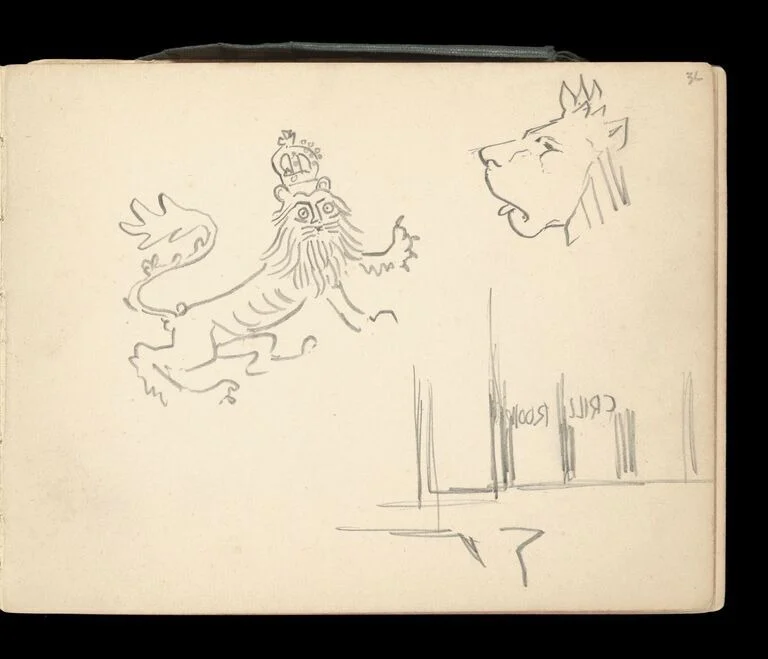
Turning the page reveals what is arguably the most exciting historical artifact of the volume, hidden amidst seemingly mundane doodles. Alongside two casual sketches of lions, Caldecott jotted down a quick drawing of a window bearing the reversed inscription "GRILL ROOM." Through this simple, offhand doodle, researchers found concrete, undeniable evidence that Caldecott had physically visited the V&A site during his time in London, interacting with spaces that visitors can still explore today. Although he would have known the institution under its historical moniker, the South Kensington Museum, the sketch anchors the young artist firmly within its walls.
The Grill Room depicted by Caldecott is today known as the Poynter Room. It originally formed one of the V&A’s three pioneering refreshment rooms, which first opened to the public in 1868 to provide weary visitors with food and drink amidst their museum explorations. While the actual physical room was famously adorned with rich, elaborate ceramic tiles and decorative surfaces, Caldecott chose not to capture the intricate interior ornamentation in his quick sketch—perhaps because he was distracted, hungry, and busy enjoying his lunch.

Further examination of the same page reveals clues pointing to yet another cultural institution visited by Caldecott during his Victorian sightseeing excursion. Positioned just above the sketch of the Grill Room is a highly stylized drawing of a lion, an image directly copied from a rare 17th-century earthenware dish crafted by the English potter Thomas Toft.
Toft’s distinctive slipware style is unmistakable to modern eyes, and the original dish can readily be picked out today within the V&A’s dedicated Ceramics galleries. However, the dish was not originally part of the V&A’s collection during Caldecott’s lifetime. At the precise time of the artist’s London trip in the late 19th century, the dish resided within the collections of the Museum of Practical Geology, which was then housed at Jermyn Street in the City of Westminster. This provenance is solidly corroborated by the artifact’s formal listing in the 1871 published catalogue of British pottery and porcelain held at the geological museum.
The Museum of Practical Geology, which later evolved into the Geological Museum, eventually became one of the V&A’s close neighbors along Exhibition Road in 1935, before its collections were ultimately absorbed into the Natural History Museum, where many of its geological specimens now reside within the Red Zone galleries.

For contemporary visitors hoping to retrace Caldecott’s footsteps and replicate a genuine Victorian museum experience, a trip to level four of the V&A South Kensington campus offers a direct link to the past. Approximately 1,500 of the more than 2,500 decorative arts objects that were officially transferred between the museums in 1901 are currently housed and displayed across the V&A’s galleries. Among this historic transfer is the very same Thomas Toft dish that caught Caldecott’s eye and was immortalized in the pages of his travel sketchbook. Alternatively, art historians, researchers, and casual enthusiasts alike can view these objects digitally through the museum’s online collections portal.
Encountering this newly catalogued sketchbook serves as a powerful reminder of the enduring cultural footprint left by the V&A’s collections, demonstrating how they have inspired generations of artists, illustrators, and casual visitors over the decades. It highlights the critical importance of maintaining and researching these institutional archives to serve as a foundational sourcebook for the creative economy well into the future. It prompts a reflective question for curators and modern viewers alike: as Randolph Caldecott wandered the halls of the South Kensington Museum as a relatively junior and aspiring artist, did he ever imagine that the small, unassuming sketchbook held tightly in his hand would one day become a treasured part of the very institution he was exploring?
The ongoing research project continues to uncover the rich layers of the artist’s legacy, supported at every step by The Randolph Caldecott Collection Trust.