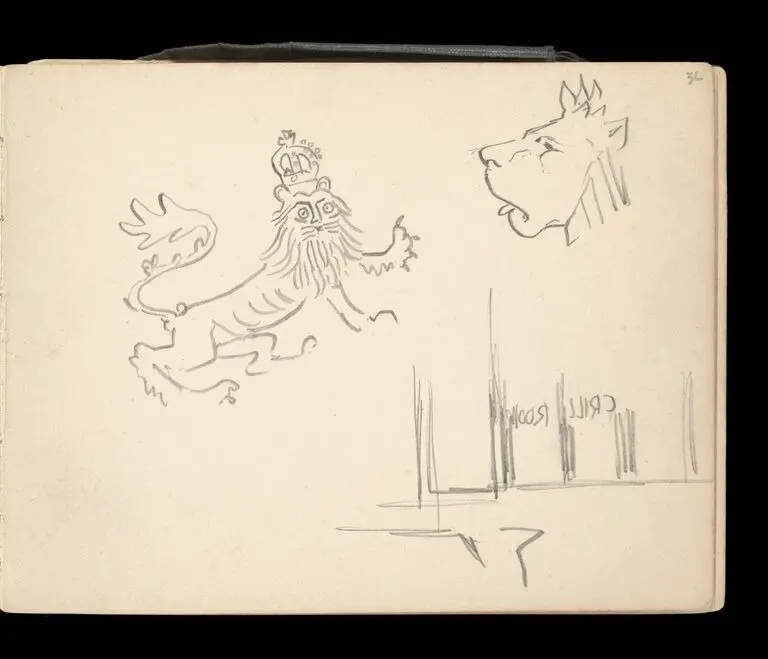
An ongoing cataloguing and research project at the Victoria and Albert (V&A) Museum has brought to light a remarkable historical discovery within a previously uncatalogued sketchbook belonging to the celebrated 19th-century artist and illustrator Randolph Caldecott. The find not only offers a charming, intimate glimpse into the personal travels and everyday humor of the artist, but also provides definitive, documentary evidence of Caldecott visiting the museum during the Victorian era—long before his own works would eventually find a permanent home within its vaults.
The discovery is being made by a V&A museum intern undertaking a five-month project to research and catalogue the institution’s extensive holdings of works on paper by Caldecott. Best known for his influential annual "Picture Books," which include timeless children’s classics such as "The House that Jack Built" and "Babes in the Wood," Caldecott remains a towering figure in the history of British illustration. His dynamic, expressive style helped redefine Victorian children’s literature, and his legacy is championed today through initiatives supported by The Randolph Caldecott Collection Trust.

When the five-month cataloguing project commenced, the V&A’s collection already included seven of Caldecott’s pocket-sized sketchbooks. Initial cataloguing work had previously been completed on six of these volumes. A review of their descriptions revealed that these pre-catalogued books were packed with preliminary studies and quick annotations that directly informed many of the more highly developed, finished pieces preserved in the museum’s broader collection. These volumes have long served researchers as invaluable windows into Caldecott’s creative process and artistic background.
However, it was the seventh volume—which had remained entirely uncatalogued until now—that yielded the most delightful and unexpected surprises. This particular pocket sketchbook captures Caldecott’s observations between 1868 and 1872, a formative period when the artist lived and worked in the Northwest of England.
Historical clues embedded inside the book immediately set the scene for the artist’s journey. Caldecott famously carried a small sketchbook with him wherever he traveled to record the world around him. In the inside front cover of this specific volume, a modest pencil annotation provides a precise geographical and temporal marker: "Manchester to London 5hrs."

The opening pages of the sketchbook display a series of observational drawings depicting rural life across Northwest England, where Caldecott resided until his permanent relocation southward in 1872. Among these early entries is a delicate pencil drawing capturing the historic Old Dee Bridge in Chester. Shortly after these rural vignettes, the artist documents his long five-hour train journey from Manchester down to the capital. True to form, Caldecott records the slog with his characteristic good humor, sketching a humorous sequential cartoon of a male passenger growing visibly fatigued hour by hour, only to miraculously perk up, straighten his posture, and don his top hat the exact moment the locomotive pulls into London.
Turning the page reveals what is arguably the most exciting historical detail in the entire volume. Tucked neatly among a pair of quick sketches featuring lions, the artist drew a simple interior view of a window accompanied by the handwritten words "GRILL ROOM" written in reverse. This subtle notation provides the first definitive piece of physical evidence confirming that Caldecott actually visited the site himself. Though it was known to Caldecott and his contemporaries as the South Kensington Museum, the location is instantly recognizable as the modern-day V&A.
The Grill Room depicted by Caldecott—now celebrated as the Poynter Room—was originally one of the pioneering V&A refreshment rooms that first opened to the public in 1868 as part of the museum’s grand expansion of visitor amenities. While the physical space of the room was famously designed to be richly decorated with ornate ceramic tiles and elaborate artistic fixtures, Caldecott’s sketch bypasses these grand architectural flourishes entirely. Instead, art historians and curators suggest the busy illustrator may simply have been too focused on enjoying his lunch to record the decorative surroundings in meticulous detail.

Further analysis of the sketchbook pages reveals evidence of yet another major cultural institution visited by Caldecott during his London excursion. Positioned directly above the sketch of the Grill Room is a highly stylized drawing of a lion. Research into the visual source material confirms that this drawing was copied directly from a 17th-century earthenware dish created by the renowned English potter Thomas Toft.
Toft’s slipware designs are exceptionally distinctive, making it easy for modern visitors to locate the original dish within the V&A’s permanent Ceramics galleries. However, the dish was not part of the museum’s holdings during Caldecott’s Victorian sightseeing trip. At the time Caldecott sketched it, the piece was housed within the collection of the Museum of Practical Geology, which was then located on Jermyn Street in Westminster. This provenance is solidly confirmed by the artifact’s appearance in the official 1871 catalogue of British pottery and porcelain published by the geological museum.
The Museum of Practical Geology eventually evolved into the Geological Museum and became one of the V&A’s prominent Exhibition Road neighbors in 1935, before its collections were ultimately absorbed into the Natural History Museum, where many of those historic objects remain visible today within the Red Zone galleries. For visitors and researchers seeking to retrace Caldecott’s exact steps and experience a direct connection to the Victorian era, level four of the V&A South Kensington campus offers a tangible link. Approximately 1,500 of the more than 2,500 decorative arts objects that were officially transferred between the institutions in 1901 are currently housed there, including the very same Thomas Toft dish captured in Caldecott’s pocket sketchbook. These items can also be explored digitally through the museum’s online collection portals.

Reflecting on the significance of the find, the cataloguing project highlights the profound, enduring role that the V&A’s collections have played across generations, serving not only the public but inspiring successive waves of creatives, illustrators, and designers. The discovery prompts a fascinating historical reflection: whether a very junior, traveling Randolph Caldecott, sketching casually in a modest pocketbook during a 19th-century trip to London, could ever have imagined that the very pages in his hand would one day be preserved as treasured artifacts within the museum’s own permanent collections.
The ongoing cataloguing project is generously supported by The Randolph Caldecott Collection Trust.