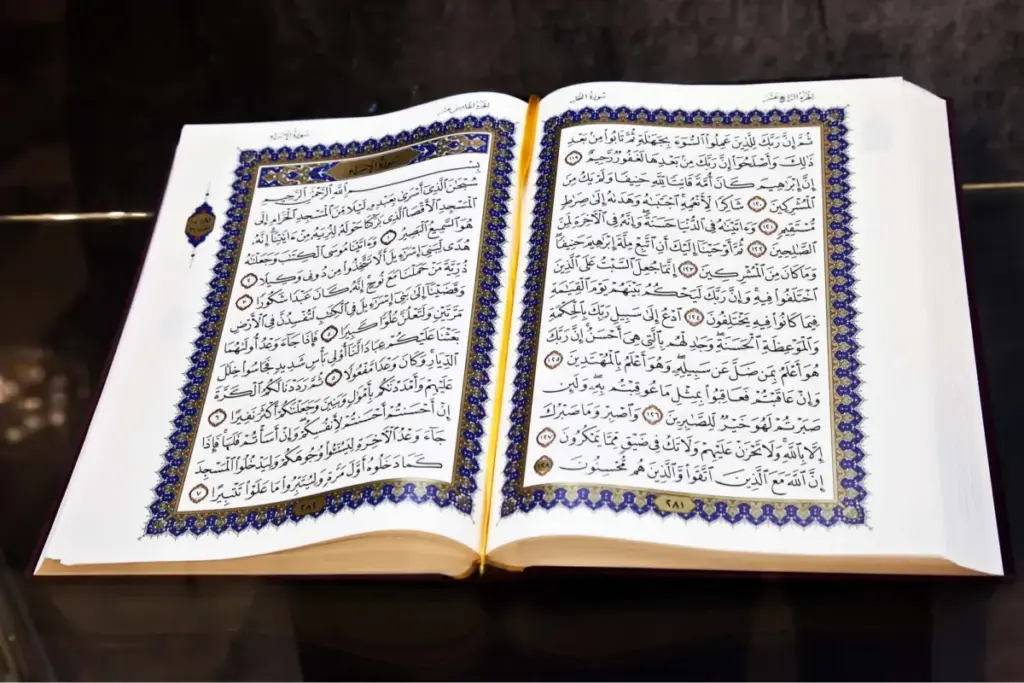
From the moment life and consciousness began on Earth, the relationship between the Creator and humanity has been defined by continuous care, sustenance, and most importantly, divine guidance. In Islamic theology, Almighty Allah is not merely the architect of the cosmos who set the universe in motion; rather, He actively and continuously sustains, directs, and guides His creation. While the natural laws governing the physical universe form one fundamental layer of this divine system, humanity has been blessed with a distinct and elevated form of guidance designed specifically to navigate moral, spiritual, and existential choices.
This special covenant between the Creator and humankind was established at the very dawn of human history. When humanity’s tenure on Earth began, a solemn promise was made to Adam and his descendants. This foundational message is permanently recorded in the Quran, specifically in Surah Al-Baqarah (2:38), where Allah declares:
Go down, all of you, from hence. But verily there cometh unto you from Me a guidance, and whoso follow My guidance, there shall no fear come upon them neither shall they grieve.

Throughout the centuries, this divine light was transmitted to humanity through a continuous lineage of prophets and messengers. These chosen individuals were sent successively across different eras and civilizations, carrying the same core message of truth, until the final messenger, Muhammad (peace and blessings be upon him), received the ultimate and comprehensive revelation that would complete the chain of prophethood.
To understand how this communication takes place, one must examine the concept of revelation in Islamic tradition. A person chosen by Allah to receive His divine guidance is known as a prophet, referred to in Arabic as a nabi, or a messenger, known as a rasul. These noble figures receive the literal word and guidance of Allah through revelation, shouldering the profound responsibility of communicating it faithfully to their respective communities and followers.
The Quran emphasizes the universal nature of this prophetic mission, highlighting that no nation or era was left entirely without a moral compass. In Surah An-Nisaa (4:163–165), Allah elaborates on this unbroken chain of divine communication:
Surely We have revealed to you as We revealed to Noah and the Prophets after him, and We revealed to Abraham and Ishmael and Isaac and Jacob and the Tribes and Jesus and Job and Jonah and Aaron and Solomon, and to David We gave the Psalms, and Messengers We have mentioned unto you before and Messengers We have not mentioned unto you, and Allah spoke directly unto Moses — Messengers of good cheer and of warning, in order that mankind might have no argument against Allah after the Messengers, and Allah is Ever Mighty, Wise.

This extensive passage underscores a fundamental principle of Islamic theology: the message brought by the prophets was fundamentally unified in its call to worship the One True God and uphold justice, even if certain legal details or practices varied according to the specific needs of their times. The inclusion of both well-known prophets and those whose names and stories were not explicitly detailed to mankind illustrates the broad scope of divine mercy. Every single messenger served as a bearer of glad tidings for those who chose righteousness, and a warner against corruption and injustice, ensuring that humanity would never be left without clear guidance or a valid plea of ignorance before their Creator.
At the heart of this communication process is the Arabic linguistic root wahi, which translates fundamentally to revelation or inspiration. In Islamic scholarship, studying the exact mechanics and linguistic nuances of wahi is essential for understanding how the divine will was translated into human language and understood by the prophets.
The verb form awha, meaning "revealed," and its corresponding noun wahi appear in numerous contexts throughout the Quran. Across these diverse occurrences, the term carries several distinct shades of meaning, yet they all consistently point back to a singular, underlying conceptual core: the act of directing, guiding, or inspiring someone in a subtle, profound, or direct manner.
Rather than representing a single, rigid mode of communication, the concept of wahi encompasses a rich spectrum of divine interaction. In the broader linguistic and Quranic usage, inspiration can manifest in different ways depending on who or what is being addressed. For instance, the Quran applies variations of this root to describe natural instincts instilled in creation, such as the guidance given to bees, as well as the profound spiritual promptings cast into the hearts of prophets, or direct communication from behind a veil, and communication through angelic intermediaries like the Angel Gabriel.

By examining these various dimensions, scholars of Quranic studies have long sought to map out the comprehensive framework through which Allah communicates with His creation. The overarching narrative remains clear and consistent: revelation is an act of supreme mercy. It bridges the metaphysical chasm between the Creator and the created, offering humanity a clear pathway through the complexities of mortal life. Through the mechanism of wahi and the legacy of the prophets, individuals are provided with the moral clarity required to navigate existence with purpose, dignity, and inner peace, fulfilling the ancient promise made to humanity at the very beginning of its earthly journey.