As cultural institutions continually re-examine their archives to unearth hidden narratives, the Victoria and Albert Museum (V&A) is offering a fresh look at the formative years of one of the 19th century’s most beloved illustrators. A five-month cataloguing and research project currently underway at the museum is shining a spotlight on the early works on paper by Randolph Caldecott (1846–1886), a foundational figure in children’s book illustration whose annual “Picture Books,” such as The House that Jack Built and Babes in the Wood, delighted Victorian audiences and heavily influenced generations of artists.
The project, which focuses on the museum’s extensive holdings of Caldecott’s works on paper, is supported by The Randolph Caldecott Collection Trust. Through ongoing research into the V&A’s collection, the initiative aims to provide deeper insight into Caldecott’s life and career trajectory, tracing his evolution from an unenthusiastic regional bank clerk into a celebrated professional artist.
Central to the V&A’s collection of Caldecott’s early output is a rare album of sketches compiled by William Clough, a former co-worker of the artist. This album preserves some of the earliest known works by Caldecott held by the museum, many of which predate his professional career entirely. Like many aspiring artists of his era—and indeed, today—Caldecott initially pursued art as a coping mechanism and an escape during his downtime while locked into a conventional, white-collar day job.
The son of a woollen draper and tailor who later transitioned to accountancy, Caldecott’s early professional life followed a predictable, respectable path. He initially worked within his father’s business before securing a position as a bank clerk at Whitchurch Ellesmere Bank. By 1867, his career path led him northward to Manchester, where he took up employment at the Manchester & Salford Bank.
Yet, ascending the traditional ladder of Victorian commerce proved ill-suited for the 21st-year-old artist. Caldecott routinely demonstrated a clear preference for taking long walks out of the city to visit customers’ houses rather than enduring the stifling atmosphere of the banking hall. Reflecting on this disconnect decades later, Caldecott offered a candid assessment of his youthful mindset in an 1885 letter to his former colleague Clough, noting that “there was seldom visible in me any steady sober respect for the work of the bank.”

Even while trapped at his desk, Caldecott was acutely conscious of his desire to escape the confines of corporate drudgery. In a 1870 letter addressed to a fellow clerk, he lamented the toll of the daily routine, writing that “the sweet bonds of friendship between clerks are now and then temporarily broken asunder by the bad tempered engendered of a round of dreary, shut-up, daily drudgery.”
The newly catalogued sketch album provides a vivid window into how Caldecott managed this daily monotony. Filled with loose drawings of people and animals jotted down on scraps of paper, the album illustrates the constant, irrepressible creativity that eventually fueled his prolific professional output. Much of the artwork produced during his banking years consists of characterful illustrations conjured directly from his imagination, setting them apart from the direct observational studies typically found in standard sketchbooks.
A notable exception within the album, however, is a page dedicated to portraits of his immediate colleagues. Captured unaware while hard at work, these men were unwittingly immortalized in pen and ink by their daydreaming peer. For these individuals, Caldecott’s candid sketches represent what are likely the only surviving likenesses of their faces. Recognizing the historical value of these portraits, either Caldecott or Clough thoughtfully labeled each figure with their respective names or initials.
Leveraging historical records, researchers cross-referenced Manchester and Salford directories from 1863 to 1876 alongside the 1871 census data to identify the full names and residential addresses of nearly all the depicted colleagues. While an initial identification pointed toward a "J. R. Wilkinson," expert assistance from the archivists at the NatWest Group archives—which houses historical documentation concerning the Manchester & Salford Bank and its corporate lineage through Williams Deacon’s Bank Ltd.—confirmed that the figure was actually T. R. Wilkinson.
Thomas Read Wilkinson enjoyed an extensive 49-year career at the bank, having commenced his employment in 1841 at the tender age of 15. Caldecott was similarly 15 years old when he embarked on his banking career at Whitchurch Ellesmere Bank. Furthermore, another depicted colleague, Thomas Butterworth, had a 16-year-old son who was also working as a bank clerk at the time. Entering the workforce at fifteen was standard practice during the Victorian era, making Caldecott’s prior extended stay in formal education somewhat unusual for children of his social standing.

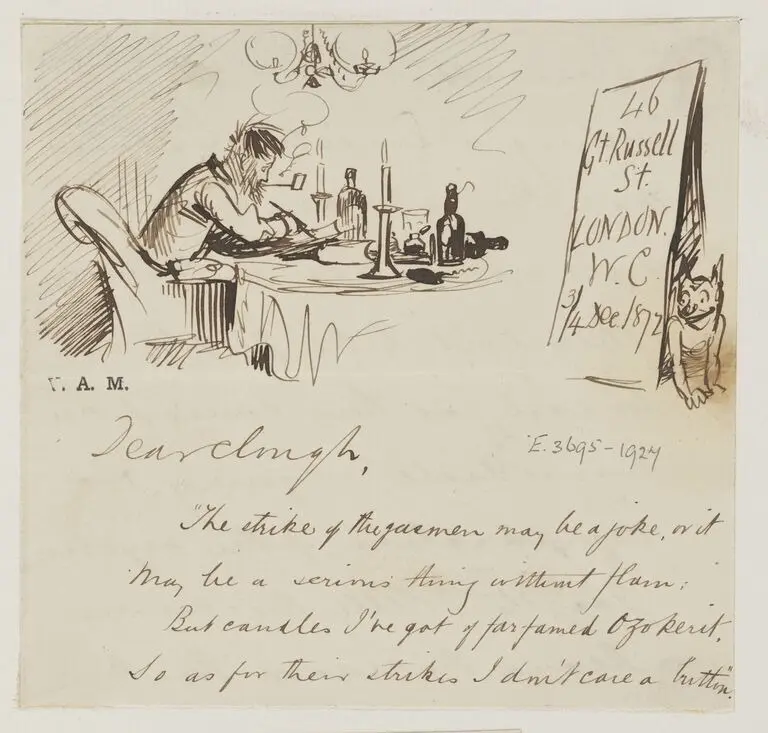
Even after Caldecott finally broke free from regional banking to relocate to London in 1872, he maintained the deep friendships he had forged during his Manchester years. His enduring correspondence with William Clough continued for decades, with many of their illustrated letters later published in the volume Yours pictorially : illustrated letters of Randolph Caldecott, edited by Michael Huchkins.
The depth of their lifelong bond was underscored following Caldecott’s untimely death in 1886. In a commemorative tribute published in the Manchester Quarterly, Clough remembered his late friend fondly, writing, “No envy, malice, or uncharitableness spoiled him; no social flattery or fashionable success, made him forget those he had known in the early years.”
While Caldecott’s sketches of his Manchester banking colleagues generally constitute the sole surviving visual records of their faces, a solitary exception exists in the person of "H. B. Harrison," fully identified as Henry Bowers Harrison. Harrison was a bank clerk who shared a parallel career trajectory with Caldecott, albeit being 16 years his senior. He entered the banking profession at 16 before eventually relocating to Manchester by the age of 20. Following Harrison’s death in 1895, one of his daughters authored a biography of his life, featuring a formal portrait of her father as the frontispiece. Comparing the published photograph to Caldecott’s pen portrait reveals that the young artist’s caricature was remarkably accurate.
The survival of these detailed biographical records opens a poignant window into the everyday lives of ordinary Victorian clerks, whose personal histories might otherwise have been lost to time were it not for the artistic doodles of a bored, imaginative youth. With the V&A’s comprehensive cataloguing project now complete, researchers, genealogists, and descendants alike have renewed opportunities to connect names to faces, viewing 19th-century banking life uniquely through the observant, witty eye of Randolph Caldecott.
The complete collection of Randolph Caldecott’s bank-era drawings is publicly accessible via the V&A’s online Explore the Collections portal.