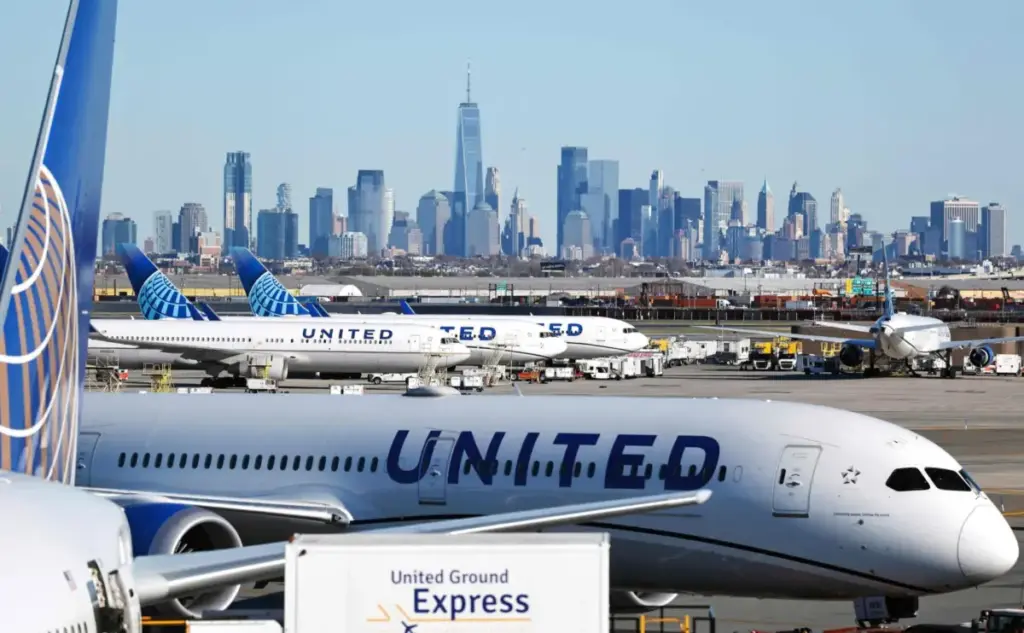
United Airlines announced on Monday that it successfully resolved a significant technology issue that temporarily halted flight departures across its network for approximately an hour. The sudden disruption occurred just days after a historic nationwide air traffic control outage caused widespread chaos and lengthy delays for travelers and airlines throughout the United States.
The software and connectivity disruption, which was largely contained and ended by approximately 6 p.m. ET (11 p.m. GMT) on Monday, underscored the vulnerability of modern commercial aviation to unexpected computer failures. The incident vividly demonstrated how internal technical glitches can ground flights even when physical aircraft are fueled, fully prepared, and manned by ready flight crews waiting on the tarmac.
Company officials and federal authorities were quick to clarify that there was no immediate indication connecting Monday’s internal United Airlines outage to the catastrophic Friday Federal Aviation Administration (FAA) shutdown. That earlier federal failure triggered the longest nationwide ground stop for departing flights since the tragic terrorist attacks of September 11, 2001, leaving millions of passengers stranded or facing cascading itinerary changes over the weekend.
"This is not an FAA system-wide problem," U.S. Transportation Secretary Sean Duffy stated during an interview on Monday evening on Fox News’ "Hannity" program, addressing public concerns about compounding infrastructure failures. "I don’t know what the root cause of United is," Duffy added, emphasizing that the federal aviation network itself was operating normally outside of the airline’s independent technical glitch.
United Airlines confirmed via official statements that its technology issue affecting flight departures had been entirely resolved. The carrier noted that flights already airborne at the time of the outage, as well as all regional flights operated by United Express, remained completely unaffected throughout the duration of the incident. Furthermore, the airline explicitly sought to quell cybersecurity fears, stating categorically that "there is no indication that this was a cybersecurity-related issue."
However, internal communications revealed a more complex operational headache behind the scenes. An internal memo from the United pilots union, reviewed by Reuters, detailed that a companywide web-based outage had simultaneously crippled multiple vital applications utilized daily by flight crews. Among the impacted systems were crucial internal tools used for crew communications, scheduling, and pre-departure data verification.
Crucially, the union memo explained that United had been rendered temporarily unable to provide final, accurate aircraft weights for departing flights. Pilots were explicitly advised by union leadership to follow local airport station guidance regarding whether they should attempt to leave their gates. In the highly regulated aviation industry, precise weight and balance calculations are absolute prerequisites for safe flight operations, dictating everything from takeoff speeds to fuel burn requirements, meaning pilots cannot legally depart without them.
In a subsequent memo issued later in the evening, the union reported that United’s core systems were steadily coming back online and successfully reintegrating data, directing its members to monitor updated company communications as normal operations resumed.
Airlines have historically struggled with similar system-wide automated weight-and-balance bottlenecks. In August 2025, United temporarily grounded large portions of its domestic fleet following an isolated malfunction involving its legacy Unimatic system, which supplies essential flight data to software calculators determining aircraft weight and balance. While aviation analysts immediately drew parallels, it was not immediately clear whether Monday’s outage directly involved the Unimatic framework or a broader web-portal infrastructure failure.
Similar vulnerabilities have struck competitors as well. Alaska Airlines experienced a nearly identical nationwide ground stop of its departures in April 2024 following a sudden failure within its proprietary weight-and-balance software systems.
Flight Disruptions
The timing of Monday’s computer failure could hardly have been worse for the major carrier. As of 6:50 p.m. ET (11:50 p.m. GMT) on Monday, flight-tracking and data platform FlightAware reported that United had accumulated 645 flight delays—accounting for roughly 20 percent of its total daily operating schedule—alongside 25 outright cancellations.
Aviation experts noted that it remained difficult to precisely parse how many of those individual flight disruptions were directly attributable to Monday’s specific technology issue, given that the airline was still actively struggling to recover normal aircraft and crew positioning from Friday’s unprecedented nationwide FAA ground stop.
Wall Street reacted swiftly to the operational hiccup, with United Airlines shares sliding 2.5 percent in after-hours trading as investors weighed the potential reputational and logistical fallout. On social media platforms, frustrated passengers shared their experiences, with several travelers reporting that their aircraft had actually pushed back from the gate, taxied out toward the active runway, and subsequently been forced to return to the terminal due to the sudden loss of digital clearance and weight data.
The technological stumble arrived precisely as U.S. air travel was attempting to return to a semblance of normalcy following the conclusion of Friday’s massive system failure. That nationwide ground stop lasted for nearly five hours after a catastrophic failure crippled the FAA’s core telecommunications network, plunging airports across the country into gridlock.
According to comprehensive aviation analytics compiled by Cirium, more than 18,100 flights scheduled to depart from U.S. airports between Friday and Sunday were either canceled outright or failed to take off within three hours of their originally scheduled departure times. While not every single one of those delays was directly caused by the FAA outage, the staggering figures illustrated the fragile nature of tightly integrated flight schedules and the massive ripple effects that single-point-of-failure incidents can trigger across the national airspace system.