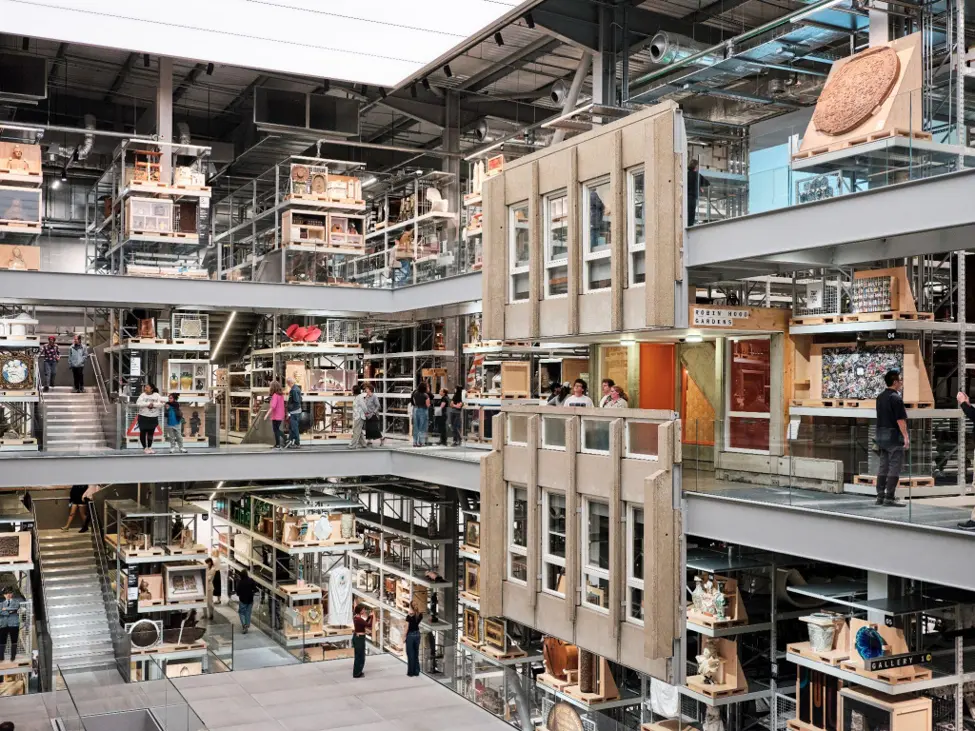
As visitors step into a modern museum, they rarely pause to consider the intricate systems of wayfinding and labeling that guide them from gallery to gallery. Yet, these physical cues are fundamental to the visitor experience, shaping how people navigate vast collections and engage with historical and cultural artifacts. Traditionally, however, museum wayfinding has carried a heavy environmental cost, relying heavily on single-use plastics, energy-intensive manufacturing processes, and short-lived materials that are discarded the moment an exhibition changes.
A groundbreaking new approach is taking shape across London’s upcoming cultural landscape. For the development of the V&A East Storehouse, the David Bowie Centre, and the V&A East Museum, Hackney-based design studio Fieldwork Facility has teamed up with the Victoria and Albert Museum to completely reimagine how museums handle interpretation, labeling, and spatial navigation. By embedding sustainability into the very core of the design process rather than treating it as an afterthought, the collaborators have set a new benchmark for environmental responsibility in institutional architecture and graphic design.

The initiative challenged the design team to look far beyond conventional industry practices. According to Robin Howie, creative director and founder of Fieldwork Facility, the scope and ambition of the brief surpassed anything the studio had previously encountered. Working alongside environmental impact consultants Urge Collective, the team evaluated the lifecycle of every material considered for the project, ensuring that aesthetic innovation went hand in hand with rigorous ecological stewardship.
Creating a Kit of Parts Through Modular Design
At the heart of the wayfinding strategy for the V&A East Storehouse and the V&A East Museum is a deeply considered modular framework. Although both venues maintain their own distinct architectural identities and visual atmospheres, their signage systems were developed in tandem using a unified philosophy. Rather than utilizing permanent, glued, or single-use installations, the designers created a flexible "kit of parts."
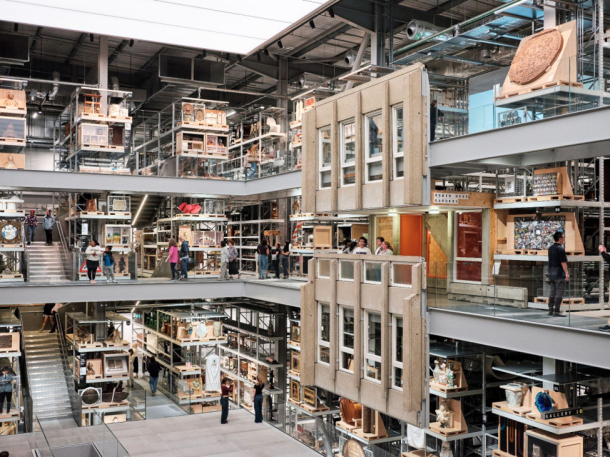
Every sign is engineered so that it can be easily disassembled, reconfigured, and adapted for future layouts. If a gallery changes its focus or requires updated information, individual components can be swapped out without discarding the entire structure. Furthermore, when the materials eventually reach the end of their operational lifecycle, they can be cleanly separated into distinct material streams for efficient recycling. This modularity ensures that the physical infrastructure of the museum can evolve organically alongside its programming, significantly cutting down on material waste over the coming decades.
Designing Bespoke Fonts for Reuse
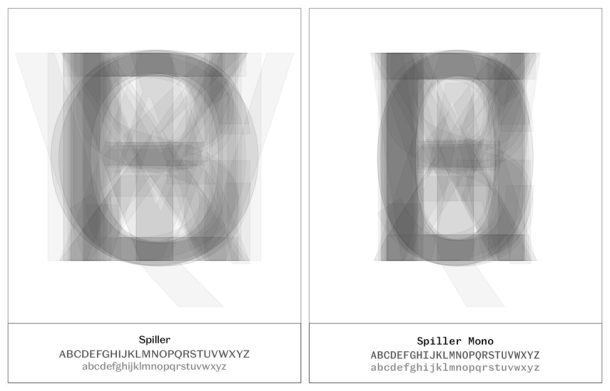
Translating this modular vision into reality presented immediate typological challenges. The V&A utilizes a bespoke brand typeface known as Spiller across its communications and physical spaces. However, in its original form, Spiller proved poorly suited for a rigid modular environment because its letterforms varied dramatically in width, ranging from extremely wide to very thin. This variance compromised legibility and spatial efficiency when fitted into standardized tiles.
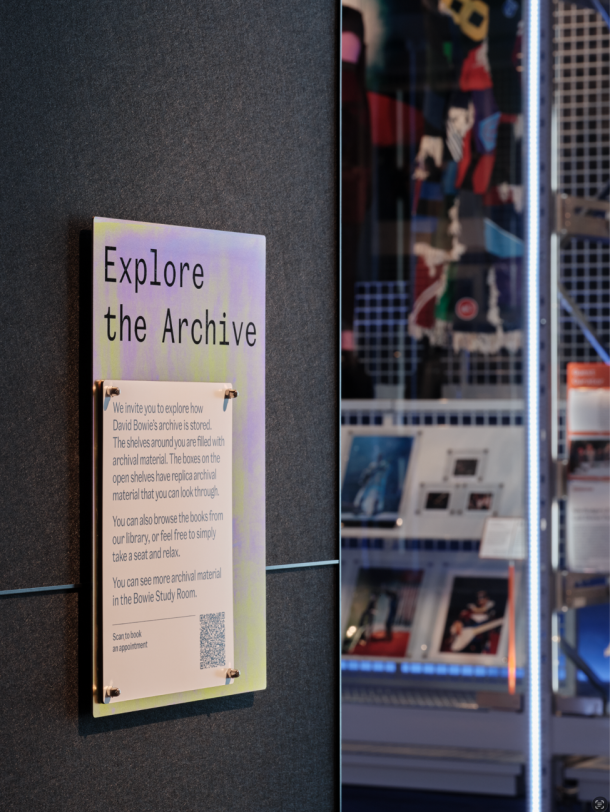
To resolve this issue, the museum commissioned type foundry Commercial Type to develop a new variant called Spiller Mono. This custom typeface features evenly sized, uniform letterforms that maintain the brand identity of the V&A while guaranteeing high legibility within the strict constraints of modular signage tiles. The creation of Spiller Mono highlights how technical graphic design and sustainability can intersect, proving that custom digital assets can be crafted specifically to reduce physical material waste and improve functional longevity.
What Goes Into Making Signs?
While the V&A East Storehouse and the V&A East Museum share an underlying architectural logic, they express their individuality through distinct palettes of low-carbon and recycled materials. At the V&A East Storehouse, the primary signage is constructed using recycled composite paper for the dark blocks and tiles, paired with recycled plastics for the lettering. These components are housed within sturdy aluminum cases, accented in select locations by enameled lava-stone roundels.

The enamelling process—where powdered glass is fused to lava stone at exceptionally high temperatures—results in a hard, glossy, and durable finish. While the intense heat required for enamelling represents one of the more energy-intensive aspects of the project, it was deliberately chosen to honor the V&A’s deep-rooted celebration of craftsmanship and traditional manufacturing techniques.
Meanwhile, the V&A East Museum adopts a different material language, blending sustainably sourced timber with recycled plastics. Early collaboration with Urge Collective allowed Fieldwork Facility to assess the carbon footprints of various raw materials before production began. This analysis led to a crucial logistical shift: instead of specifying bamboo imported from China, the team selected European-grown sycamore, dramatically reducing the carbon emissions associated with long-distance shipping and transport.
Designing to Reduce Waste
Minimizing waste extended well beyond the selection of raw materials and deep into the manufacturing stage. Fieldwork Facility coordinated closely with fabricators to ensure that production processes were optimized to generate as little scrap as possible. Crucially, any offcuts and leftover material generated during the cutting and shaping of the signs were returned directly to the suppliers, where they were reprocessed into new raw materials rather than being sent to landfills.
Beyond Single-Use Vinyl
One of the most persistent environmental challenges facing modern museums is the widespread reliance on self-adhesive vinyl for graphics and temporary wayfinding. Although vinyl graphics are inexpensive, quick to print, and easy to install or remove, they are overwhelmingly made from non-recyclable plastics and cannot be repurposed. Whenever an exhibition concludes or a museum updates its program, entire fleets of vinyl graphics are typically stripped away and discarded.
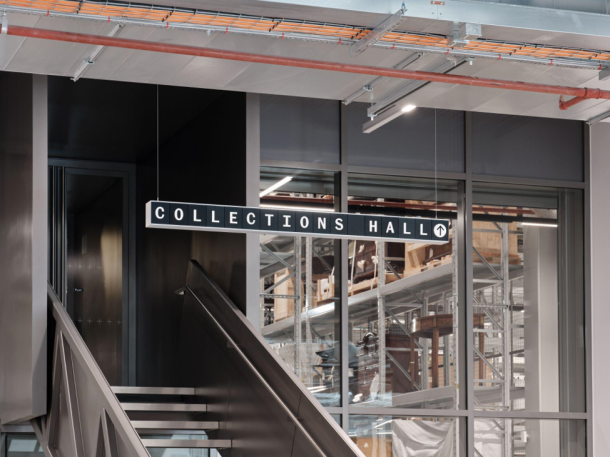
Fieldwork Facility sought to break this cycle by drastically reducing the use of single-use vinyl across both V&A East sites. Wherever possible, permanent and semi-permanent graphics were painted directly onto the walls. By replacing disposable vinyl with hand-painted wall applications, the design team eliminated substantial amounts of petroleum-based plastic waste from the museum’s daily operations.
Designing Signage for Exhibitions
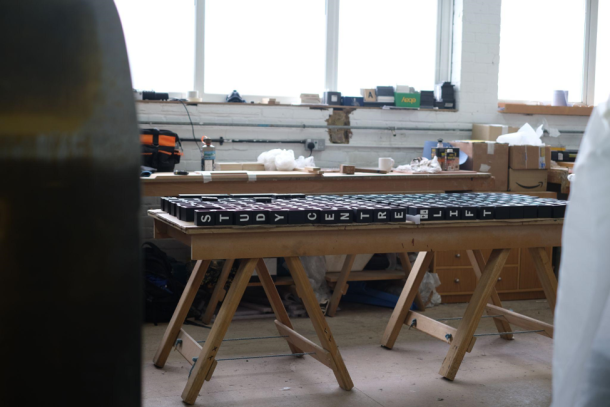
Navigating temporary exhibitions presents a notoriously difficult puzzle for museum designers, as frequent updates usually necessitate a continuous cycle of new signage. To address this sustainably, the team designed and fabricated 1,240 individual tiles made from wood and recycled plastics for the V&A East Museum. Each tile was individually cut, engraved, finished, and assembled by hand.
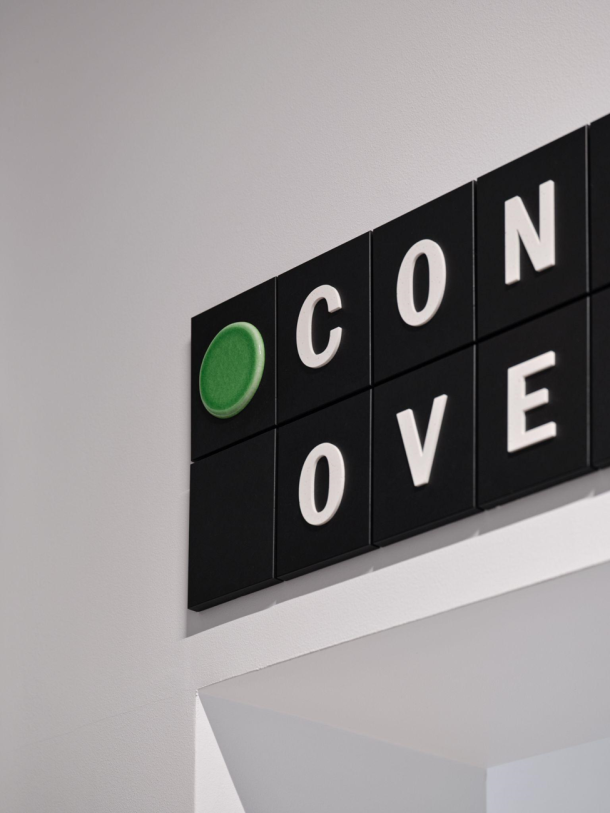
To ensure the system could adapt to future programming without requiring new materials, Fieldwork Facility analyzed five years of past exhibition titles to gauge typical name lengths. This data-driven approach informed the creation of a dedicated reserve bank of 1,115 spare tiles, allowing staff to easily update Welcome Directories and Discovery signs whenever an exhibition changes.
To further prevent the reintroduction of vinyl for rapidly shifting events and temporary displays, the museum integrated narrow, scrolling LED ticker signs. These digital displays provide real-time, dynamic information that can be updated instantly without generating physical waste. To complement this technology, the designers developed yet another bespoke typeface, "V&A Eastbound," which includes a wide array of unique symbols and glyphs tailored specifically for future institutional announcements.
Despite these comprehensive efforts to eliminate disposable materials, approximately six square meters of vinyl remains in specific areas across the East Museum wayfinding scheme. Vinyl was retained strictly as a permanent solution in locations where traditional screen printing was technically unfeasible.
The Future of Wayfinding in Museums
The development of V&A East demonstrates how prioritizing sustainability from the very beginning of a design project can yield high-performance signage that is both visually striking and ecologically responsible. By implementing modular systems that encourage disassembly and reuse, meticulously tracing the origins of raw materials, and finding creative alternatives to single-use plastics and vinyl, the project charts a new course for cultural institutions worldwide. By treating the entire lifecycle of every material as a fundamental design parameter, the collaboration has proven that sustainability need not be an administrative afterthought, but rather the very foundation of creative innovation.