LONDON — Since stepping into the role of Archives Cataloguer at the V&A Wedgwood Collection, a recurring motif has quietly emerged from the historical ledgers, shape books, and storage drawers: the humble seashell. For one staff member, whose childhood was spent combing the Yorkshire coastline for interesting rocks, sea-glass, and marine treasures, realizing that shells formed a cornerstone of the historic Wedgwood aesthetic proved to be a delightful professional surprise.
This deep-rooted design influence spans more than two centuries, bridging the natural world with the industrial ambitions of British ceramic manufacturing. From the foundational experiments of company founder Josiah Wedgwood I in the 18th century to modern iterations produced well into the 19th and 20th centuries, marine motifs have left an indelible mark on one of the world’s most renowned ceramic collections.

The Naturalist Roots of Josiah Wedgwood I
Born in 1730, Josiah Wedgwood established the Wedgwood company in 1759, earning a lasting reputation as a master potter, innovator, and experimentalist. Yet, his inquisitive mind extended far beyond the pottery kilns of Staffordshire. Alongside his mastery of clay and glaze chemistry, Wedgwood held profound interests in botany, drawing, chemistry, and industrial design.
He was particularly captivated by the natural sciences, developing a dedicated fascination with conchology—the collection and scientific study of shells—as well as palaeontology, the study of fossils. In 18th-century elite circles, conchology was widely pursued under the affectionate moniker of "shell fancying." Wealthy collectors gathered rare specimens from global expeditions, cataloging, displaying, and occasionally transforming them into intricate decorative artworks.

This personal passion directly influenced the trajectory of early Wedgwood production. Late 18th-century shape books preserved in the archive contain an extensive array of marine-inspired forms. During this era, European interior design was dominated by the Rococo style, which favored organic curves, asymmetry, and "rocaille" decoration—a French term derived from rockwork and broken shell motifs.
Shape sheets from the period outline detailed sketches for tableware such as the Wreathed Shell Dessert Set, complete with the technical scientific names of the marine species that served as their muse. Archival records show that the Argonauta Argo, commonly known as the "Paper Nautilus" shell, became an exceptionally popular form, inspiring production runs that continued uninterrupted into the 20th century.

Royal Patrons and Elite Dining Services
The demand for sophisticated, nature-inspired ceramics quickly captured the attention of international royalty. Among the most notable early commissions was the Husk Service, a complete dinner and dessert service ordered in 1770 by Empress Catherine II of Russia. The Empress, herself an avid shell enthusiast, acquired hand-painted Queen’s ware dishes finished in delicate rose-purple, showcasing the high standard of artistry maintained at Wedgwood’s Etruria factory.
As production methods evolved, Wedgwood expanded beyond traditional holloware. Beginning in 1776, the factory manufactured plain, printed, enamelled, and painted ceramic tiles. Many of these architectural and decorative components drew heavily from the natural world, with elaborate shell patterns recorded across successive tile pattern books. This manufacturing stream remained active until 1902, when changing industrial demands led to the closure of the tile department at Etruria, which had operated since 1769 before operations later consolidated in Barlaston.

The aesthetic crossover between architectural tiles and tableware is clearly demonstrated in surviving pieces, such as late 19th-century bone china plates molded directly into Scallop shell configurations, mirroring pattern number 432 from the factory’s historical tile archives.
Innovation in Jasperware and the Tea Craze
Perhaps no innovation is more closely linked to Josiah Wedgwood I than jasperware. Developed through thousands of rigorous experiments during the 1770s and perfected by 1775, jasperware is a fine-grained, unglazed stoneware that can be permanently colored through the addition of various metal oxides, prized for its smooth, matte finish.

As British social habits shifted in the late 18th century, the middle classes embraced a booming tea culture, driving unprecedented demand for specialized tea-drinking apparatuses. Responding to this cultural shift, Wedgwood produced charming jasperware tea caddy spoons molded into the precise form of Pecten shells. These small, functional items combined utilitarian purpose with the era’s ongoing obsession with natural history.
By the mid-to-late 19th century, the popularity of conchology evolved into a cultural phenomenon frequently dubbed "conchylomania." To satisfy this insatiable market, Wedgwood adapted its palette and manufacturing techniques, introducing vibrant majolica-glazed creamware teapots and sugar bowls adorned with rich seashell and coral reliefs.

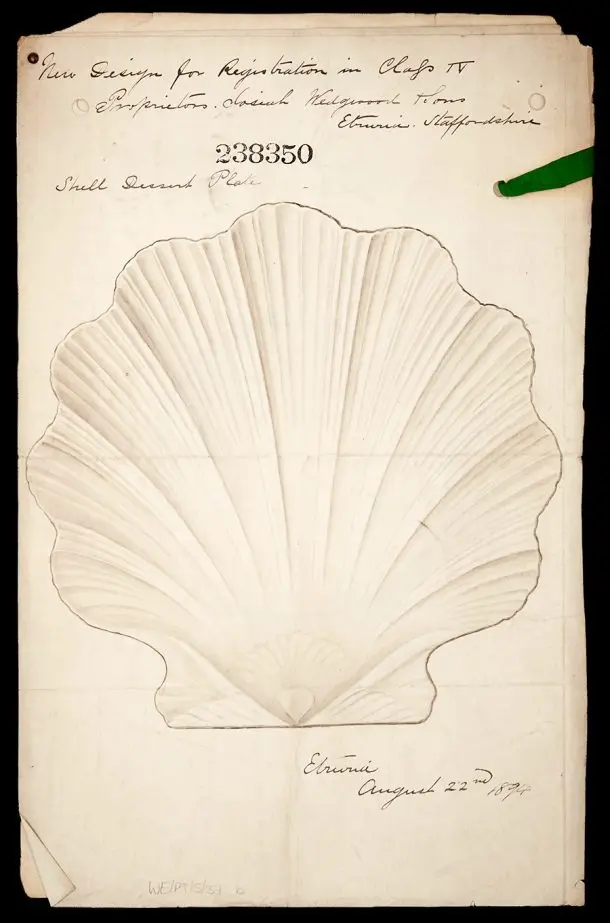
Official design patent certificates housed within the V&A Wedgwood Collection archive illustrate the commercial protection sought by the company during this period. A formal patent registration dated August 1894 features a detailed illustration of a shell dessert plate, confirming that consumer appetite for marine-themed tableware remained robust near the close of the Victorian era.
20th-Century Revivals and Modern Glazes
The enduring appeal of marine forms persisted well into the 20th century. In 1982, the factory produced jasperware bowls and jugs featuring white applied relief Pecten shells. By drawing directly upon archival designs first established in the 18th and 19th centuries, modern craftspeople successfully bridged historical heritage with contemporary manufacturing standards.

Throughout the 20th century, Wedgwood ceramicists continually experimented with new bodies and glaze formulations. This period of technical exploration frequently resulted in modern reproductions of classic 18th-century shapes, most notably the iconic Nautilus design.
To align with modern interior design preferences for soft, muted aesthetics, Wedgwood introduced historical shell forms in new pastel colorways, such as the Alpine Pink dessert service. At the same time, specialized decorative techniques were

applied to capture wider audiences, including iridescent lustre glazes created by brushing metallic solutions across ceramic surfaces prior to firing.
Although shell shapes and patterns are not actively manufactured by Wedgwood today, marine-inspired ceramics remain highly coveted by international collectors, museum curators, and design enthusiasts.

Across the globe, contemporary artists and designers continue to look to natural forms like seashells to explore and promote the beauty and preservation of the natural world. In doing so, modern creators echo the profound curiosity of 18th-century conchologists, whose meticulously curated collections continue to reside in museums as a permanent source of inspiration and study.