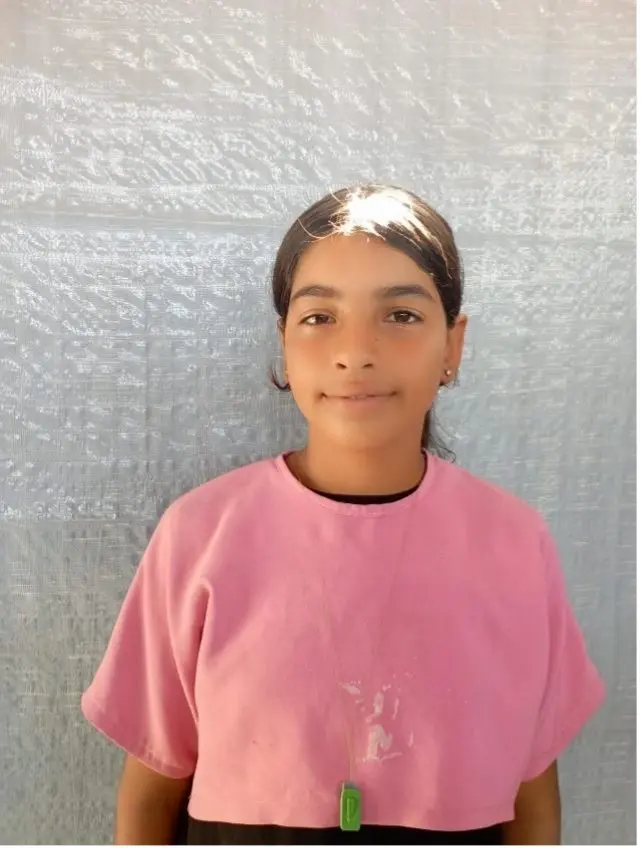
At just 12 years old, Amira has already endured a lifetime of profound sorrow. She has faced the devastating loss of her father, the trauma of displacement, and the total destruction of her family home. Yet, despite the catastrophic circumstances that surround her daily life, she resolutely continues her education and holds fast to a singular, guiding dream: to grow up and become a nurse.
Amira was only nine years old when her father passed away from cancer. To a young child, he was far more than a parent; he was a steadfast source of love, safety, and unwavering strength. His death fundamentally altered the landscape of her childhood, introducing an early grief that few children should ever have to bear. But the tragic chapter was only the beginning of a larger upheaval. When the war in Gaza erupted, Amira and her grieving family were thrust into yet another harrowing period defined by profound loss, ongoing fear, and radical instability.
Forced to Leave Everything Behind
Before the conflict upended their lives, Amira lived peacefully with her mother, Manal, and her siblings in the Al-Salam neighbourhood of Rafah. It was a community where they had built routines, memories, and a sense of permanence. When the escalating violence forced the family to flee for their safety, they had to make agonizing choices in a matter of moments. They left the vast majority of their belongings behind, managing to carry only a few essential clothes, some basic bedding, and a handful of kitchen items.
At the time of their departure, they clung to the fragile hope that their displacement would be temporary and that they would soon be able to return to the familiarity of their home. That hope, however, was violently dashed. Their house was ultimately destroyed, rendering a return impossible and locking the family into a prolonged state of displacement. With nowhere else to go, they eventually established a makeshift tent to serve as their shelter.
Life inside the tent presented a relentless series of survival challenges. The structure offered virtually no insulation against the elements, becoming stiflingly hot during the scorching summer months and bitterly, bone-chillingly cold when winter arrived. When seasonal rains fell, water leaked directly into the living space, turning the dirt ground beneath them into thick, impassable mud.
Basic survival necessities became daily obstacles. The family struggled constantly to secure adequate access to water and food. They often had to spend grueling hours waiting in long lines just to collect water from passing distribution trucks. When they could no longer afford to purchase food independently, they were forced to rely entirely on community kitchens for their sustenance.
Losing Everything Again to Fire
The family’s endurance was tested to its absolute limits when disaster struck their temporary refuge once more. In another major and devastating blow, their tent caught fire, reducing their remaining shelter and possessions to cinders.
The fire swept through what little they had managed to salvage, destroying their few remaining clothes, their minimal cooking equipment, and any personal belongings that linked them to their past life. Reflecting on the sheer scale of the disaster, Manal shared the agonizing reality of the aftermath: "Everything we owned was turned to ashes."
The incident stripped the family down to zero once again, leaving them entirely without the basic items required to navigate daily existence. Today, their immediate needs are profound and urgent. They require a much stronger, more secure shelter equipped with waterproof coverings to withstand the harsh weather, alongside a functioning bathroom, cooking equipment, new clothes, and shoes.
Continuing to Study Despite Displacement
Despite the crushing weight of these dire living conditions, Amira refuses to abandon her education. She continues to study online and has advanced to the seventh grade, demonstrating a fierce determination that refuses to be extinguished by circumstance.
Without access to electricity or even a basic washing machine, Amira also takes on significant responsibilities to support her family, washing clothes entirely by hand. Amid these grueling daily tasks, she maintains her focus on the future. She dreams of becoming a nurse, a vocation born perhaps from her early experiences with illness and loss in her family, and desperately hopes she will be granted the opportunity to see her studies through to completion.
Beyond her academic pursuits, Amira enjoys drawing as a creative outlet, though she currently lacks the basic materials needed to practise her art. Her immediate personal needs remain acute, requiring essential provisions such as winter clothing, proper underwear, and shoes to protect her from the elements.
Supporting Orphaned Children in Gaza
The crisis facing Amira and her family mirrors the difficult reality confronted by countless children across Gaza who have lost parents, homes, and any foundational sense of security. Organizations like Islamic Relief have worked for decades to address these immense vulnerabilities. Through its Orphan Sponsorship Programme—which has been active in Gaza since 1999—the organization provides vital, structured support to orphaned children and their surviving guardians.
The programme operates on a one-to-one sponsorship model, matching an individual donor with a child. The child’s guardian then receives a regular monthly financial payment. In the context of Gaza, families have the flexibility to utilize this support for the needs they deem most urgent at any given moment, whether that includes purchasing food, securing clothing, accessing healthcare, or funding education.
In response to the current crisis, Islamic Relief has significantly expanded the reach of the programme. More than 25,000 children throughout Gaza are currently receiving sponsorship support, though an overwhelming backlog of over 5,000 children remains on the waiting list. Where logistical conditions permit, sponsored families also receive supplementary seasonal support, including food parcels for Ramadan and Qurbani, Eid gifts for the children, and essential winter items.
Holding On to Hope
Amira’s story is a testament to the resilience of children caught in the crosshairs of conflict, capturing both the immense tragedies they endure and their fierce refusal to let go of tomorrow. Despite losing her father, her home, her belongings, and the safety of a permanent roof over her head, she continues to study, draw, and dream.
Her aspirations remain remarkably simple: she wants to finish her education, train to become a nurse, and ultimately live somewhere safe alongside her family. Through ongoing humanitarian initiatives like Islamic Relief’s Orphan Sponsorship Programme, vital lifelines are extended to children and families striving to survive and hold onto hope in Gaza.