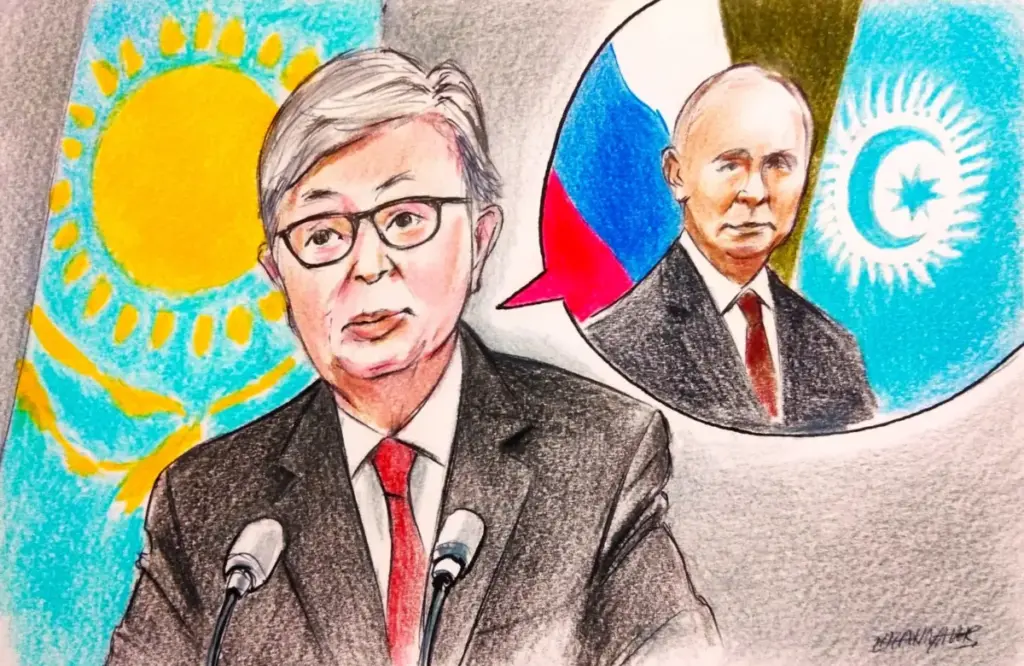
The diplomatic landscape surrounding the Organization of Turkic States (OTS) has entered a complex new phase following a strategic proposal raised by Kazakh President Kassym-Jomart Tokayev. Speaking at the OTS Summit in Ankara, President Tokayev’s suggestion regarding Russia has ignited a significant debate regarding the future trajectory, institutional identity, and regulatory boundaries of the expanding geopolitical bloc.
The proposal, which immediately captured the attention of regional analysts and member-state capitals, touches upon the delicate balance between fostering broader international cooperation and maintaining the core linguistic and cultural identity of the Turkic world. According to the official transcript released by the Office of the President of Kazakhstan, Tokayev put forward two distinct pathways for engaging Moscow: either inviting Russia to join the newly established OTS+ cooperation format or allowing the country to participate in select activities of the organization under an observer status framework.
As a distinguished and experienced statesman, Tokayev presented his case by deliberately underscoring the deep historical and cultural threads that connect Russia with the broader Turkic world. He pointed specifically to the millions of Turkic peoples living within the borders of the Russian Federation, the presence of numerous Turkic-origin loan words embedded within the Russian language, and collaborative cultural initiatives such as the "Altai – Cradle of Turkic Civilization" project, which enjoys active support from Kazakhstan and positive promotion by Moscow. Tokayev argued that extending such a participatory mechanism to a major neighboring power would elevate the organization’s overall international prestige and yield practical benefits for all member states. Significantly, in the same address, he emphasized that the OTS must strictly avoid transforming into a military alliance, thereby establishing a clear political and defensive boundary for the initiative.
Diplomatic observers note that Tokayev’s maneuver exemplifies masterclass diplomacy, attempting to carefully advance regional integration and internal solidarity within the Turkic world while simultaneously safeguarding stable, predictable relations with Moscow. This dual sensitivity is natural for Central Asian republics navigating a multipolar global order, and it carries considerable importance for the institutional evolution of the OTS. However, the fundamental yardstick for any such initiative must remain its tangible contribution to the sovereign independence and collective interests of all Turkic member states. The deepening of diplomatic and economic relations with external powers like Russia can only hold meaningful value to the extent that it reinforces the organization’s autonomous capacity to dictate its own strategic priorities. Ultimately, the collective will of the sovereign member states will chart the direction of any future partnership.
To properly evaluate the feasibility of Tokayev’s proposal regarding observer status, it is necessary to examine the legal architecture governing the organization. The foundational legal document of the bloc, the 2009 Nakhchivan Agreement, established the initial parameters for external outreach in Article 16. This provision permitted the granting of observer status to third-party states, international organizations, and international forums. Notably, the original 2009 text did not impose a strict language-based requirement for observer candidates, leaving the procedural mechanisms and governing principles to be fleshed out through subsequent specialized regulations.
A critical legal shift occurred over a decade later, on Nov. 12, 2021, during the Istanbul Summit, where the official observer status regulation was formally adopted. This updated regulation introduced a specific and non-negotiable eligibility requirement: only states that officially recognize a Turkic language or a closely related language as their state or official language at the national level may apply for observer status. Elaborating on this legal reality, Kürşad Zorlu, deputy chair of the Justice and Development Party (AK Party) and head of Relations with Turkic States, emphasized in a public statement that this linguistic requirement must hold validity throughout the entirety of the applicant country’s territory.
An analysis of Article 68 of the Russian Constitution demonstrates the legal hurdle facing Moscow under current criteria. While the Russian Federation allows individual constituent republics to designate their own regional state languages alongside Russian, the official language status of these regional idioms—such as the Tatar language—remains confined to local jurisdictions and does not translate into official-language status across the entire federation. Consequently, despite the rich cultural presence of Turkic communities within Russia, Moscow currently fails to meet the strict linguistic criteria mandated for institutional observer status. While the existence of these vibrant Turkic populations forms a vital bridge for cultural relations, it does not fulfill the legal threshold established by the Istanbul regulations.
From a legal standpoint, the 2009 Nakhchivan Agreement and the 2021 observer regulations cannot be viewed as conflicting alternatives. The 2009 agreement merely outlined the general framework and delegated the authority to establish specific conditions for observer status to subsequent regulatory bodies. Therefore, legal experts argue that Russia cannot be admitted unconditionally today based solely on the original, broader text of the Nakhchivan Agreement. For such an outcome to materialize in the future, Moscow would either need to meet the prevailing language requirements, or the member states would need to amend the relevant organizational rules through due legal process. In either scenario, unanimous member approval and a formal decision by the competent organizational body remain absolute prerequisites.
As an alternative to full observer status, the OTS already possesses a dedicated mechanism designed for flexible external engagement: the OTS+ format. Established by the organization during the 2025 Gebele Summit, this framework was specifically created to cultivate practical, flexible relationships with external partners in areas of mutual economic, cultural, and political interest. As Zorlu explained, convening a formal meeting with a third-party country at the level of heads of state or foreign ministers under the OTS+ umbrella requires the explicit approval of all member states. Contact with Russia could certainly be structured within this established framework; however, such meetings would not automatically confer formal observer status upon Moscow. The exact scope, agenda, and boundaries of any such cooperation would be negotiated and determined on a case-by-case basis.
Zorlu’s measured approach has been widely praised by regional analysts as a valuable blueprint that charts a viable path for pragmatic diplomatic engagement while rigorously preserving the organization’s foundational pillars of language and identity. His timely reminder of internal institutional rules reflects a prudent, defensive stance regarding the structural integrity of the Turkic world. Ensuring that joint decisions remain transparent and predictable is essential if the OTS is to maintain its growing international prestige and institutional gravity. External interest from major global powers should serve to reinforce, rather than dilute, the confidence of member states in their own established rules.
Furthermore, Zorlu’s public call to revitalize cultural relations through the International Organization of Turkic Culture (TÜRKSOY) has garnered significant attention. He recalled that robust cooperation between the six Turkic republics located within the Russian Federation and TÜRKSOY was effectively frozen in 2015 following decisions made in Moscow, suggesting that this frozen dynamic should now be constructively reassessed. A concrete expression of any genuine desire for cultural rapprochement would involve facilitating direct, unobstructed contacts with regional compatriots in specialized fields such as science, art, and language education. Such steps would help translate mutual diplomatic trust into everyday reality, establishing sustainable, long-term bridges between universities, research centers, and cultural institutions across borders.
From Türkiye’s strategic perspective, the most appropriate approach lies in cultivating external contacts that serve tangible mutual interests while fiercely preserving the founding philosophy of the organization. The subject matter, operational scope, and expected benefits of any cooperative endeavor must be defined with absolute clarity. Although observers do not possess voting rights or direct participation in the organization’s internal decision-making processes, the immense political weight carried by a major global power like Russia necessitates profound caution. The sovereign equality of all member states and their unimpeded ability to set their own regional agendas must be permanently safeguarded. Projects designed to strengthen solidarity within the Turkic world and deepen cultural ties with global compatriots can only be evaluated and approved against these stringent criteria.
Under Ankara’s current chairpersonship, the overriding priority remains enhancing the institutional capacity of Turkic states to act in complete unison on the international stage. President Tokayev’s proposal, while sparking lively debate, ultimately aligns with the overarching objective of strengthening the bloc’s diplomatic footprint. The legal reality remains straightforward: Russia cannot attain formal observer status within the OTS under current constitutional language conditions and existing observer bylaws, but it can engage in meaningful cooperation through the flexible OTS+ framework, provided there is unanimous approval from all member states. The clear legal and political distinctions emphasized by officials like Zorlu will serve as a vital compass moving forward. The ultimate, lasting value of the Turkic world’s relations with external actors will continue to be measured by how effectively those engagements contribute to its collective independence, institutional resilience, and shared strategic will.