
By Musheera Ashraf
Saharanpur, Uttar Pradesh: India’s contemporary digital narrative is overwhelmingly told through metrics of unprecedented scale. Every single minute, millions of Unified Payments Interface (UPI) transactions course through servers across the country. Seamless online services, digitized public grievance portals, and welfare schemes intricately linked to smartphone applications define the modern administrative vision. Yet, far removed from this glossy metropolitan horizon, in rural clusters where smartphones are tightly shared commodities and essential passwords are matters of guesswork, women continue to inhabit the profound margins of a technological transition that has accelerated far faster than they could follow.
This stark dichotomy is vividly illustrated in the daily reality of Musheera Ashraf’s reporting from Uttar Pradesh. Musayyada, a thirty-five-year-old widow residing in a village situated roughly ten kilometres from Saharanpur, begins her day long before the urban centers stir to life. At the break of dawn, she boards a crowded, rattling local tempo to visit the nearest gas agency. Her mission is simple yet frustratingly elusive: she needs to find out why her government-backed cooking gas cylinder subsidy has failed to reflect in her account for three consecutive months. By the time she arrives at the agency, a weary queue has already formed outside the locked gates, composed mostly of people seeking similar administrative redress.
When her turn finally arrives, agency staff inform her with bureaucratic indifference that her grievance can only be resolved if she purchases a new gas pipe, which they insist is mandatory. Musayyada blinks in disbelief, caught off guard by an arbitrary commercial demand tied to her administrative welfare. "I changed the pipe just a month ago. I do not need it," she protests, pointing out the practical redundancy of the purchase. The official reply is flat, rehearsed, and completely devoid of empathy: "It is mandatory. Even if you do not need it now, you can use it later."
The price of the mandated pipe is two hundred rupees—an amount roughly equivalent to the cost of a day’s worth of meals for her family of four. For a household surviving on the thinnest of margins, a forced, unnecessary expense dictated by a bureaucratic counter represents a severe financial blow, underscoring how administrative digital shifts often translate into compounded vulnerabilities on the ground.
Musayyada carries a second-hand feature phone that she managed to purchase for twenty-five hundred rupees, a sum she paid off through difficult, staggered installments. "A phone is necessary now. Even if we skip a meal, we have to keep a phone," she explains, capturing the paradoxical centrality of technology in modern poverty. Yet, her operational command over the device is severely restricted. She uses it almost exclusively to receive incoming calls and to dial her married daughter living in a neighboring village. For practically every other digital necessity, she is forced to depend on the local shopkeeper next door—even for the routine booking of her Liquefied Petroleum Gas (LPG) cylinder.
When asked how she manages to remember her daughter’s phone number given her inability to read or write digits conventionally, she laughs shyly. "Akhir me do zero hain," she says, noting that there are two zeroes at the end of the sequence, anchoring her fragile connection to her child in a visual and mnemonic marker rather than digital literacy.
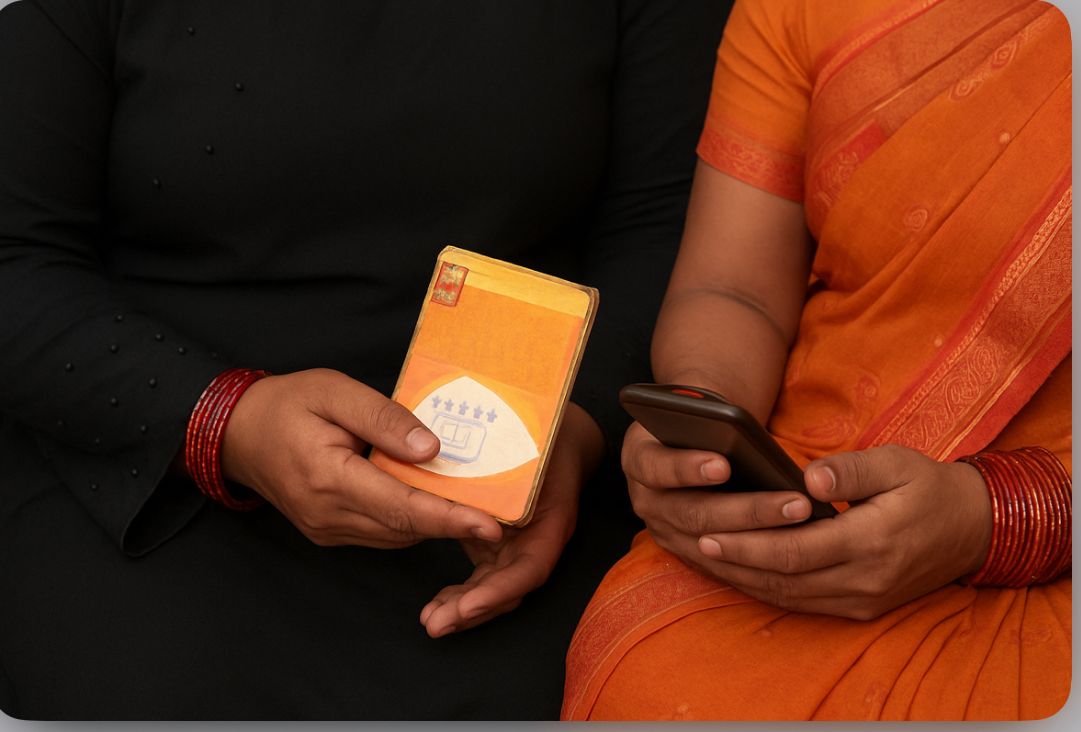
Across the vast expanses of rural India, women routinely depend on neighbors, local shopkeepers, and male family members to execute the most elementary digital tasks. These helping hands, predominantly male, execute everything from booking cooking gas to verifying the deposit status of state subsidies. Trust effectively fills the massive void left by systemic digital exclusion and a lack of formal education, but this reliance carries hidden, often severe risks.
In another household in the same region, an elderly woman found herself incessantly distressed by mysterious phone calls from complete strangers. It transpired that a younger male relative had casually used her primary mobile number to register multiple unvetted online accounts and commercial platforms without her knowledge or consent. "I had no idea why people were calling me by someone else’s name," recalls sixty-two-year-old Savitri, reflecting the bewildering ways personal data can be harvested and compromised without the owner’s understanding.
These occurrences might appear minor when measured against the sweeping macro-statistics of India’s national digital push, but they powerfully illustrate how fluidly the boundary between misplaced trust and acute personal vulnerability blurs in households unequipped for the digital age.
A decade into the overarching Digital India mission, a deeply entrenched gendered digital divide continues to dictate the terms of modern citizenship—strictly demarcating who gets to actively participate and who must stand outside the administrative door. Comprehensive data reveals that nearly forty percent fewer rural women own smartphones compared to their male counterparts. Furthermore, among the fraction of women who do manage to possess a device, a significant proportion exercise little to no actual control over its usage, content, or data privacy.
This profound divide becomes even sharper when examining the landscape of digital finance. Men are statistically far more likely to perform UPI transactions than women, creating a measurable gap of nearly fourteen percentage points. Paradoxically, official macro-level UPI statistics routinely obscure this stark disparity because transaction data is rarely disaggregated or analyzed by gender. However, independent observers and professionals working directly within the digital payments ecosystem readily acknowledge the underlying imbalance.
In 2023, a senior executive at Google Pay publicly noted that women accounted for less than thirty percent of active UPI users. The following year, a representative from the National Payments Corporation of India (NPCI) corroborated a strikingly similar estimate during industry discussions. If these low figures characterize national averages, the participation rate plummets even further when narrowing the focus to semi-urban and deeply rural interiors.
The psychological dimension of this exclusion is equally formidable. A fifty-year-old schoolteacher living in Saharanpur possesses a fully functioning UPI payment application downloaded on her smartphone, yet she steadfastly refuses to use it. "What if the money goes to the wrong person? Who will return it to me?" she asks, expressing a very real, paralyzing anxiety. When she needs to transfer funds or settle a bill, she routinely hands her device over to her son. "If something goes wrong, I will be blamed. Better not to try," she concludes, illustrating how the fear of administrative error reinforces lifelong dependency.
Fear serves as an unseen yet immensely powerful barrier across rural communities. Many rural women explicitly state their preference for physical cash not because they lack cognitive awareness of digital tools, but because they profoundly lack institutional confidence. They have repeatedly heard neighborhood anecdotes of digital fraud, stolen passwords, accidental financial transfers that could never be reversed, and phones getting permanently blocked after a series of failed authentication attempts. For households living on the precipice of poverty, a single digital mistake carries financial consequences far heavier and more punishing than a physical miscalculation.

Sita, a thirty-year-old newly married woman, summarizes this pervasive sentiment with striking simplicity. She has never booked her own cooking gas cylinder in her life. "My husband does it. I do not have a phone," she explains matter-of-factly. When she occasionally uses her husband’s device, her access is strictly cordoned off from administrative tools; she uses it solely to watch entertainment videos on YouTube. "If something goes wrong, I will have to hear from everyone," she adds, pointing to the social censure women face when attempting to navigate systems they have not been trained to master.
This acute fear of committing an error is far from an imagined anxiety. It is carefully shaped by decades of socio-cultural conditioning—years of being sternly told to remain cautious, of being disproportionately blamed for household or administrative mistakes, and of being afforded very little margin for trial and error. Meanwhile, government and corporate digital services continue to expand aggressively at breakneck speed. Welfare schemes are incessantly linked to mandatory mobile applications, subsidies require periodic online authentication, SIM cards demand biometric revalidation, and commercial banks insist on rigorous digital Know Your Customer (KYC) compliance. Each newly added procedural layer demands a baseline of digital self-assurance that millions of women have never been institutionally or socially permitted to build.
Contemporary digital content creators have attempted to capture adjacent layers of this persistent reality on social media platforms. Recently, an Instagram creator operating under the handle @lifeofpuja articulated a universal frustration in a viral video, noting that "no matter how much she works or how many followers she earns, she is still known as someone’s wife or daughter-in-law." Rural women quietly echo this exact sentiment in their daily routines, where they rarely receive independent recognition for acquiring new operational skills. Their primary social identity remains strictly tethered to the patriarchal household unit rather than their individual competencies or technological literacy.
Experts working on grassroots digital rights emphasize that the core crisis extends far beyond a simple deficit in literacy, pointing instead to structural dependence. Sarvothanam, a New Delhi-based organization dedicated to online safety and targeted digital training workshops, highlights the inherent dangers of this arrangement. "Women who do not know how to use their phones rely entirely on others. But the very same people can misuse their privileged access. Personal photographs, private messages, and even their confidential OTPs are shared without them truly understanding what is happening in the background," a representative from the organization explains.
Despite the systemic magnitude of these challenges, localized pockets of organic change are slowly unfolding across the region. In a village situated near the historic town of Deoband, Rahima, who proudly stands as the first university graduate in her immediate family, actively dedicates her time to teaching basic digital skills to her mother and neighboring women. "I tell them how to open incoming SMS messages, how to find saved contacts in the directory, and how to identify suspicious online links," she shares. It is slow, painstaking work, but it is driven fundamentally by empathy, community care, and an impulse toward protection rather than administrative efficiency.
Parveen, a dedicated social worker who routinely engages with rural women across Saharanpur in western Uttar Pradesh, argues that the path forward demands intensive structural interventions. She advocates for sustained handholding, comprehensive community-level training programs, and autonomous, women-led digital learning circles. "Digital empowerment is not only about handing over a manufactured device. It is fundamentally about making women feel safe, confident, and entirely in control of their own choices," observes a digital rights volunteer active in the same geographical belt.
India’s broader digital journey continues to race ahead on the global stage, yet a significant segment of its population is still compelled to walk cautiously behind it. The women inhabiting these rural villages are not engaged in active resistance against technology itself; rather, they are desperately trying to navigate an unforgiving landscape that has shifted at a velocity far exceeding their access, their institutional confidence, and their baseline trust.
For these women, true autonomy is not measured in abstract metrics like total applications installed on a screen or seamless financial transactions completed per second. Instead, it is measured in quiet, hard-won victories: successfully answering a text message without asking for external help, checking an elusive subsidy status independently for the very first time, or daring to press a digital button without the crushing dread of incurring blame. And until these quiet victories become ordinary, everyday realities, the nation’s accelerated digital future will continue to leave its women standing outside the door.