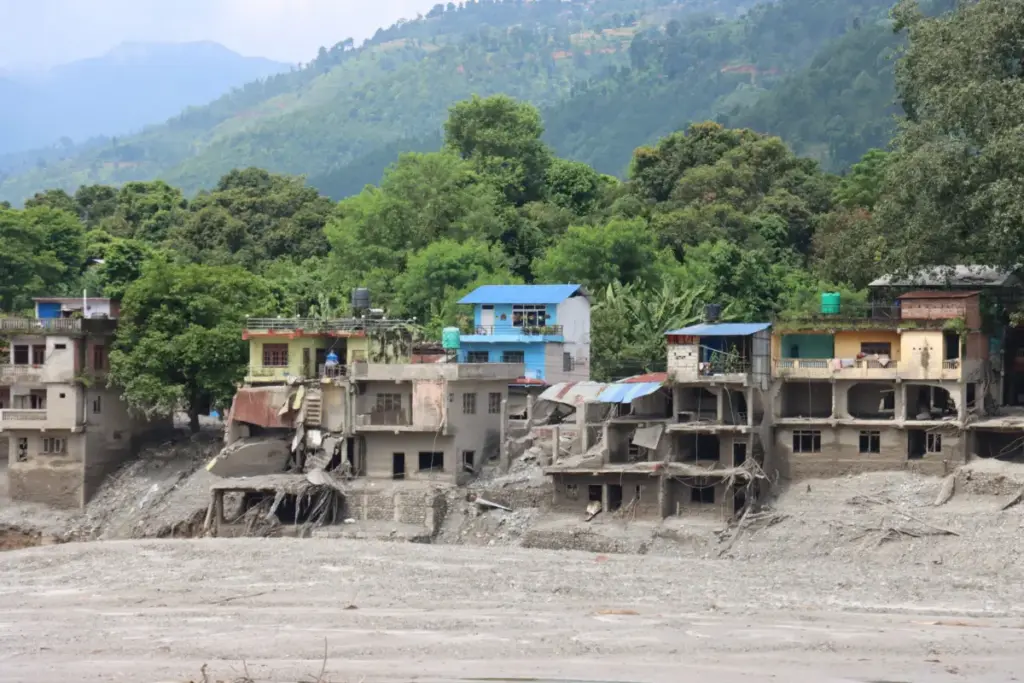
One month after catastrophic floods tore through towns and villages in Nepal, the humanitarian crisis continues to deepen severely, leaving thousands of vulnerable survivors in urgent need of ongoing aid, humanitarian agency Islamic Relief has warned.
The disaster, which struck rapidly on August 26, has left a trail of immense destruction across the affected regions. According to official assessments conducted by the Nepalese government, the floods have caused an estimated US$2.7 billion in infrastructural and economic damage. More than 84,000 people have been left in critical need of humanitarian assistance. At least 1,450 people are now officially confirmed to have been killed by the raging waters, while more than 5,000 people remain missing and unaccounted for, leaving families in agonizing uncertainty.
Thousands of survivors remain displaced from their homes, grappling with critical food shortages as emergency food rations are rapidly depleted. Aid organizations warn that many affected communities are likely to face a prolonged hunger crisis extending well into 2027, as their primary sources of livelihood, agricultural lands, and food stores have been utterly destroyed by the torrential waters.
Government assessments indicate that approximately 7,000 buildings were completely destroyed in the deluge. This widespread destruction has left 32,000 people still displaced from their permanent residences, with many currently sheltering in temporary camps, makeshift facilities, or with relatives and neighbors. The sheer scale and speed of the floods caught many residents entirely off guard, preventing them from taking preventive action until it was too late to secure their properties.
In response to the escalating catastrophe, Islamic Relief launched an emergency appeal immediately after the disaster struck. Working in close collaboration with Nepalese authorities and local partner organizations, the charity has so far delivered emergency shelter and other vital relief items to more than 8,000 people. Building on these initial relief efforts, the organization is now scaling up its operations to deliver essential food supplies and emergency shelter support to an additional 1,000 families in the hardest-hit areas.
Laxmi Raj Joshi, Islamic Relief’s emergency response manager in Nepal, described the deteriorating situation on the ground, emphasizing the multi-layered nature of the crisis.
"The humanitarian impact of the flood has continued to deepen over the past month. Whole communities remain displaced and their income and homes are gone. Within a second they lost their household, their livelihood, their land and stores. Now they are in a deepening financial crisis," Joshi said.
Highlighting the looming threat of widespread malnutrition and poverty, Joshi added, "We are worried that in the coming weeks the food crisis will be alarming. Emergency food rations have been used, and people don’t have money to buy more. Without income and shelter, people don’t know where they will go or what will they do. People need continued support to stop hunger spreading and restore safe and dignified living conditions."
The human cost of the disaster is vividly reflected in the personal accounts of those who lived through the terrifying ordeal. Shyam Lal Shrestha, a 75-year-old resident, shared his harrowing experience with Islamic Relief workers.
"When I first received the message that a flood was coming, I did not believe it. But when I saw the water rushing towards us, I realised how serious the situation was. I immediately ran to free my buffalo and make sure it could escape. At the same time, I pushed my wife towards a higher and safer place. She has a problem with her knees and could not run as fast as I could, so I was very worried about her safety," Shrestha recounted.
"Everything happened so quickly. We had very little time to think or collect our belongings. Our main priority was simply to get ourselves and our animals to a safe place," he continued.
Describing his uncertain future and deep emotional ties to his homeland, Shrestha explained the profound trauma left in the wake of the disaster. "For now, we are staying at our neighbour’s house and receiving food at the holding centre. But I do not know what will happen next. I have spent 75 years of my life here in this village. This is where I was born, where I have lived all my life, and where everything I know is. I cannot simply leave and go somewhere else. We have lost our sense of security, but I have nowhere else to go. I only hope that somehow we can rebuild our lives here."
Islamic Relief has a long-standing operational history in Nepal, having first established its presence in the country in 2015 to mount an emergency response to the devastating Gorkha earthquake. Over the years, the organization has maintained active community partnerships, working last year alongside local organizations to support more than 113,000 people across Nepal through various developmental and humanitarian initiatives. These ongoing projects have historically focused on improving access to education and safe drinking water, as well as helping vulnerable rural communities adapt to the growing threats of climate change and increasingly frequent natural disasters.