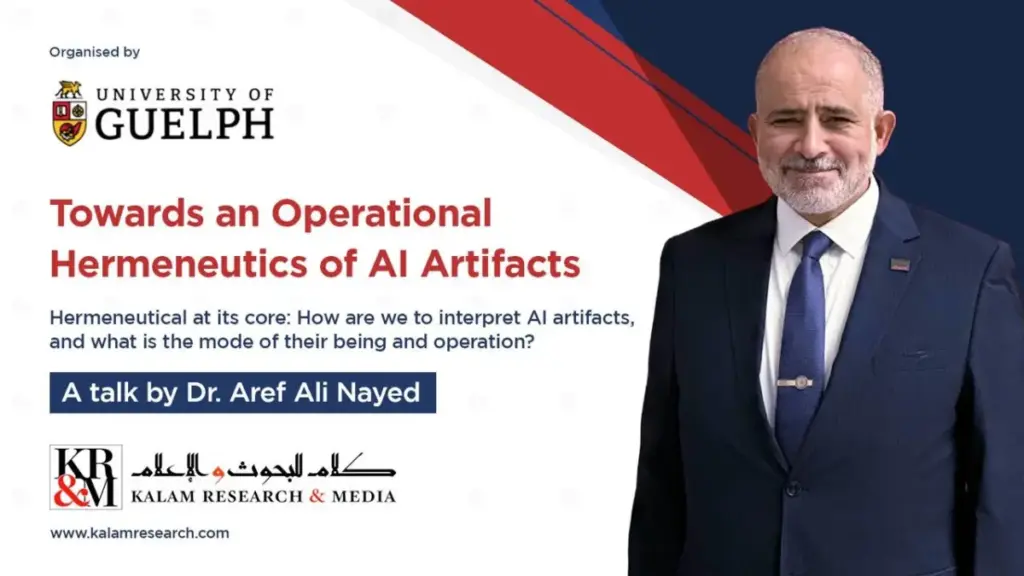
GUELPH, ONTARIO — Dr. Aref Ali Nayed, Chairman of Kalam Research & Media (KRM), recently delivered a prominent academic lecture at the University of Guelph, offering deep insights into the intersection of hermeneutics, artificial intelligence, and the ethical governance of emerging technologies. The presentation marked a significant homecoming for Dr. Nayed and served to strengthen international academic bridges between research institutions focused on the responsible development of machine intelligence.
About the Lecture
The lecture served as an exploration of how Operational Hermeneutics—a theoretical framework originally developed by Dr. Nayed during the 1990s precisely at the University of Guelph—provides essential tools for understanding and ethically engaging with AI-generated artifacts. During his presentation, Dr. Nayed discussed the ways in which modern artificial intelligence systems function not merely as computational tools, but as operational artifacts that actively interpret, generate meaning, and shape human understanding.
As society grapples with the rapid proliferation of machine-generated content, the lecture underscored the urgent necessity for robust interpretive frameworks. Dr. Nayed explained that because AI systems synthesize and output information through complex algorithmic processes, human society requires sophisticated hermeneutical models to evaluate the validity, origin, and ethical implications of these digital creations. The presentation addressed how human-AI interaction transforms traditional notions of authorship, interpretation, and truth, calling for a proactive approach to technological governance that prioritizes human dignity and moral responsibility.
Related Initiatives and Institutional Collaboration
This comprehensive lecture formed a core component of Dr. Nayed’s broader engagement with the Centre for Advancing Responsible and Ethical Artificial Intelligence (CARE-AI) at the University of Guelph. His visit and subsequent discussions successfully reinforced ongoing collaborations between Kalam Research & Media and prominent Canadian AI research institutions. These institutional partnerships are centrally focused on developing rigorous ethical frameworks to guide the future trajectory of artificial intelligence research and commercial deployment.
The engagement with CARE-AI highlights a growing international recognition that technological innovation must be matched by equally rigorous philosophical and ethical inquiry. By bridging the gap between Middle Eastern research entities like KRM and Canadian academic centers of excellence, these collaborative efforts aim to foster a global dialogue on the governance of emerging technologies, ensuring that artificial intelligence remains aligned with human values and societal well-being.
Further Reading and Academic Contributions
Expanding directly upon the critical themes addressed during his University of Guelph lecture, Dr. Nayed has recently published a comprehensive academic monograph titled “Towards an Operational Hermeneutics of AI Artifacts.”
The newly released paper provides an in-depth examination of how AI-generated outputs must be understood as operational artifacts that demand active hermeneutical engagement rather than passive consumption. Within the monograph, Dr. Nayed proposes innovative frameworks designed to assist scholars, technologists, and policymakers in interpreting machine-generated content accurately. Furthermore, the paper confronts the profound ethical dimensions inherent in contemporary human-AI interaction, offering a structured approach to mitigating the risks associated with algorithmic bias, misinformation, and the erosion of authentic human communication.
The University of Guelph Partnership and Intellectual Homecoming
The University of Guelph holds a profound and unique significance within Dr. Nayed’s broader intellectual journey. It was on this very campus during the 1990s that he originally formulated and developed the foundational concepts of Operational Hermeneutics during his doctoral research. His return to Guelph represents a powerful homecoming of ideas, bringing decades of academic refinement, practical testing, and global application back to their historical birthplace.
Today, those foundational concepts are being successfully adapted to meet the unprecedented contemporary challenges posed by AI ethics. KRM’s enduring partnership with the University of Guelph and CARE-AI forms an integral part of a much broader, interconnected network of collaborations with leading Canadian AI institutions. This network actively includes prestigious bodies such as the Vector Institute for Artificial Intelligence and the Canadian Institute for Advanced Research (CIFAR), creating a dynamic ecosystem for interdisciplinary research.
KRM’s Groundbreaking Research in Artificial Understanding
While the vast majority of conventional artificial intelligence research remains narrowly focused on optimizing machine performance, processing speed, and computational efficiency, Kalam Research & Media has taken a fundamentally different path. KRM has pioneered advanced research in Artificial Understanding (AU)—a distinctive and philosophical approach that asks fundamental questions regarding comprehension, meaning, interpretation, and intentionality within artificial systems.
Grounded firmly in the principles of Operational Hermeneutics, KRM’s specialized Artificial Understanding research program seeks to transcend traditional technical metrics. The program is designed to explore how artificial systems might genuinely comprehend context rather than merely simulate language patterns, bridging the chasm between raw data processing and true human-like interpretive capacity. Through these sustained research efforts, KRM continues to contribute vital perspectives to the global discourse on artificial intelligence, ensuring that technological advancement proceeds hand in hand with deep ethical reflection and philosophical clarity.