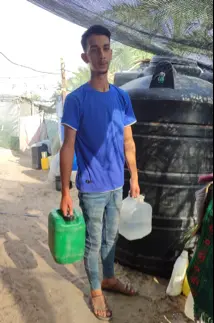
GAZA — Long before the quiet corners of his maternal grandparents’ home were shattered by shelling, Muhammed’s world was defined by the simple rhythms of childhood. He attended school regularly, threw himself into his studies with fierce dedication, and spent his sunlit afternoons swimming and playing football with his friends and cousins. Surrounded by a loving and supportive family, his younger sisters grew up in an environment where safety was second nature.
That sense of security vanished the moment the conflict arrived.
Forced to flee with little more than the clothes on their backs, Muhammed’s family found themselves thrust into the harsh reality of displacement in Gaza. Having lost his father when he was just two years old, Muhammed suddenly had to shoulder an immense burden. Today, he tries his best to be a pillar of strength not only for his two younger sisters, but also for his aging grandfather, navigating the daily trials of survival from the confines of a fragile tent.
Despite the destruction of his home and the overwhelming physical hardships of camp life, Muhammed has steadfastly refused to give up. In a landscape where everyday existence requires grueling effort—fetching water from afar, collecting firewood for cooking, and enduring the acrid smoke that hangs heavy in the air and strains their breathing—he continues to look toward tomorrow. In a small living space that offers little to no protection against the biting cold and driving rain, he holds fast to a singular belief: that education is his most powerful tool to build a better future for himself and his family.
Determined to Continue His Education
The daily realities of life in a displaced persons tent are exhausting and unforgiving. Yet, when it came to his education, Muhammed maintained an unbreakable resolve.
To take his high-school exams, he walked long distances each day simply to find a stable connection to the internet. Upon returning to the damp, freezing confines of his family’s tent, he seized every quiet moment he could find to review his notes and prepare for his classes. The conditions were far from ideal; studying required intense concentration amid the chill of winter and the constant disruptions of camp life.
Ultimately, his extraordinary perseverance paid off. Muhammed graduated from high school with an impressive score of 84 percent—an achievement made all the more remarkable by the profound instability and adversity under which he studied.
The successful completion of his secondary education opened the door to university, bringing a renewed sense of hope to the young man and his dependents. His first semester was provided free of charge, allowing him to take his first steps toward a higher education by enrolling in a digital marketing course.
However, the path ahead remains steep. As he looks toward subsequent semesters, Muhammed faces mounting anxiety over how he will manage future tuition fees. Beyond institutional costs, he urgently needs a reliable laptop to complete his coursework, research assignments, and fully participate in his chosen field of study. For Muhammed, earning a university degree is not merely about personal accomplishment or acquiring a professional qualification; it represents a vital lifeline to secure stable employment, achieve financial independence, and lift his family out of ongoing vulnerability.
Islamic Relief’s Orphan Sponsorship Provides Vital Support
Amid the ongoing crisis, the support systems surrounding vulnerable families have become critical to their survival. For Muhammed and his household, the monthly sponsorship he receives through Islamic Relief has emerged as a cornerstone of stability during an exceptionally turbulent period.
The financial assistance helps the family meet their most essential daily needs, easing the crushing financial pressures that accompany long-term displacement. By alleviating some of these immediate burdens, the sponsorship affords Muhammed the necessary breathing room to concentrate on his academic commitments and maintain his focus on the future.
The demand for such life-saving interventions has surged exponentially across the region. Before the current crisis, Islamic Relief was actively supporting 8,700 sponsored orphans. Today, through the mobilization of resources and the generosity of global donors, the organization’s program supports nearly 25,200 orphaned children—representing an increase of approximately 190 percent. Thanks to this widespread backing, the organization has effectively tripled the number of children it supports inside Gaza.
Despite these expanded efforts, the scale of need remains immense. Currently, more than 5,100 orphaned children remain on Islamic Relief’s waiting list, urgently hoping for the lifeline that sponsorship provides.
A Family Still in Urgent Need
While Muhammed strives to secure an independent future through his education, the immediate living conditions inside the family’s tent remain dire and precarious.
The family is in desperate need of safer, more secure shelter to withstand the worsening winter weather. A larger tent, coupled with heavy-duty protective coverings, would provide essential shielding from the persistent rain, wind, and freezing temperatures that threaten their health.
Beyond shelter, the household lacks basic domestic items necessary for daily dignity. They require durable mattresses, warm blankets, adequate storage solutions for their meager clothing and personal belongings, proper cooking equipment, and seasonal winter clothing and shoes for Muhammed and his younger sisters.
For Muhammed specifically, access to a laptop and assistance with future university tuition fees are paramount. Without these resources, his hard-won opportunity to pursue higher education hangs in the balance, threatening to derail the very future he has fought so hard to protect. Fulfilling these basic requirements would grant the family a degree of safety and stability, allowing Muhammed to stay enrolled and continue working toward his ambitions.
Holding on to Hope
Muhammed has lost his childhood home, his neighborhood, and the predictable life he once knew. Yet, through every hardship, he has preserved his conviction that knowledge and learning can transcend physical destruction.
His unwavering dedication to his studies while navigating the uncertainties of displacement serves as a testament to his resilience and his profound commitment to transforming his family’s circumstances. With sustained assistance, young people like Muhammed are better equipped to safeguard their education, protect their ambitions, and maintain hope for the days ahead.
Through ongoing donor support, organizations like Islamic Relief continue to serve as a vital lifeline for orphaned children and vulnerable families throughout Palestine, ensuring that resilience is met with the tangible resources needed to endure and rebuild.