November 6, 2025
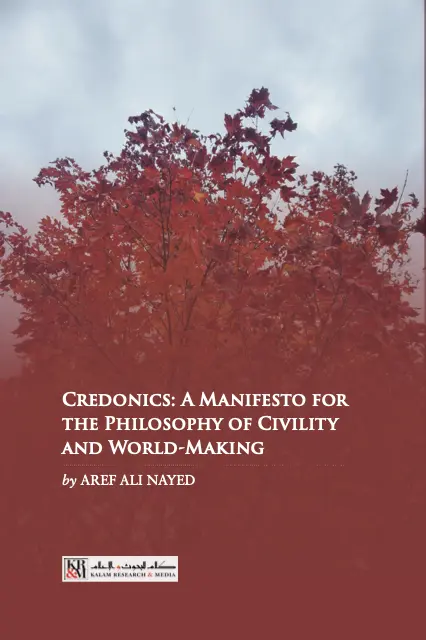
In a significant development for contemporary philosophy and cultural studies, Dr. Aref Nayed has introduced a comprehensive new monograph detailing "Credonics"—a groundbreaking discipline designed to move beyond the perceived shortcomings of traditional memetics. Spanning forty-three pages, the newly released publication offers a rigorous alternative for understanding how human civilizations transmit meaning, tradition, and culture across generations.
The release of the monograph addresses what scholars have long identified as a critical gap in the study of human societies. While previous decades saw extensive attempts to analyze cultural transmission through the lens of memetics—treating cultural ideas as isolated units replicating much like genes—critics and scholars have increasingly viewed that framework as overly reductionist and superficial. Credonics steps into this intellectual space by offering a more holistic, systematic approach to the deep structures that govern societal thought and action.
At the core of the new discipline is the systematic study of credos. Rather than viewing culture as a collection of floating ideas or viral information, Credonics defines credos as intricate clusters of presuppositions, foundational assumptions, and deeply lived commitments that act as the structural "cultural DNA" of civilizations. These foundational credos are responsible for generating the mechanisms by which societies make sense of reality, create lasting meaning, build overarching narratives, and construct complex social worlds.
To operationalize this new field of study, the framework outlines a foundational architecture known as the "Fourfold of Making." This conceptual model breaks down the cognitive and cultural processes of civilization into four interconnected dimensions. The first dimension is sense-making, which concerns the organization of human perception in the face of raw experience. The second is meaning-making, focused on the integration of those experiences into a coherent worldview. The third dimension, narrative-making, provides temporal articulation, allowing societies to connect their past, present, and future into a unified story. Finally, world-making encompasses the tangible realization of these processes through the construction of social institutions, legal systems, and cultural artifacts.
Beyond the mechanics of cultural creation, the monograph addresses the crucial challenge of how distinct cultural systems interact in an increasingly interconnected global landscape. In response, Dr. Nayed introduces a refined concept of civility, defining it far beyond traditional notions of mere politeness. Within the credonic framework, civility is understood as the rigorous discipline of interpretive coexistence—an ethical regulation that enables multiple, divergent credos to interact, negotiate, and coexist within a shared space without resorting to mutual erasure or conflict.
The release of the forty-three-page monograph represents a substantial synthesis of several distinct intellectual traditions. Major contributions of the work include a rigorous critique of memetics for its analytical superficiality, alongside a thoughtful extension of R.G. Collingwood’s historical and presuppositional analysis. Furthermore, the discipline successfully unites modern hermeneutics with the established theories of cultural inheritance, bridging gaps that have historically separated continental philosophy from sociological and historical research.
Given its broad scope, the implications of Credonics extend far beyond academic philosophy, offering immediate and practical applications across a variety of critical modern sectors. One of the most forward-looking applications proposed in the text is credonic governance for artificial intelligence ethics. As artificial intelligence systems become deeply embedded in human society, the framework suggests that aligning AI behavior with human values requires an understanding of underlying credos rather than superficial rule-following.
In addition to AI ethics, the monograph provides robust frameworks for educational reform, political pluralism, civilizational renewal, and intercultural and interfaith dialogue. By mapping out the presuppositions that drive different communities, the discipline aims to foster deeper mutual understanding in diplomacy and education, helping societies navigate ideological polarization and cultural friction.
Scholars, researchers, and professionals interested in exploring the complete theoretical arguments, methodologies, and detailed proposals outlined in the publication can access and download the full forty-three-page monograph directly through the Kalam Research website.