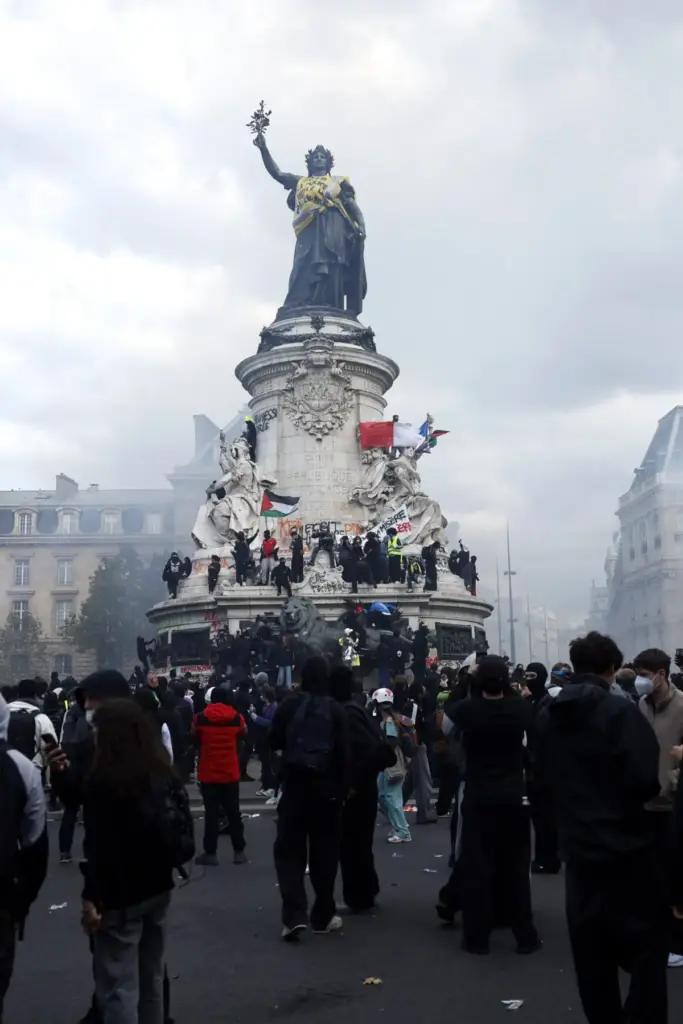
Paris — A wave of nationwide protests and demonstrations has brought widespread disruption to France, as mounting public anger over deteriorating conditions in educational institutions converges with deep-seated frustration over high living costs and a government accused of turning a blind eye to the struggles of ordinary citizens.
The coordinated mobilization, which has drawn participants from a broad spectrum of French society, has transformed public squares and thoroughfares into focal points of dissent. From Paris to regional hubs across the country, citizens have taken to the streets to voice their grievances against an administration they believe has failed to adequately address the socio-economic pressures facing households and public services alike.
The demonstrations represent a convergence of various anti-government movements and labor factions. The mobilization has notably brought together veteran activists from the Yellow Vest (Gilets Jaunes) movement, high school and university students, powerful trade unions, and various grassroots civic groups. This coalition of interests highlights the multifaceted nature of the discontent, which bridges generational divides and unites distinct sectors of the population under a shared banner of economic anxiety and institutional neglect.
At the heart of the current wave of unrest is a potent mixture of economic grievances. Protesters are rallying against soaring living costs, persistently high fuel prices, and a perceived erosion of public services. For many demonstrators, the daily struggle to make ends meet has been exacerbated by inflation and inadequate governmental intervention. The presence of Yellow Vest activists underscores the enduring legacy of a movement that, years after its initial emergence, continues to tap into a deep vein of populist resentment regarding taxation, purchasing power, and the perceived disconnect between the political elite in Paris and the working class in provincial France.
Simultaneously, the education sector has emerged as a central flashpoint for the protests. Teachers, school staff, students, and parents have raised alarms over the deteriorating conditions within French schools. Demonstrators are demanding urgent improvements to educational infrastructure, increased funding, and better working conditions for educators, arguing that years of budget cuts and administrative neglect have severely compromised the quality of learning and the well-being of students. The alignment of student unions with broader labor and anti-poverty campaigns has amplified the urgency of these demands, turning schools and universities into active centers of resistance and debate.
As the protests unfold, the capital city has experienced significant disruptions. In Paris, residents navigating the aftermath of the demonstrations have expressed dismay over property damage and the tangible impact of the unrest on daily urban life. Local reactions reflect a complex sentiment among the populace: while many citizens express sympathy or outright solidarity with the underlying economic frustrations driving the protests, others voice concern over the escalation of tension and the physical toll exacted on city streets by clashes and vandalism.
Journalists on the ground, including reporting teams covering the unfolding events, have documented the tense atmosphere in areas such as the iconic Place de la République, where large crowds have gathered to voice their dissent. Visual and multimedia reports from the demonstrations have captured the scale of the mobilization, illustrating the heavy police presence and the determined resolve of the demonstrators as they demand immediate policy changes from the government.
The current crisis poses a formidable political test for French authorities, who find themselves pressed to respond to a populace that feels increasingly marginalized by economic pressures and institutional decline. As the nationwide mobilization continues to unfold, with labor unions threatening further industrial action and student groups organizing ongoing assemblies, the pressure on the government to pivot from its current trajectory and offer tangible solutions to the cost-of-living and public service crises remains intense.