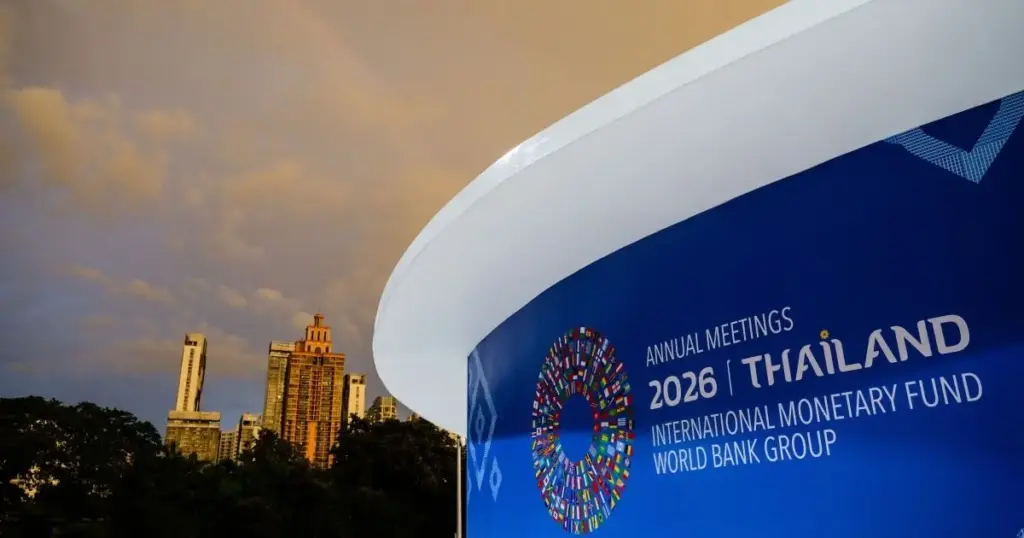
BANGKOK — Finance ministers and central bank governors from the world’s leading economies are gathering in the Thai capital on Thursday for high-stakes discussions against the backdrop of an increasingly uncertain global economic outlook. The meetings, held in Bangkok, are taking place amid severe market jitters and supply chain disruptions driven by the ongoing US-Israel war on Iran.
The high-level gatherings are being conducted in conjunction with the annual meetings of the International Monetary Fund (IMF) and the World Bank. These cornerstone events of global financial diplomacy have brought international policymakers, economists, and central bankers to Bangkok for a week of intensive sessions running from October 12 to October 18. The dialogues are expected to address a cascade of compounding crises, ranging from soaring energy costs and stubborn inflation to ballooning national debt burdens and persistent international trade imbalances.
What are the G20, the IMF and the World Bank?
To understand the weight of the discussions unfolding in Bangkok, it is helpful to look at the institutional framework of global economic governance. The G20 is an premier economic forum comprising 19 of the world’s largest national economies, including the United States, China, the United Kingdom, Australia, Brazil, India, Japan, Indonesia, and Saudi Arabia, alongside two regional bodies, the European Union and the African Union. The grouping operates under an annually rotating presidency, which is currently held by the United States.
Collectively, the member countries of the G20 account for approximately 85 percent of global gross domestic product (GDP) and roughly three-quarters of international trade. The forum was originally established in 1999 as a specialized platform for finance ministers and central bank governors to coordinate responses to shared financial vulnerabilities in the wake of the Asian Financial Crisis. In the years since, it has expanded its footprint into a broader summit-level forum for national leaders to tackle pressing macroeconomic challenges.
Operating alongside the G20 are the IMF and the World Bank, twin institutions born out of the 1944 Bretton Woods conference in the United States. Convened by Allied Powers toward the end of the Second World War, that historic gathering sought to establish the foundational contours of the post-war international financial and monetary order.
Headquartered in Washington, DC, the IMF is an international financial institution dedicated to fostering global monetary cooperation, securing financial stability, facilitating international trade, and promoting sustainable economic growth. Its membership encompasses virtually all of the world’s sovereign states, with only a small handful of exceptions, such as North Korea, Cuba, Vatican City, and Monaco.
The World Bank, also based in the United States capital, serves primarily as a multilateral development lender, providing crucial loans, credits, and grants to developing countries to fund infrastructure, poverty reduction, and institutional reforms. It currently boasts a membership of 189 countries.
Who will be attending the meetings?
The delegations arriving in Bangkok feature many of the most influential figures in international finance. Most finance ministers and central bank governors representing G20 member states are present, alongside IMF Managing Director Kristalina Georgieva and World Bank Group President Ajay Banga.
However, the meetings are missing one of the most prominent officials in global economic policymaking. US Treasury Secretary Scott Bessent is a notable absence from the gatherings. As the chief economic official of the world’s largest economy and the nation holding the current G20 chair, Bessent’s decision to skip the events has drawn considerable attention from international observers.
United States officials have pointed to pressing "domestic engagements" as the reason for Bessent’s absence. In his place, Washington is being represented by Deputy Secretary Francis Brooke and Undersecretary for International Affairs Erin Browne, who carry the mandate of the US administration into the multilateral negotiations.
The gathering in Bangkok holds critical procedural importance. As one of several ministerial-level meetings held by the group throughout the year, these discussions are designed to lay the groundwork and shape the policy agenda for the headline G20 leaders’ summit scheduled to take place in Miami, Florida, on December 14-15.
What is on the agenda?
The economic fallout from the US-Israel war on Iran towers over the entire Bangkok agenda. Military actions and security escalations across the Middle East have profoundly disrupted normal economic activity throughout the region. More critically for the rest of the world, strategic disruptions to maritime shipping through the Strait of Hormuz—a vital global energy chokepoint—have triggered a severe surge in international energy prices.
Crude oil prices have consistently hovered above $100 a barrel for much of the past eight months. This prolonged elevation in energy costs has placed severe financial strains on government coffers and ordinary household budgets alike, creating acute pressure points across the Gulf region and rippling outward into the broader Asian economies heavily reliant on imported oil.
In the lead-up to the official opening of the meetings, Australian Treasurer Jim Chalmers MP spoke candidly about the urgency of the moment. He announced that he would use his time in Bangkok to call for an immediate cessation of conflicts in the Middle East and the urgent reopening of the Strait of Hormuz, asserting that these steps are precisely what the global economy desperately needs to regain its footing.
"The war in the Middle East is having a devastating economic impact and is pushing up fuel prices, inflation and interest rates around the world," Chalmers said in a formal statement released prior to the sessions.
Beyond the immediate geopolitical shocks, policymakers are grappling with structurally high public debt levels. Many major economies are currently shouldering national debt loads that exceed 100 percent of their annual GDP, a threshold that includes the United States, Canada, Japan, Italy, and France.
Addressing this mounting vulnerability, IMF Managing Director Kristalina Georgieva delivered a sobering speech on Wednesday. She warned that escalating global debt poses a distinct and present danger to the stability of the world economy. Georgieva cautioned that governments navigating these fiscal tightropes face difficult realities, emphasizing that there is no "magic formula" capable of allowing nations to completely avoid painful policy choices such as tax hikes or sweeping spending cuts.
In addition to these shared macroeconomic concerns, individual G20 members have brought their own specific national priorities and geopolitical grievances to the negotiating table.
The United States has consistently raised alarms regarding what it terms "global imbalances." This terminology serves as a diplomatic reference to China’s state-driven industrial economic model, which Washington argues has enabled Chinese manufacturers and exporters to flood international markets with heavily subsidized, low-cost goods.
US President Donald Trump has long maintained that China’s massive trade surplus—which reached a cumulative $938bn in September—is tangible proof that the rules of international trade are systematically stacked against American manufacturers and workers.
In a written statement addressed to the IMF on Wednesday, US Treasury Secretary Scott Bessent echoed these longstanding grievances, calling for concrete international action to address mismatched trade balances and distortions in the global marketplace.
"This especially includes strengthening its analysis and engagement on the role non-market policies and practices and exchange rates play in driving external imbalances," Bessent stated. "Policymakers around the world are having difficult discussions about how to sustain market-based systems amid distortionary policies from some economies that skew competition and hurt employment."
Despite the pressing need for coordinated international action, deep-seated geopolitical divisions and competing national interests continue to cloud the prospects for consensus. Friction among major powers has frequently paralyzed diplomatic communiques. A clear demonstration of these fractures occurred at the previous meeting of G20 finance ministers, held in Asheville, North Carolina, on August 31 and September 1. At that gathering, member countries ultimately failed to issue a joint communique after Beijing strongly objected to proposed language concerning international trade practices.
As discussions continue through the week in Bangkok, delegates face the formidable challenge of bridging these ideological and economic divides to chart a viable path forward for a fractured global economy.