TEHRAN — Across the sprawling avenues and neighborhoods of Tehran, a striking visual campaign has dominated the public landscape. Banners emblazoned with the provocative text, “Do you know how to work with this?” peer down from billboards and overpasses, accompanied by stark imagery of rocket-propelled grenades, sniper rifles, assault weapons, and various pieces of military and communications hardware.
This pervasive public messaging campaign is the visible tip of a much larger state-driven initiative designed to recruit, train, and arm volunteer civilians. Operating under the umbrella of the Basij militia—itself a subordinate arm of the powerful Islamic Revolutionary Guard Corps (IRGC)—the effort seeks to integrate ordinary citizens into the state’s security apparatus as geopolitical tensions remain high.
The Islamic Republic first introduced these messages during a sweeping mobilisation drive known as Janfada, or "those who sacrifice their life," launched in late March at the height of military escalations involving the United States and Israel.
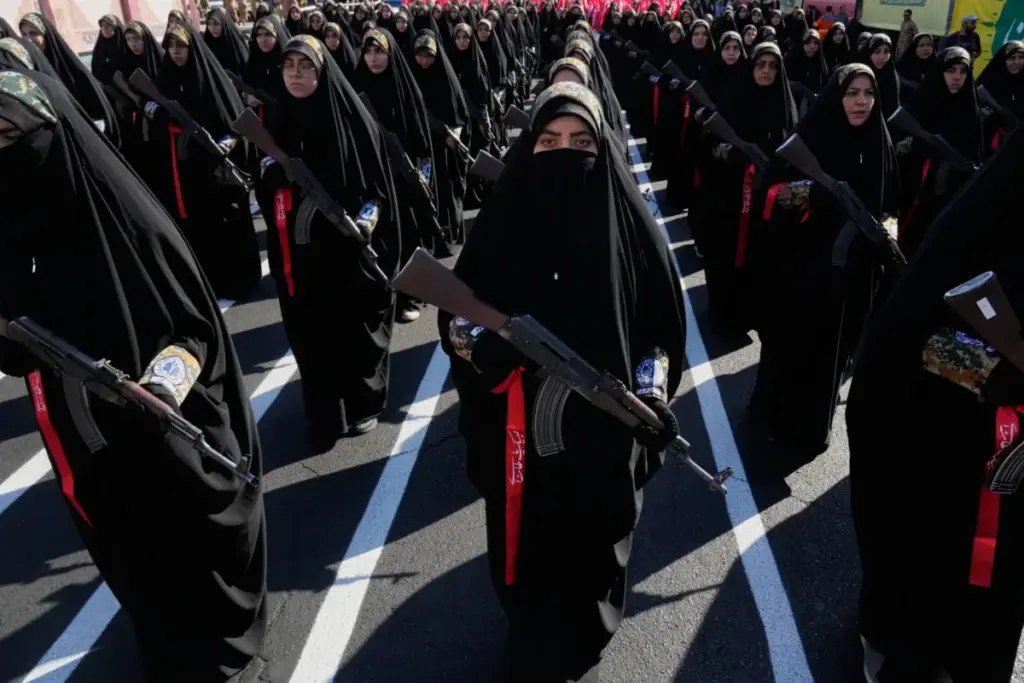
The campaign culminated in its first major public demonstration on Friday, when thousands of recruits marched through downtown Tehran. Described by the authorities as a "military exercise," the procession featured a sea of participants—including children, women, and men—many of whom marched with masked faces and sunglasses.
Ahead of the event, state officials predicted an turnout of 313,000 people. While footage broadcast by state television did not definitively corroborate that precise figure, the number carries deep symbolic weight in Twelver Shia tradition, representing the core companions of Mahdi, the messianic hidden imam believed by the faithful to reappear near the end times to establish global justice.
Hassan Hassanzadeh, the head of the IRGC in Tehran, reported to state broadcaster IRIB that more than 600,000 individuals had registered for the active mobilization portion of the campaign through an online portal within a single week. State authorities have publicly stated they anticipate total sign-ups to eclipse one million, noting that an initial 1,000 units, formally designated as "battalions," have already been established.
The Janfada campaign previously courted international skepticism and domestic debate just a month after its inception in March, when officials claimed that an astonishing 31 million people—representing slightly more than a third of Iran’s entire population, or over half of all citizens aged 12 and older—had registered.
Independent analysis by foreign-based activists who examined the registration website’s source code suggested that the actual number of registrants was closer to four million. Furthermore, analysts pointed out that the portal required only a telephone number to complete registration, omitting the need for a national identification number. Following public scrutiny over the figures, the live-updating recruitment ticker on state media slowed significantly. However, IRGC commander Hassanzadeh asserted on Friday that cumulative registrations had reached 33 million, though authorities have yet to publish verifiable documentation to substantiate the claim.
Organizers have emphasized that the mobilization effort extends beyond purely military applications. According to state reports, approximately 26 percent of registrants opted for combat and security training, while others channeled their participation into auxiliary sectors including rescue operations, social services, media outreach, and financial support.

This push for civic mobilization coincides with severe domestic challenges. During Friday’s parade, President Masoud Pezeshkian appealed directly to the assembled volunteers to assist his administration by conserving fuel, electricity, and other essential resources. The country is currently grappling with a compounding energy imbalance and broader economic instability.
Earlier in the month, the government raised fuel prices and restricted gasoline quotas for personal vehicles as it attempts to manage a stringent budget deficit and fuel production shortfalls directly linked to the ongoing war. Iranian households and industrial sectors have likewise suffered from rolling power blackouts throughout the summer months, with the impending cold season threatening to exacerbate natural gas shortages across the resource-rich nation.
Focus on Children and Youth
A prominent and controversial aspect of the Janfada mobilization drive in Tehran has been its deliberate focus on children and teenagers. During Friday’s military exhibition, several young teenagers were seen carrying assault rifles and other weaponry within the procession, while others participated in the marching ranks. Over recent months, armed teenagers have occasionally been observed managing checkpoints and roadblocks across Tehran and various other Iranian cities.
Sasan Zare, the official spokesman for the Janfada campaign, told the state-linked Iranian Labour News Agency that boys aged 15 and older are officially permitted to register, with future plans under consideration to incorporate children under the age of 15 into the fold.
"Our effort concerning children and teenagers, first and foremost, is to introduce them to the culture of sacrifice and resistance," Zare stated. "The stronger their value system is formed from childhood, and the more they become familiar with concepts like patriotism and self-sacrifice, the more significant the impact can be on their future."
Women also figured prominently in the Friday parade. Numerous volunteers clad in traditional chadors marched alongside their male counterparts, with many handling weapons on the public streets. Notably, some female participants were documented riding motorcycles during the demonstration, an activity traditionally prohibited for women in everyday Iranian civil life.
Strategic Context and Purpose
The public parade also served as a showcase for domestic military hardware utilized in the ongoing conflict with the US and Israel. These developments unfold against a backdrop of persistent friction over the geopolitical future of the Strait of Hormuz and the ultimate resolution of the war. The United States continues to enforce a naval blockade against Iran’s southern ports alongside an intensified regime of economic sanctions.
Mohsen Rezaei, Iran’s security chief, told Al Jazeera that a set of seven formal conditions for potential negotiations had recently been transmitted to Washington via diplomatic intermediaries, though he maintained that military commanders remain fully prepared to resume hostilities if necessary.
Despite the grand scale of the mobilization, Iranian authorities have offered limited explanation as to why hundreds of thousands of civilians are being recruited into armed and auxiliary security roles at a time when a direct ground invasion by the US is widely considered unlikely.

The campaign arrives several months after thousands of people were killed during widespread nationwide protests in January—unrest that the Iranian government has consistently characterized as a foreign-orchestrated "coup" fomented by the US and Israel alongside domestic agents acting in alignment with foreign interests.
Simultaneously, international pressure regarding human rights has mounted. A United Nations fact-finding mission alleged on Friday that the Islamic Republic committed crimes against humanity during its suppression of the protests. Additionally, Amnesty International released an extensive report identifying dozens of senior Iranian officials allegedly implicated in crimes against humanity during the 2022–2023 nationwide demonstrations sparked by the death in police custody of Mahsa Amini, a young woman detained for allegedly wearing her hijab improperly.
In light of this domestic history, Iranian authorities have issued repeated warnings against public unrest, underscoring that any actions perceived as threats to national security or public order remain strictly prohibited.
Ali Alfoneh, a senior fellow at the Arab Gulf States Institute, offered an analytical perspective to Al Jazeera, suggesting that the Janfada campaign functions primarily as a rebranding effort for the Basij militia, an organization whose public standing has been deeply affected by its role in suppressing domestic dissent.
Alfoneh noted that following the outbreak of the Iran-Iraq War in 1980, hundreds of thousands of Iranians enthusiastically volunteered for front-line military service driven by genuine religious and patriotic fervor, a mobilization largely channeled through the Basij.
"Since the end of the war in 1988, however, the Basij has evolved into an instrument of domestic coercion and the suppression of dissent, severely damaging the organisation’s public image," Alfoneh said.
Consequently, he argued, the current public mobilization drive can be understood as an attempt to reconstruct the Basij’s historical patriotic identity in anticipation of both external and internal challenges—serving as a hedge against the possibility of a US- or Israeli-instigated civil conflict in Iran’s peripheral border regions, as well as large-scale popular uprisings fueled by worsening economic pressures at home.