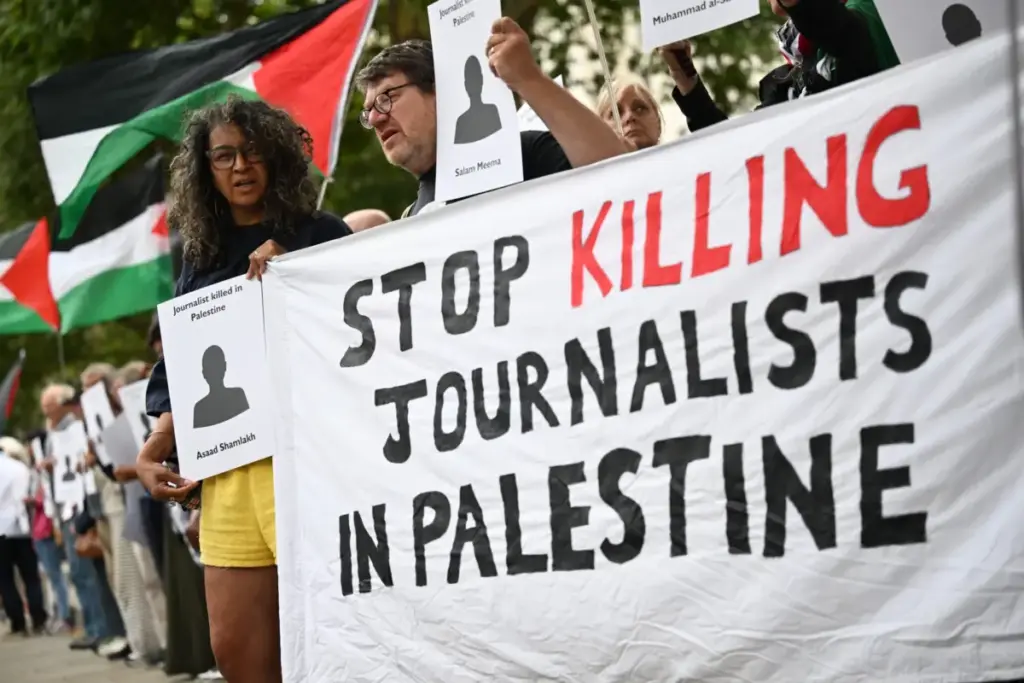
LONDON — Hundreds of journalists, trade unionists, human rights defenders, and supporters of Palestinian rights gathered in anguish outside Downing Street on Whitehall on Wednesday, uniting in a powerful vigil to mourn the Palestinian journalists and media workers slain by Israeli military forces in Gaza.
Organized by the Freelance Branch of the National Union of Journalists (NUJ), the solemn demonstration drew crowds carrying banners bearing the names of fallen Palestinian reporters. These media workers paid the ultimate price while doing their jobs, risking their lives daily to document and report the true scale of the plight, destruction, and suffering experienced by the civilian population in the Gaza Strip.
Ahead of the gathering, senior NUJ officials delivered an official letter to No. 10 Downing Street. The correspondence explicitly outlined the union’s expectations of the UK government, demanding urgent action and greater accountability regarding the protection of reporters and journalists operating in conflict zones. Among the notable political figures present at the demonstration in solidarity was Labour MP and NUJ parliamentary group secretary John McDonnell, standing shoulder-to-shoulder with members of the press and civil rights advocates.

The demonstration followed a devastating wave of recent casualties among media personnel in Gaza. Earlier in the week, strikes hit the Nasser Hospital, resulting in the deaths of several journalists who worked for major international media outlets, including Reuters, The Associated Press, Middle East Eye, and Al Jazeera. The fatalities at the hospital did not mark the end of the day’s toll; a sixth journalist, Hassan Douhan, who served as a correspondent for the Al-Hayat al-Jadida newspaper, was killed in a separate military strike later that same Monday in Khan Younis.
Speakers at the Whitehall vigil delivered impassioned addresses condemning the ongoing slaughter of reporters and lambasting the international community for its perceived inaction and double standards. Former BBC and LBC presenter Sangita Myska took to the microphone to highlight the death of prominent Al Jazeera correspondent Anas Al-Sharif, whose reporting had been a vital lifeline for global viewers seeking on-the-ground truths from the enclave. Myska recalled that despite Al-Sharif being formally listed as facing a high risk of death by the Committee to Protect Journalists (CPJ), he was left unprotected and was ultimately killed on August 10.
"Governments neither said anything nor did anything about this," Myska told the hushed and grieving crowd. She noted that Israel had unjustifiably labeled Al-Sharif as a terrorist, stressing that the military campaign continues to pose direct, ongoing threats to the lives of journalists reporting from the region. Describing Palestinian journalists as "the bravest people in the world," Myska praised their unwavering dedication to their craft, noting that they continue their essential work despite relentless attacks and intimidation, even as Western institutions often appear to belittle their profound professional sacrifices.

Myska went on to sharply criticize Western media coverage and institutional hypocrisy regarding the targeted killings of journalists in conflict zones. Drawing a stark comparison to illustrate her point, she challenged the crowd and the wider media landscape: "If Russia had killed five journalists on live broadcast, do you think the British media would have ignored it? I don’t think so. A Palestinian journalist being killed is not just the death of one person — it is the death of journalism."
Pennie Quinton, chair of the London Freelance branch of the NUJ, delivered another compelling speech demanding concrete measures from the UK government. Her demands included formal British support for an active investigation by the International Criminal Court into what she described as the blatant and systematic targeting of journalists and media workers by the Israel Defense Forces.
The gathering also heard from Palestinian journalist Ahmed Alnaouq, who offered a searing assessment of the impunity enjoyed by the attacking forces. "Why does Israel kill journalists? Because it can. Because it knows it will answer to no one. Because reality is its greatest enemy," Alnaouq told the attentive crowd. "As long as no one opposes them, unfortunately, Israel will continue killing Palestinians. The Palestinian journalists who were killed will not be forgotten; their stories will continue to be told, and we will shout their names."

NUJ General Secretary Laura Davison also addressed the mourners, paying tribute to the extraordinary courage of those documenting the conflict under unimaginable conditions. "We owe a collective debt to those reporting from Gaza in the most horrendous of circumstances," Davison said. "They are representing our profession — that commitment to reporting what is happening on the ground whatever the cost. And they have paid the price. They are the eyes and ears of the world on the ground."
The emotional memorial concluded with the ceremonial reading of the names of the deceased journalists, followed by a traditional funeral prayer performed in absentia. The London demonstration was mirrored by similar solidarity vigils held across the United Kingdom, including in Belfast, Edinburgh, and Cardiff, as media workers nationwide united in grief and protest.
The recent fatalities among media personnel in Gaza have pushed the total number of Palestinian journalists killed in Israeli military attacks since October 2023 to 270. This staggering loss of press life unfolds against the broader backdrop of an unprecedented humanitarian catastrophe in the coastal enclave. According to local and international humanitarian assessments, more than 62,700 Palestinians have been killed in Gaza since the outbreak of hostilities in October 2023. The relentless military campaign has devastated the territory’s infrastructure, leaving the surviving civilian population facing severe shortages of food, medicine, and clean water, with widespread famine gripping the region.

International legal scrutiny surrounding the conflict continues to mount. Last November, the International Criminal Court issued arrest warrants for Israeli Prime Minister Benjamin Netanyahu and his former Defence Minister Yoav Gallant, citing reasonable grounds to believe they bear criminal responsibility for war crimes and crimes against humanity committed in Gaza. Additionally, Israel faces an ongoing genocide case brought by South Africa at the International Court of Justice concerning its military operations in the Palestinian enclave.