Dhading, Rasuwa, Nuwakot, Nepal — As nine-year-old Ram Thakur walked uphill with his mother and dozens of other residents fleeing surging floodwaters on August 26, he looked back and saw brown water violently chasing them.
So they started running. His mother, who had been holding his hand until then, gripped it tighter to help him climb faster. Then, as the terrifying sounds of the swirling, roaring water mingled with the desperate shouts of those around them, she yelled her final instruction to her son: "Chhito maathi hinda, pachhaadi na-hera," Nepali for "Climb up faster, don’t look behind."
That is precisely what Thakur did, scrambling higher and higher up the treacherous slope until he finally dared to look back. The muddy water was still gurgling close by, but his mother was no longer there.
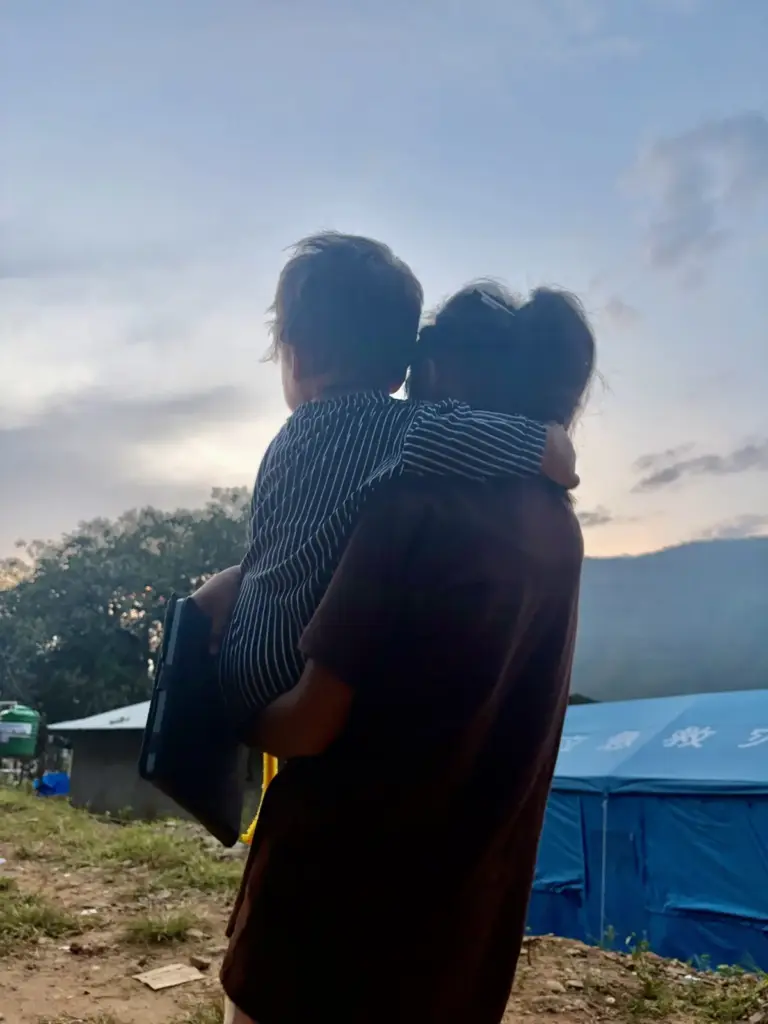
Nearly four weeks later, Thakur is still waiting—hoping against hope—for his mother and father to return. He is currently living in a government primary school converted into a temporary shelter house in the Nuwakot district of Nepal, sharing the space with 26 other children who share a similarly heartbreaking fate.
They are among more than 500 children currently living in various temporary shelter homes scattered across Nepal’s flood-affected districts, with their parents either confirmed dead or missing. Under Nepali law, an individual must be missing for a daunting 12-year period before they can be officially declared dead by the state. While the law does offer an exemption from this waiting period during sudden natural disasters, availing of it requires relatives to formally apply to a district court for a judicial declaration of death.
For now, Thakur and hundreds of other children like him live in a painful legal and emotional limbo. Legally, they are not yet considered orphans because their parents’ official statuses remain unresolved. But in practice, they are utterly without their parents—a devastating reality that has defined their lives since the catastrophic late-August floods that claimed the lives of more than 1,400 people and left at least 5,000 others missing across the Himalayan nation.

"They should have come by now"
The morning of August 26 had begun like any other ordinary school day for young Thakur. He was on his way to school with his mother at approximately 8:00 AM when the sudden disaster struck without warning. Thakur’s father, who worked locally as a mountain guide and driver, was still at home at the time, as his workday typically did not begin until 10:00 AM.
Suddenly, the peaceful morning was shattered by frantic cries echoing through the neighborhood: "Daudanu, baadhi!" which translates urgently to "Run, flood!"
They walked, climbed, and ran for their lives until Thakur was ultimately separated from his mother in the chaos. He subsequently found himself trapped and stranded on a steep hill for a harrowing day and night alongside 13 other survivors before a military helicopter finally arrived to airlift them to safety.
"I was so scared and hungry. I thought I will also die," Thakur recalled, looking down at his empty hands. "My school bag, which had biscuits and a lunchbox, was also gone [in the flood]."
As he sat eating a modest meal of dal, rice, and saag—their standard lunch for the day—with the 26 other children housed at the shelter, Thakur expressed deep confusion as to why his parents still had not turned up to find him.
"Mummy and papa knew how to swim, so they should have come by now," he reasoned aloud, echoing the innocent logic of a child grappling with an unimaginable loss.
A psychosocial counselor stationed at the facility noted that Thakur still instinctively bolts toward the open courtyard whenever he hears the familiar thrum of a helicopter hovering nearby, desperately hoping that his parents have finally been rescued and brought back to him.

A post-flood rapid assessment conducted this month by Nepal’s National Child Rights Council, in partnership with the international nonprofit Save the Children, revealed that more than 1,000 children were sheltering in temporary camps. This total includes more than 100 children who are entirely unaccompanied by any relatives, as well as 439 children who are separated from their parents but are staying with extended family members, according to Ayush Joshi, program director for Save the Children in Nepal.
In total, more than 32,000 children have been displaced by the severe monsoon floods. Local government officials and international humanitarian organizations are working around the clock to trace missing family members and safely reunite displaced children with their relatives, said Leon Muwoni, head of child protection at UNICEF Nepal.
Thus far, relentless tracing efforts have successfully reunited 18 children with their parents, Muwoni noted.
"She does not speak to anyone"
The primary school shelter where Thakur currently lives has been partitioned into eight functional rooms to accommodate the displaced youth. Six of these rooms have been thoughtfully prepared by local nonprofit organizations, outfitted with waterproof sleeping mats, comfortable bedding, and soft toys, while workers labor to construct sturdy bunk beds for the children. A seventh room serves as a secure storage depot for food rations, and the eighth operates as a communal kitchen.
Most of the daily operations and security at the shelter are managed by personnel from the Nepal Police, working alongside representatives from humanitarian nonprofits. A dedicated female counselor is also stationed on-site full-time to provide much-needed mental health support.
Roughly 100 kilometers (60 miles) away at another children’s shelter established in the Dhading district, four-year-old Shibani Tama has retreated into a shell of silence, no longer speaking at all. Both of her parents were confirmed killed in the rushing torrents.
Caregivers at the Dhading facility report that the toddler barely retains any memories of the neighborhood she once called home, nor does she recognize her extended relatives, none of whom have stepped forward to claim or care for her. All that Shibani has been able to communicate to rescue teams and counselors is that she was sitting in her classroom when her teachers frantically instructed her and her schoolmates to rush uphill.

"She does not speak to anyone. Doesn’t let anyone comb her hair, too. Barely lets us change her clothes in two to three days after insisting," said Yamuna Bhattarai, a resident caregiver at the shelter. "It is very disturbing to see her and others who are in extreme shock. All of them are in dire need of psychosocial help."
"Only ones for each other now"
The catastrophe has forced many young survivors into premature adulthood. Numerous children who lost both parents have never previously had to wash their own hair, change their clothes, or feed themselves. Others have unexpectedly found themselves responsible for protecting and comforting younger siblings while still grappling with their own profound trauma.
Ten-year-old Sanju Lama was traveling toward her grandmother’s house accompanied by her two-year-old baby brother in the Rasuwa district—statistically the hardest-hit area during the floods—when helpful strangers intervened, pulling them both to safety as their family home was entirely swallowed by the muddy deluge. Her parents, who should have been safely indoors when the disaster struck, remain missing.
"Sanju gets shocked by loud sounds, even when her name is called out," Bhattarai said, describing the child’s acute anxiety. "She keeps holding her little brother’s hand tight, almost all the time. At night, she often wakes up scared."
During the daylight hours, the young girl tries to create a semblance of normalcy by reading English poetry aloud to her toddler brother. "They are the only ones for each other now," Bhattarai observed quietly.
According to figures released by UNICEF, the disaster has severely crippled the region’s educational infrastructure. Across the affected districts, 18 schools have been completely destroyed, and another 20 have sustained heavy structural damage, depriving thousands of children of safe physical spaces to learn, play, and recover from their trauma. Furthermore, dozens of other schools situated perilously close to swollen riverbanks remain highly vulnerable to future erosion and flooding. An estimated 10,000 school-age children now face an exceptionally uncertain educational future.
Help falling short
Despite the mobilization of nonprofits, counselors, and childcare workers inside the converted primary school shelters in Dhading and neighboring districts, experts acknowledge that current efforts to help children feel genuinely safe and comfortable are frequently falling short of what is truly required.

While relief organizations have successfully distributed books, educational supplies, and play materials, humanitarian workers note that very few children are actually utilizing them. Many remain deeply withdrawn, mentally distracted, or simply too emotionally overwhelmed to engage in play.
Joshi of Save the Children noted that while volunteers have distributed toys and study materials to shelters, sobering behavioral patterns have emerged among the youth. In some instances, volunteers have observed children whose parents are missing "making and setting up families with parents in the dollhouses," acting out their deep yearning for familial stability.
"These children probably don’t even understand what exactly has happened or why," Joshi said. "They are clueless about the next day, and the future in totality."
Compounding the psychological toll is the physical reality of overcrowded shelters, where families and unaccompanied children live in close quarters with minimal personal privacy. At the same time, child protection authorities and humanitarian agencies face a delicate dilemma, exercising extreme caution before releasing children into the custody of adults claiming to be relatives.
"Some of the children whose relatives have been located are kept in shelters if those relatives cannot provide sufficient documentation or proof of guardianship, to avoid the risks of trafficking or child labour," explained Leon Muwoni of UNICEF.
Back at the shelter home in Nuwakot, Thakur sat quietly on the front porch as an evening snack sat untouched on his lap. His wide eyes gazed fixedly into the brilliant orange sky of the setting sun, silently scanning the horizon for the familiar silhouette of a rescue helicopter carrying his parents back to him. But as twilight faded, it was only the cold mountain darkness that arrived, bringing no choppers, and no answers.