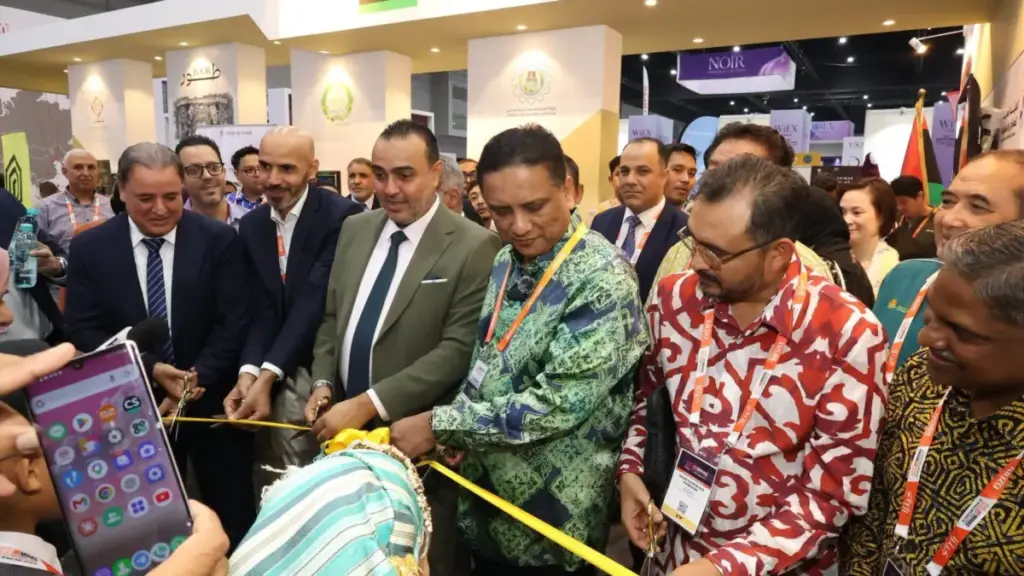
KUALA LUMPUR — Libya has marked a significant milestone in its international trade relations by making its debut appearance at the Malaysia International Halal Showcase (MIHAS), establishing a national pavilion at the prestigious trade event for the very first time. This strategic move comes as both nations actively seek to build upon a remarkable and sharp increase in bilateral commercial activity over recent years, signaling a new chapter of economic cooperation between Southeast Asia and North Africa.
The official inauguration of the Libya Pavilion took place on Thursday, led by Datuk Seri Reezal Merican Naina Merican, chairman of the Malaysia External Trade Development Corporation (MATRADE). The ribbon-cutting ceremony was held during the grand opening of the 22nd edition of MIHAS, hosted at the sprawling Malaysia International Trade and Exhibition Centre (MITEC) in the heart of Kuala Lumpur. The historic arrival of the Libyan delegation at the world’s premier halal exhibition highlights a mutual desire to deepen economic ties and explore untapped markets across different regions.
The introduction of the Libyan pavilion arrives at a time when commercial ties between Malaysia and Libya have undeniably gained strong momentum. According to official figures released by MATRADE, bilateral trade between the two countries reached an impressive RM1.03 billion in 2025. This figure represents a phenomenal increase of 38.9 percent compared to the previous year, demonstrating the rapidly expanding economic bridge connecting Kuala Lumpur and Tripoli.
Furthermore, Malaysian exports to Libya have continued on an aggressive upward trajectory this year. Data for the first eight months of 2026 indicates that Malaysian exports rose by a staggering 73.4 percent when compared to the corresponding period a year earlier, touching RM106.5 million. A closer look at the trade composition reveals that machinery, equipment and parts, chemicals and chemical products, as well as palm oil and palm oil-based agricultural products, stood firmly among the primary export categories driving this impressive growth.
Behind the scenes, the newly established pavilion is jointly organized by the Tripoli Chamber of Commerce, Industry and Agriculture, alongside Libya’s General Authority for Exhibitions and Conferences. This collaborative effort underscores the seriousness with which Libyan institutions are approaching their expansion into the Southeast Asian market, utilizing the trade platform to showcase their national capabilities to a global audience.
For Libya, participation in MIHAS 2026 provides an invaluable and timely opportunity to introduce its domestic companies and homegrown products to both Malaysian and international businesses. More importantly, it grants the North African delegation direct exposure to Malaysia’s highly mature, sophisticated, and globally recognized halal trade infrastructure, which has taken decades to build and refine.
Essam Al-Aoul, chairman of Libya’s General Authority for Exhibitions and Conferences, noted during the event that Libya is particularly interested in leveraging Malaysia’s extensive experience in halal certification. Specifically, the Libyan delegation is closely examining the comprehensive regulatory and administrative system administered by the Department of Islamic Development Malaysia, widely known and respected internationally as JAKIM.
This keen interest in Malaysia’s gold-standard certification framework reflects a much broader, concerted effort by Libya to systematically develop its own domestic halal sector from the ground up. Al-Aoul explained that the country’s Government of National Unity is actively working hand-in-hand with relevant national institutions to thoroughly review existing regulations and formulate new policies. These strategic updates are designed to vigorously support the growth of the local halal industry while simultaneously strengthening the international recognition and credibility of Libyan products in global export markets.
The debut appearance at MIHAS does not stand as an isolated event, but rather as the logical continuation of earlier, sustained efforts by both governments to deepen commercial relations. In May 2024, MATRADE spearheaded a high-powered Export Acceleration Mission to Tripoli, bringing together 10 ambitious Malaysian companies to explore the North African market firsthand. MATRADE reported that the carefully curated mission successfully generated nearly RM250 million in immediate business opportunities, laying a robust foundation for future economic partnerships.
In addition to that successful mission, Malaysia also marked its presence by participating in the Tripoli International Fair earlier this year. This consistent engagement helped maintain steady commercial momentum between the two countries, effectively keeping the dialogue open and paving the way for Libya’s milestone participation at MIHAS 2026.
Reflecting on the broader geopolitical and economic implications of the new pavilion, Datuk Seri Reezal Merican Naina Merican emphasized that the Libya Pavilion serves as a vital gateway. It provides unique opportunities not only for Malaysian enterprises but also for wider ASEAN companies seeking reliable access to lucrative North African and Mediterranean markets. Simultaneously, it grants Libyan businesses unprecedented exposure to the dynamic markets of Southeast Asia, creating a two-way street of commercial discovery.
The timing of this collaboration is undeniably significant for both sides of the partnership. Over the past several decades, Malaysia has dedicated immense resources to building a comprehensive, export-oriented halal ecosystem that seamlessly encompasses rigorous certification, advanced manufacturing, specialized trade, and professional services. Meanwhile, Libya is actively seeking to develop its own industrial capabilities, diversify its economy, and broaden the international market reach for its native products.
This year’s edition of MIHAS brings together a massive gathering of 2,000 exhibitors hailing from 58 countries, creating a bustling hub of international commerce. Against this backdrop, MATRADE has set an ambitious target of generating RM5 billion in trade sales directly from the multi-day event, underscoring the sheer scale and economic importance of the showcase.
For Libya, however, the immediate significance of its maiden presence at the exhibition remains distinctly specific. Its very first national participation provides Libyan businesses with a coveted physical place within an established international halal marketplace. At the same time, it offers Malaysian companies yet another viable avenue for exploring dynamic commercial opportunities across the North African region.
Ultimately, the true, longer-term measure of this historic initiative will not be judged by the foot traffic at the exhibition hall alone, but by what follows the conclusion of the event. The true test lies in whether the preliminary business meetings held in Kuala Lumpur will successfully develop into firm export orders, reliable distribution arrangements, and enduring, mutually beneficial business partnerships between enterprises in the two distinct markets.