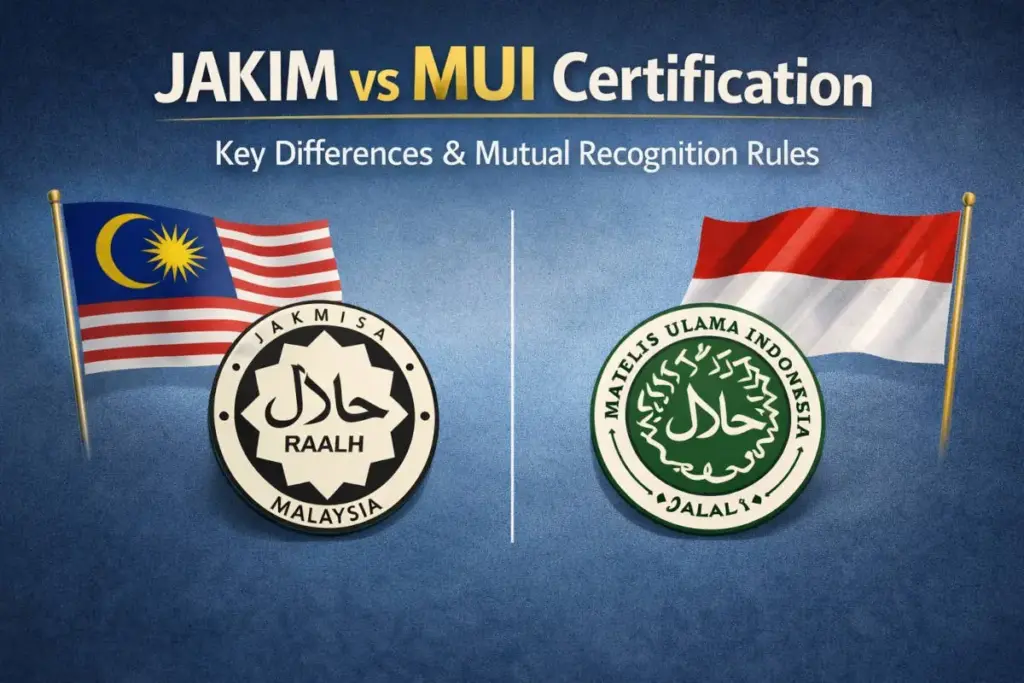
The structural divide in Southeast Asia’s halal compliance landscape is becoming increasingly pronounced, presenting distinct strategic challenges and operational realities for international exporters and regional manufacturers alike. While Malaysia maintains a unified, centralized process anchored by a single government chain, neighboring Indonesia splits its regulatory responsibilities across multiple agencies, creating a contrasting environment of legal obligations, administrative procedures, and economic considerations.
Understanding these divergent pathways is vital for businesses operating within the global halal economy. Although both nations share deep roots in traditional Islamic jurisprudence—predominantly operating within the Shafi’i school of thought—their modern administrative architectures reflect fundamentally different approaches to state oversight, market enforcement, and trade facilitation.
How Malaysia’s System Works
In Malaysia, the architecture of halal certification is characterized by end-to-end institutional control. The government agency responsible for auditing a company is the exact same authority that evaluates the product’s status and issues the official certification. At the federal level, the Department of Islamic Development Malaysia, commonly known as JAKIM, oversees multinational corporations, major exporters, and foreign applicants. Meanwhile, state-level Islamic religious departments and councils manage the certification needs of local small and medium-sized enterprises operating within their respective jurisdictions.
This centralized authority finds its legal grounding in the Trade Descriptions Act 2011, alongside two critical legislative orders enacted that same year: the Trade Descriptions (Definition of Halal) Order 2011 and the Trade Descriptions (Certification and Marking of Halal) Order 2011. These orders explicitly designate JAKIM and the respective state religious authorities as the sole competent bodies authorized to validate halal claims for goods and services nationwide. Consequently, private entities or commercial enterprises are legally barred from issuing independent halal declarations.
Auditing protocols strictly follow comprehensive frameworks such as the Malaysian Halal Certification Procedure Manual, the Malaysian Halal Management System, and specific product standards like the national food standard. Despite its high level of standardization, processing speed has historically been a primary point of critique. High-ranking officials, including Deputy Prime Minister Ahmad Zahid Hamidi—who chairs the Malaysian Halal Council—have previously addressed application delays stretching across months, prompting administrative directives to streamline decision-making timelines for applicants navigating the national portals.
How Indonesia’s System Works
Conversely, Indonesia operates a decentralized, multi-agency model where no single body governs the certification lifecycle from initiation to completion. Applicants seeking credentialing in Indonesia must submit their documentation through a digital portal overseen by the Halal Product Assurance Organizing Agency, known as BPJPH. Following submission, an accredited halal inspection body conducts the necessary facility audits, after which a designated fatwa committee evaluates the product’s religious compliance before BPJPH officially issues the credential.
This multi-tiered system underwent significant structural evolution following legislative reforms. While independent inspection bodies handle technical audits, religious determinations can originate from various branches of the Indonesian Ulema Council or regional ulama councils. Legislative adjustments have further introduced government-appointed fatwa committees to manage specific application tracks and statutory deadlines, enhancing administrative throughput. Furthermore, regulatory updates have elevated BPJPH into a distinct nonministerial agency reporting directly to the presidency, injecting greater political weight and administrative agility into Jakarta’s national halal policies.
Side-by-Side Structural Comparison
The structural divergence between the two nations manifests across nearly every dimension of regulatory compliance, from legal foundations to fee schedules and enforcement mechanisms.
Malaysia’s legal framework relies heavily on trade description legislation, positioning certification as a voluntary market choice for most consumer goods, provided that any explicit halal claims originate exclusively from designated competent authorities. Indonesia, however, enforces a comprehensive legal mandate requiring halal certification for a vast array of goods entering, circulating, or traded within its borders, systematically phased across different industrial sectors over time.
In terms of validity and renewal, Malaysia typically issues fixed-term certificates—such as two-year approvals for standard food and beverages and one-year terms for slaughterhouses—accompanied by routine annual surveillance audits. In contrast, Indonesia’s regular certification route offers extended validity, remaining active indefinitely provided that the underlying ingredients and manufacturing processes remain entirely unaltered.
Financial structures also vary considerably. Malaysia levies predictable, tiered annual certification fees calculated against a company’s overall business turnover, alongside nominal processing charges. Indonesia implements a zero-fee structure for qualifying micro and small enterprises utilizing a self-declaration pathway, while regular commercial applications are priced based on the volume of audit days required, specific product categories, and baseline operational expenditures.

Mandatory in Indonesia, Voluntary in Malaysia
The legal enforcement of halal status highlights a fundamental philosophical difference between the two markets. Indonesia’s regulatory framework treats certification as a strict legal prerequisite for commercial circulation. Uncertified products must be explicitly labeled with non-halal declarations where applicable, and the national rollout continues to phase in compliance across diverse sectors, ranging from food and beverages to consumer goods and pharmaceuticals.
Malaysia approaches the requirement primarily as a voluntary market mechanism for the majority of domestic goods, with the crucial caveat that unauthorized halal labeling is strictly prohibited. An enterprise in Malaysia is legally permitted to sell uncertified food items, provided it refrains from marketing them as halal. However, commercial realities often mirror mandatory regimes; robust consumer expectations and strict supermarket standards compel mass-market food producers to secure official JAKIM accreditation to remain competitive. For non-food categories such as cosmetics and household products, uncertified brands maintain a more visible presence in the retail space.
What Certification Costs
For commercial entities, government administrative fees represent only a fraction of the total expenditure required to achieve and maintain compliance. The broader financial commitment encompasses internal staffing—such as dedicated halal executives—facility modifications, supply chain adjustments, and comprehensive audit preparations.
In Malaysia, official fee schedules are transparently linked to corporate turnover, ensuring that micro-enterprises face minimal financial burdens while larger corporations contribute scaled amounts. Foreign applicants face structured processing and manufacturing location fees depending on their regional base.
Indonesia’s cost architecture for regular applications scales dynamically with the complexity of the audit process. Expenses are determined by multiplying the number of required auditor days by category-specific unit costs, supplemented by operational overhead and inspector travel expenses for foreign facilities. While these variable expenses can fluctuate based on industrial complexity, the open-ended validity of Indonesian certificates offers long-term cost efficiencies for companies with stable, unchanging product formulations, sparing them from recurring renewal audit expenses.
Mutual Recognition and Cross-Border Trade
Bilateral cooperation between JAKIM and BPJPH has established formal pathways for mutual recognition, facilitating regional trade through structured memoranda of cooperation. These agreements allow eligible products bearing authorized national credentials to enter neighboring markets under agreed-upon diplomatic and administrative understandings.
Nevertheless, cross-border trade still necessitates careful adherence to administrative formalities. Importers are typically required to register foreign halal certificates within domestic regulatory portals before products can be legally distributed or retailed. Furthermore, both nations maintain stringent gazetted lists of recognized international foreign halal certification bodies, ensuring that goods imported from third-party nations meet identical local religious compliance standards.
The Deadlines Exporters Now Face
Recent regulatory adjustments have reshaped the timeline for international and domestic stakeholders navigating Indonesia’s mandatory compliance schedule. Authorities have introduced extended implementation windows for specific sectors, including select food categories, beverages, slaughtered goods, cosmetics, and various consumer products, allowing industry stakeholders additional time to align their supply chains with statutory requirements.
These extensions provide crucial relief for foreign exporters—particularly those utilizing Malaysian facilities—whose certifying bodies are actively navigating mutual recognition agreements with Indonesian authorities. However, regulatory adjustments do not exempt importers from completing mandatory certificate registrations and compliance verifications before distributing products within the domestic market.
Where the Two Systems Still Clash
Despite broad theological alignment rooted in shared jurisprudential traditions, operational friction occasionally emerges between the two systems regarding procedural alignment, verification scope, and official logo usage. Because each nation maintains independent evaluation authorities, commercial goods approved in one market must successfully complete local review processes before displaying the corresponding national halal emblem.
The ongoing tension between regulatory thoroughness and administrative velocity remains a defining characteristic of regional halal governance. While rapid processing models enable micro-enterprises to secure credentials quickly, traditional audit-first systems prioritize exhaustive on-site verification to maintain consumer confidence. As both nations continue refining their administrative frameworks, international exporters must carefully balance the portable credibility of Malaysian certification with the mandatory legal requirements demanded by the Indonesian domestic market.