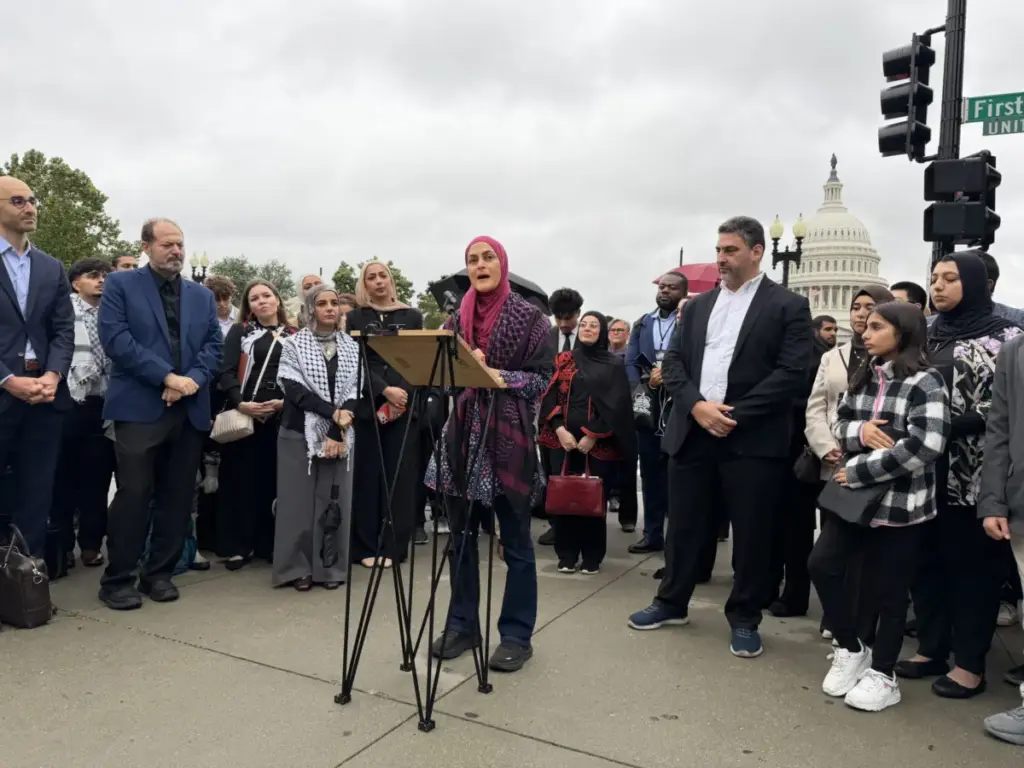
WASHINGTON, DC — Palestinian Americans converged on the United States Capitol for a high-stakes day of advocacy, carrying their message straight to the offices of federal lawmakers under the looming shadow of a newly reported $2.8bn military transfer to Israel approved by the administration of US President Donald Trump.
The mobilization, organized by the advocacy group Americans for Justice in Palestine Action (AJP Action), brought more than 300 constituents from across the nation to Washington. Throughout the day, these participants held meetings with representatives and staffers from more than 100 congressional offices. Their agenda was direct and comprehensive, centering on legislative initiatives aimed at addressing Israel’s devastating war in Gaza, surging rates of Israeli settler violence across the occupied West Bank, and what organizers described as the weaponization of US immigration law to suppress Palestinian advocacy domestically.
For many of the participants, the journey to Capitol Hill was deeply personal. Jenna Escheik, a 19-year-old student originally from just outside Ramallah in the occupied West Bank, was part of a delegation meeting with lawmakers and staffers from Virginia, including prominent figures such as Democratic Senator Tim Kaine and Republican Representative Rob Wittman. Heading into her meetings, Escheik acknowledged she was preparing for challenging conversations with politically diverse offices.
“I think the main point that we’re trying to get every single office across to is that we’re all proud to be American, and we all have our taxpayer dollars that we just don’t want to see going to wars,” Escheik said.
Similarly, Yaseen Shaikh, a 22-year-old who traveled with a delegation representing Cleveland, Ohio, prepared to meet with the offices of Republican Senator Jon Husted—who is navigating a competitive midterm race against former Democratic Senator Sherrod Brown—as well as Ohio’s other Republican Senator, Bernie Moreno. Both senators have consistently opposed legislative measures aimed at restricting or conditioning arms sales to Israel. Despite the political uphill battle, Shaikh expressed a deep sense of historical continuity and purpose.
“As I stand among my peers here, among people who I stand on their shoulders, I can only feel hopeful and optimistic that we will make a difference and that change will come,” Shaikh told Al Jazeera. “We just have to be vehicles for that.”
Palestinian Rights ‘Catching Up’ with Lawmakers
For decades, successive presidential administrations and bipartisan majorities in Congress have consistently resisted calls to place conditions on US military aid to Israel. This institutional reluctance has largely held firm throughout Israel’s expansive war in Gaza, a conflict approaching its grim three-year milestone early next month.
The human toll of the conflict remains staggering. According to documentation tracking the escalation, nearly 74,000 Palestinians have been killed in Gaza since October 7, 2023. Even after a nominal ceasefire agreement went into effect in October 2025, nearly 1,400 additional Palestinians have lost their lives amid ongoing hostilities and enforcement actions.
This backdrop of continuous violence intensified last week when US media outlets widely reported that the Trump administration had approved a massive $2.8bn military package funded by American taxpayers. The transfer notably includes 20,000 heavy-duty MK-84 2,000-pound bombs, munitions that human rights monitors and medical professionals have repeatedly linked to catastrophic civilian devastation and high-density casualties in the densely populated Gaza Strip. The package also reportedly includes 20,000 units of the BLU-117, a close variant of the heavy munition.
In response to the reported transfer, several congressional Democrats have vowed to mount blocks against the shipment. Gregory Meeks, the ranking member of the House Foreign Affairs Committee, used his institutional leverage last week to at least temporarily slow down the formal congressional clearance process.
Osama Abu Irshaid, the executive director of AJP Action, argued that pushing through such a massive weapons package directly contradicts the views of the American public. Public opinion polls have consistently shown majority support for conditioning at least a portion of military aid to Israel, alongside surging public support for Palestinian human rights. Abu Irshaid contended that these shifting public sentiments reflect an evolving political reality that elected officials can no longer afford to ignore.
“I think now we are functioning within this context, where what happens in Palestine, the genocide that took place and continues to take place, what the terrorist settlers are doing in the West Bank, what the US and Israel are doing in the Middle East is catching up with us here,” Abu Irshaid said, “and we’re paying a price.”

While institutional resistance to conditioning aid remains entrenched within certain factions of the Democratic Party, advocates have pointed to historic shifts over the past year as evidence of a changing tide. In July of the previous year, 26 Democratic senators voted to block specific arms transfers to Israel, marking the first time in history that a majority of the party’s caucus in that chamber took such a step. By April, similar legislative resolutions captured a record 40 votes among Senate Democrats, though the measures ultimately failed to secure passage in the 100-member body.
In the House of Representatives, the "Block the Bombs Act"—a bill advocating for a partial arms embargo against Israel—accumulated 81 co-sponsors by August. Furthermore, 22 Democratic senators introduced a resolution last week demanding that the US Department of State initiate a formal investigation into violence perpetrated by Israeli military forces and settlers in the West Bank, an environment where at least nine US citizens have been killed in recent years.
Abu Irshaid expressed optimism that similar political shifts could eventually materialize within the Republican Party, which has experienced quiet internal debates over unconditional foreign aid, even though very few GOP lawmakers have shown a willingness to vote in favor of restricting assistance. Citing a December poll conducted by the IMEU Policy Project, which found that a majority of Republicans under the age of 45 would prefer to support a 2028 presidential candidate who backs reducing taxpayer-funded weapons to Israel, Abu Irshaid suggested that foundational shifts are underway.
“I think what we’re seeing now is that the dam within the Republican Party is cracking,” Abu Irshaid said. “Pero the question is, ‘What is after Donald Trump when Donald Trump no longer owns the Republican Party, owns the MAGA movement?’ I think that’s when you will see more cracks taking place.”
‘The Same System’
In addition to challenging foreign policy and military aid, advocates on Capitol Hill used Tuesday’s mobilization to shine a spotlight on domestic policy, specifically targeting what they described as the Trump administration’s utilization of immigration law to stifle pro-Palestinian free speech and activism inside the United States.
Among their primary legislative goals, constituents urged lawmakers to reform ambiguous language within the Immigration and Nationality Act of 1952. The Trump administration has increasingly relied on these legacy provisions in ongoing efforts to target and deport individuals whose presence in the US is viewed by the government as having “adverse foreign policy consequences.”
Among the speakers addressing the Capitol Hill gathering was Salah Sarsour, president of the Islamic Society of Milwaukee. Sarsour was detained by Immigration and Customs Enforcement (ICE) in April and subsequently released in June following a legal challenge. His defense team has maintained that the three-decade US resident was unfairly targeted based on a coerced confession extracted when he was detained as a young man by Israeli forces abroad.
Sarsour, who continues to navigate ongoing deportation proceedings, shared how his recent experience inside an ICE detention facility served as a grim reminder of his past imprisonment by Israeli authorities.
“Those criminals that [detained me], they still exist,” Sarsour said. “The same criminals that destroy Gaza, they killed tens of [thousands] of children and women, and men and family members.”
His sentiments were echoed by Leqaa Kordia, another speaker who was targeted by immigration enforcement following the widespread wave of pro-Palestinian student protests that swept university campuses across the United States in 2024. Kordia spent 368 days in ICE detention, an ordeal she described as profoundly dehumanizing.
“And then it hit me that… the same system that threw me in an ICE jail is the same system that funds and arms the military prisons in Israel,” Kordia told the assembled crowd.
“The same dehumanisation logic that allowed a guard to humiliate me allows the Israeli soldier to kidnap Palestinians and throw them into the shadows,” she added. “The same power that keeps my case in limbo is the same power that sends billions of US tax dollars in bombs and weapons to fuel the Palestinian genocide.”