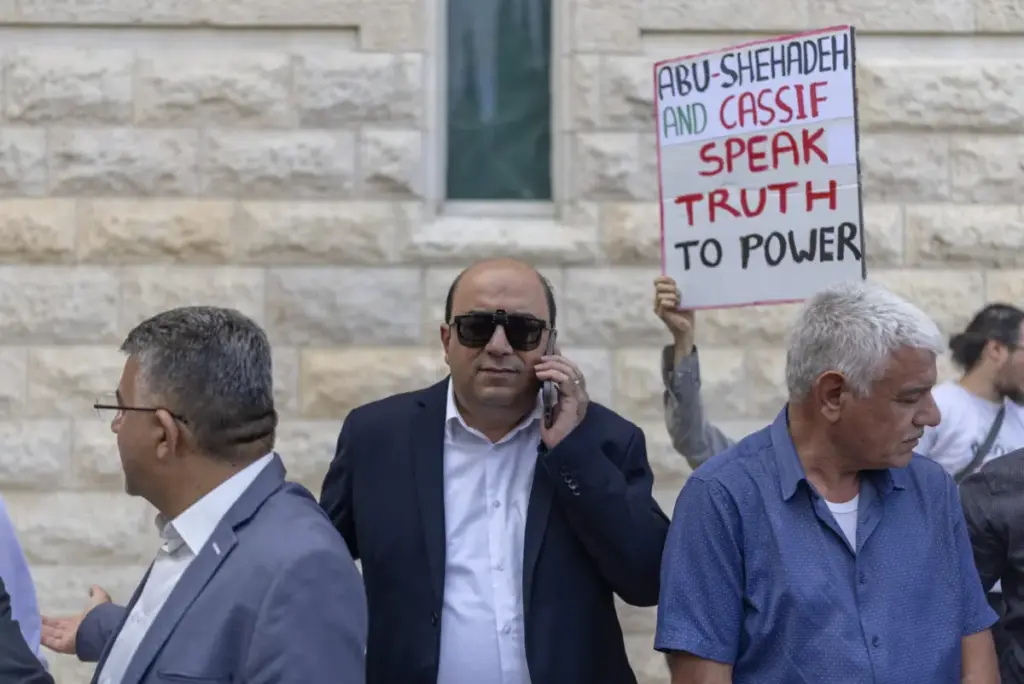
A prominent Palestinian-Israeli politician has been forced to withdraw from the upcoming parliamentary elections following intensive legal pressure over his remarks concerning the Gaza war. The development has reignited fierce debates regarding the integrity of Israel’s electoral process, with critics, legal rights organizations, and political analysts accusing Israeli institutions of applying a severe double standard that penalizes Palestinian political expression while granting immunity to far-right Israeli leaders accused of inciting violence.
Sami Abu Shehadeh, the leader of the Palestinian nationalist Balad party, officially withdrew his candidacy after the Supreme Court issued a stark warning indicating that he faced imminent disqualification from the ballot. Describing the turn of events as a historical catastrophe for democracy, Abu Shehadeh found his political career abruptly halted after months of escalating legal challenges. The court’s advisory opinion followed a prior ruling by Israel’s central elections committee, which had barred him from running for office over controversial commentary he made regarding the ongoing military campaign in Gaza.
The upcoming election, scheduled for October 27, has placed intense renewed scrutiny on the structural and systemic challenges faced by Palestinian citizens of Israel as they seek political representation within the state. Palestinian rights groups and legal experts argue that the nation’s electoral system and political elite operate under a framework of systemic bias. While Arab candidates frequently face rigorous vetting attempts and disqualification efforts, far-right Israeli politicians accused of repeatedly inciting violence against Palestinians have consistently been permitted to remain on the ballot.
Zaidon Alkinani, the founding director of the Arab Perspectives Institute, told reporters that the situation reflects a foundational reality of the state’s political design. He noted that the Israeli political elite has historically engineered the system to ensure the preservation of its Zionist identity rather than fostering a truly inclusive democracy.
The controversy has once again brought to the forefront deeply entrenched questions regarding the true scope and limitations of Palestinian participation in Israeli political life.
Who is Sami Abu Shehadeh?
Sami Abu Shehadeh is a recognized historian hailing from Jaffa and serves as the leader of Balad, a political faction that champions Palestinian nationalism and advocates for full civil and political equality for all citizens of Israel. He previously served as a member of the Knesset, representing his constituents from 2019 until 2022.
His candidacy faced immediate and aggressive legal challenges initiated by far-right Israeli National Security Minister Itamar Ben-Gvir. The challenge centered primarily on an article published by Abu Shehadeh on October 8, 2023—just one day after the Hamas-led attacks on Israel—in which he characterized the events as an important historical event.
Attorney General Gali Baharav-Miara formally backed the efforts to disqualify him, arguing before the courts that the specific phrasing utilized in the article could be interpreted as amounting to support for an armed struggle.
During hearings at the Supreme Court, Abu Shehadeh firmly stated that he did not support armed struggle. He acknowledged that a specific paragraph within the controversial article had been imperfectly worded, explaining that his true intention was to urge all parties involved to transition the conflict away from military confrontation and toward a political process.
What was the Israeli Supreme Court’s Decision?
Last month, the Central Elections Committee voted to bar a series of prominent Arab political figures and factions, including Abu Shehadeh, Hadash politician Ofer Cassif, and the two major Arab-majority electoral lists: the Joint List—comprising Balad, Hadash, and Ta’al—and Ra’am, also known as the United Arab List.
While the Supreme Court ultimately chose to overturn the bans targeting the two major electoral lists as well as Cassif, it maintained a hardline stance against Abu Shehadeh.
Ofer Cassif is a prominent politician representing the left-wing, Arab-majority Hadash-Ta’al party. In the late 1980s, the pro-Palestinian Israeli figure spent time incarcerated after refusing mandatory military service in the occupied territories. His history of political activism also includes a 2021 incident in which he claimed Israeli police physically assaulted him while he participated in a demonstration against an illegal Jewish settlement located in occupied East Jerusalem.
Following the court’s proceedings regarding his own case, Abu Shehadeh levied sharp accusations against the judicial system, claiming it had succumbed to intense political pressure from figures like Ben-Gvir. He questioned the fundamental fairness of a system that allowed a politician whom he accused of promoting violence and displacement against Palestinians to successfully orchestrate his exclusion from the democratic process.
Abu Shehadeh noted that a political figure who openly called for starving people to death in Gaza, blocking the entry of medicine, water, and food, and supporting the occupation and ethnic cleansing in the West Bank retained the power to disqualify a human rights activist with a decades-long career.
Adalah, the legal rights organization that provided legal representation to Abu Shehadeh, characterized his forced withdrawal as a severe blow to the fundamental right of Palestinian citizens to meaningful political representation. In a formal media statement, the organization asserted that the entire legal process constituted a deliberate attempt to delegitimise Palestinian citizens and their parliamentary representatives, effectively transforming racism against Palestinians into routine election propaganda.
Have Israeli Leaders Used Incendiary Language?
The legal battles surrounding the election also involved petitions submitted by various groups seeking to disqualify the political parties led by Ben-Gvir and Finance Minister Bezalel Smotrich, both of whom occupy prominent positions in the far-right cabinet.
However, the Central Elections Committee ultimately rejected those petitions, allowing both parties to secure their places on the official ballot.
Under Section 7A of Israel’s Basic Law on the Knesset, the legal framework provides specific grounds for barring individual candidates or entire electoral lists. These grounds include rejecting Israel’s character as a Jewish and democratic state, actively promoting racism, or expressing support for an armed campaign waged against Israel by a hostile state or a designated terrorist organization.
Attorney General Baharav-Miara concluded that the legal petitions aimed at excluding the far-right parties lacked the sufficient legal basis required under the statute.
Both Ben-Gvir and Smotrich have frequently drawn severe international backlash over their inflammatory rhetoric directed at Palestinians. In 2025, the governments of the United Kingdom, Canada, Australia, New Zealand, and Norway imposed targeted sanctions on both ministers, formally accusing them of repeatedly inciting violence against Palestinians residing in the occupied West Bank.
More recently, Ben-Gvir advanced a controversial seven-year plan aimed at encouraging Palestinians to leave Gaza through what he termed voluntary emigration. Speaking on the matter, he argued that instead of pursuing illusions of peace, the state needed concrete actions of emigration, famously remarking that instead of digging tunnels, it was time for people to pack suitcases.
Similarly, Smotrich has openly advocated for the displacement of Palestinians from Gaza and the formal annexation of the occupied West Bank. Both ministers have consistently called for the permanent military takeover of Gaza and the re-establishment of Jewish settlements in the territory, though these specific proposals have been publicly rejected by Prime Minister Benjamin Netanyahu.
Why Are There Accusations of a Double Standard?
The starkly contrasting treatment applied to Abu Shehadeh compared to Israel’s far-right political figures has intensified widespread accusations that the electoral system operates under a double standard.
Ahmed Najjar, a Palestinian political analyst and playwright, argued that Abu Shehadeh’s case vividly exposed the two-tier nature of Israeli democracy. He emphasized that the situation failed to demonstrate the equal application of the law, instead establishing one restrictive threshold for Jewish-Israeli politicians and an entirely different, highly punitive threshold for Palestinian citizens of Israel.
Najjar pointed to the glaring contrast between the court’s rigorous scrutiny of Abu Shehadeh’s October 2023 article and the unhindered electoral eligibility of Ben-Gvir and Smotrich, despite the extensive record of inflammatory statements attributed to them. He argued that Jewish extremism is routinely accommodated within the framework of Israel’s political system, whereas ordinary Palestinian political speech is systematically treated as an existential security threat. He concluded that any democracy that selectively excludes Palestinian representatives can no longer credibly claim to be a democracy.
Zaidon Alkinani reinforced this assessment, stating that the controversy reflects a much deeper structural problem facing Palestinian political participation rather than a localized dispute centered on a single candidate. He reiterated that Israel’s political system was historically structured to preserve its Zionist character, which inherently generates severe intimidation and political pressure for Palestinian citizens attempting to exercise their rights.
Alkinani added that these systemic pressures have only intensified since October 7, 2023, providing a powerful symbolic push and newfound confidence to right-wing nationalist parties across the political spectrum.
What Are the Difficulties Facing Palestinians in Israeli Elections?
Attempts to legally exclude Palestinian-led parties and candidates from participating in national elections are far from unprecedented.
Adalah has meticulously documented systematic challenges targeting Arab candidates and electoral lists during national election cycles in 2003, 2013, 2015, 2020, and 2022. While the Central Elections Committee—whose voting members consist of representatives from parties in the outgoing Knesset—has frequently voted to impose bans, the Supreme Court has historically overturned many of these decisions on appeal.
Palestinian citizens of Israel make up roughly 20 percent of the country’s total population. Despite this demographic presence, voter turnout among Palestinian citizens has traditionally lagged behind that of Jewish Israelis, driven in part by a sense of disenfranchisement and alienation from the state’s political institutions.
Furthermore, electoral regulations require parties to secure at least 3.25 percent of the national vote in order to successfully enter parliament. This high electoral threshold has historically compelled smaller Arab factions to form joint electoral lists to prevent vote-splitting and avoid losing parliamentary representation entirely.
Analysts note that the challenges facing Palestinian political representation extend far beyond the explicit rhetoric of the far right. According to Alkinani, even political parties that are traditionally categorized as centrist on domestic Israeli issues frequently continue to support hawkish security policies and actions directed against the Palestinian population, leaving Palestinian citizens with limited avenues for meaningful political advocacy.