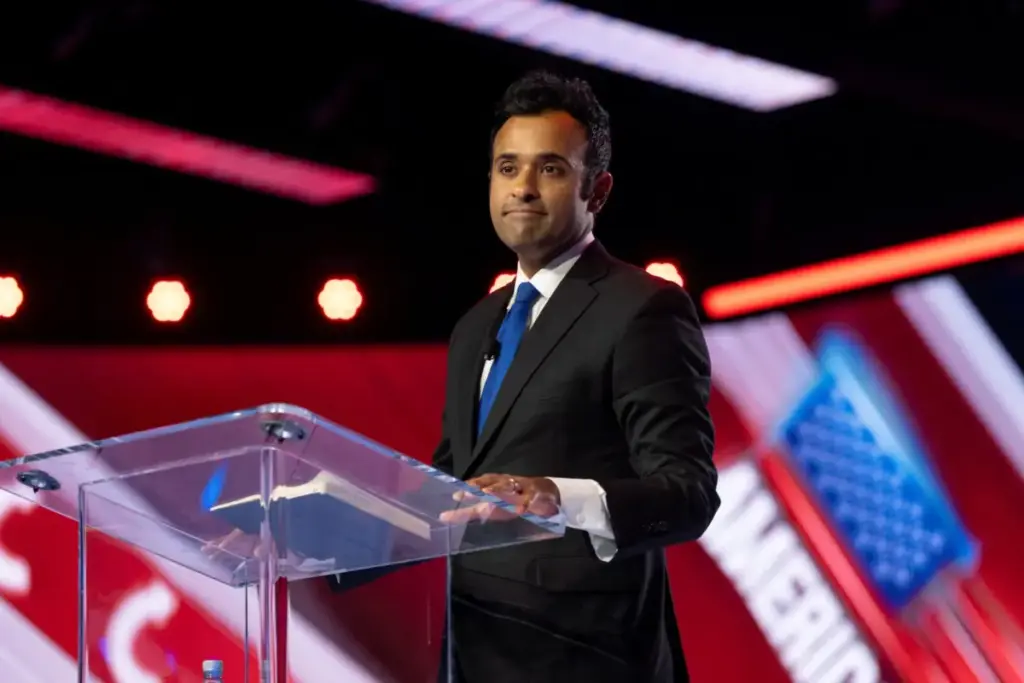
With less than two weeks remaining before the United States midterm elections on November 3, a blistering and highly personal attack advertisement released by Republican gubernatorial candidate Vivek Ramaswamy has ignited a fierce political firestorm. The campaign spot, which targets Democratic opponent Amy Acton, features her estranged mother accusing the former state health director of lying about her childhood and alleging that she suffers from a mental illness.
Despite swift blowback, condemnation from senior figures within his own party, and mounting evidence contradicting the ad’s claims, Ramaswamy has steadfastly refused to withdraw the commercial. The high-stakes standoff has exposed deep ideological fractures within the modern Republican Party, injected intense personal trauma into a premier state-level contest, and prompted major election forecasters to shift their ratings in the waning days of the campaign.
The controversy centers on a digital advertisement that began circulating online, marking an aggressive escalation in an already hard-fought race for the Ohio governor’s mansion. As the fallout continues to dominate headlines across the state and nationwide, political analysts and voters alike are left weighing the potential impacts of a strategy that has broken traditional norms of political engagement.
What Does Vivek Ramaswamy’s Advert Show?
The commercial features Donna Arthur, the estranged mother of Democratic nominee Amy Acton. In the video, Arthur directly attacks her daughter’s character, asserting that Acton is untruthful about her past and urging Ohio voters to reject her candidacy at the ballot box.
"It’s not easy for a mother to say this, but Amy has a serious problem. She is a liar. She lies about her past," Arthur declares in the footage. Specifically, Arthur disputes Acton’s well-documented accounts of experiencing childhood poverty, homelessness, and living in a tent with her family.
However, the advertisement omits a critical and harrowing piece of family history: Acton and her mother have been estranged since 1978. At the time, Acton was just 12 years old when she was removed from her mother’s custody after her stepfather was charged with raping her. Court records and contemporary news reports show that while the stepfather pleaded not guilty, he failed to appear for subsequent court dates and was never brought to trial. Both Acton and her brother, Phil Stearns, have since spoken publicly about the severe abuse they suffered during their youth.
Investigative reporting and fact-checking organizations have scrutinized the claims made in Ramaswamy’s ad, finding that historical records and archival documents corroborate key elements of Acton’s account. FactCheck.org identified records linking Acton’s stepfather to the specific campground where the family stated they lived in a tent, directly undermining Arthur’s assertion that the family never experienced such conditions. Public records also confirm that Arthur remained married to the stepfather until his death.
Despite these revelations, Ramaswamy’s campaign doubled down on the strategy. On Tuesday, his campaign confirmed its financial backing of the commercial and announced an aggressive $4 million ad buy to amplify its reach across media markets in Ohio.
Why Has the Advertisement Sparked Controversy?
The decision to weaponize a candidate’s estranged family member and childhood trauma has triggered widespread ethical questions regarding the boundaries of political campaigning. On Tuesday, Acton’s campaign issued a formal response that recounted her difficult upbringing and released a counter-advertisement featuring her brother, Phil Stearns, who offered a starkly different perspective on their childhood.
"I received a lot of abuse, but Amy always got the worst of it," Stearns states in the response ad. "She continued to receive that abuse because she knew she had to protect me."
The introduction of such deeply painful family dynamics into the public sphere has alarmed political scientists and ethicists. David Niven, a political science professor at the University of Cincinnati, noted that while political campaigns have occasionally involved family members in the past, the nature of Ramaswamy’s ad stands without modern precedent.
"We’ve seen family members used before, but not in such a deeply personal way," Niven said in an interview. "So we occasionally see a family member who’s talking about disagreements, you know, talking about a different kind of political outlook, but not this degree of just personal destruction. That’s what’s unprecedented here."
How Have Trump and Other Republicans Responded?
The ad has exposed a stark internal division within the Republican Party, pitting traditional conservatives against the populist, Trump-aligned wing of the party.

President Donald Trump and Vice President JD Vance have forcefully defended Ramaswamy and his campaign strategy. Praising the commercial as "very powerful," Trump confirmed that he encouraged Ramaswamy to keep the ad on the airwaves. Meanwhile, Vice President Vance dismissed critics within the party, publicly telling fellow Republicans to "stop whining" about the controversy and to maintain their focus on winning the upcoming midterm elections.
The reaction from state-level Republicans has been far more critical. Ohio Governor Mike DeWine, who has formally endorsed Ramaswamy’s candidacy, labeled the advertisement as "deeply, deeply troubling" and publicly urged its immediate withdrawal, even as he maintained his endorsement. Ohio Senator Jon Husted similarly distanced himself from the campaign spot.
Professor Niven pointed to the sharp split as evidence of a broader cultural and operational shift within the party. "So there’s a real divide between the Republican Party as it kind of traditionally was, that had something of a standard, and the Republican Party of Trump and Vance that will say anything at any time, regardless of the, you know, propriety of it," Niven observed. Despite the internal pushback from figures like Governor DeWine, Ramaswamy has refused to pull the ad from rotation.
Who Are Vivek Ramaswamy and Amy Acton?
The two candidates vying for leadership in Ohio bring vastly different professional backgrounds to the political arena, and neither has previously held elected office.
Vivek Ramaswamy, 41, is a prominent Republican businessman and former biotechnology executive. He first gained national prominence during his unsuccessful bid for the Republican presidential nomination in 2024, after which he endorsed Trump. A native Ohioan born and raised in the state, Ramaswamy entered the gubernatorial race backed by the president’s endorsement.
Amy Acton, 60, is a physician and former director of the Ohio Department of Health. She achieved widespread recognition and praise for leading the state’s public health administration during the initial phases of the COVID-19 pandemic under Governor DeWine. Raised in Youngstown, Acton has previously been open about her early life experiences involving poverty, homelessness, and abuse.
Political analysts suggest that the intensely negative nature of the advertisement carries significant electoral risks. Jerry Miller, a professor of communication studies and political advertising expert at Ohio University, explained that while controversial tactics are sometimes deployed to energize a candidate’s base supporters, they can easily alienate undecided voters.
"Every negative attack carries the risk of backfiring," Miller said. He added that the commercial could inadvertently generate a wave of sympathy for Acton, particularly among sexual assault survivors and their families who resonate with the difficulties of confronting such trauma.
While President Trump has repeatedly weathered major political controversies without losing the loyalty of his core supporters, analysts question whether Ramaswamy can successfully deflect the backlash in a localized state race.
"The thing that Trump has mastered is he’s always involved in a hundred controversies at a time," Niven noted. "So you kind of lose track of one controversy because it’s replaced by another one so quickly after." Pointing to Ramaswamy’s situation, Niven added, "The problem for Ramaswamy is this is the only thing people are going to be seeing and hearing. He’s not going to be able to achieve the sort of Trump controversy distraction game."
Why Does the Controversy Matter for Ohio’s Governor’s Race?
The timing of the controversy coincides with a crucial phase in the race, as recent polling data showed Acton maintaining a lead over Ramaswamy, though some surveys indicated a tightening contest.
In response to the escalating fallout, the Cook Political Report shifted its rating of the Ohio gubernatorial race from a toss-up to leaning in favor of Acton. Analysts pointed out that the race was already showing momentum for the Democratic nominee, and the severe backlash sparked by the advertisement reinforced their assessment. The controversy has also translated into tangible financial support for Acton’s campaign, including a substantial $500,000 donation from MK Pritzker, wife of Illinois Governor JB Pritzker.
With hundreds of Ohio residents already casting early ballots ahead of the November 3 election day, the ultimate impact on undecided voters remains to be seen. However, local experts agree that the ad has fundamentally altered the trajectory of the campaign.
"What is already clear is that the controversy has taken on a life of its own, becoming a major factor in this campaign, independent of the ad that sparked it," Miller stated.
Ohio stands as a critical battleground in the midterm elections. Once viewed as a reliable swing state, it has supported Donald Trump in the past three presidential cycles, and the Republican Party has held the governor’s office continuously since 2011. Should Acton secure a victory, she would become the state’s first Democratic governor in two decades.