There is a well-known anecdote told about the late Apple co-founder Steve Jobs that continues to resonate across modern engineering circles. As the story goes, Jobs once pushed his engineering team relentlessly to make the casing of the iPhone smaller, only for them to return and insist they had reached the absolute physical limit. There simply was no more space inside the device. Refusing to accept defeat, Jobs reportedly took the phone, walked over to a jug of water, and dropped it in. As he watched air bubbles rise to the surface, he pointed to them and said, "See that? That’s air. That means there’s space. Make it smaller."
That relentless pursuit of hidden potential captures precisely the ethos and driving spirit of the Muslim Tech Fest 2026. Rather than embodying a comfortable belief that the community has already done enough, the gathering pulsed with a restless conviction that there is always more space—more to build, more to imagine, and more to become. Held to showcase the intersection of modern technology and Islamic principles, the event brought together brilliant minds, ambitious entrepreneurs, and forward-thinking professionals who refuse to see faith and innovation as contradictory forces.
From Building Within to Reaching for the Stars
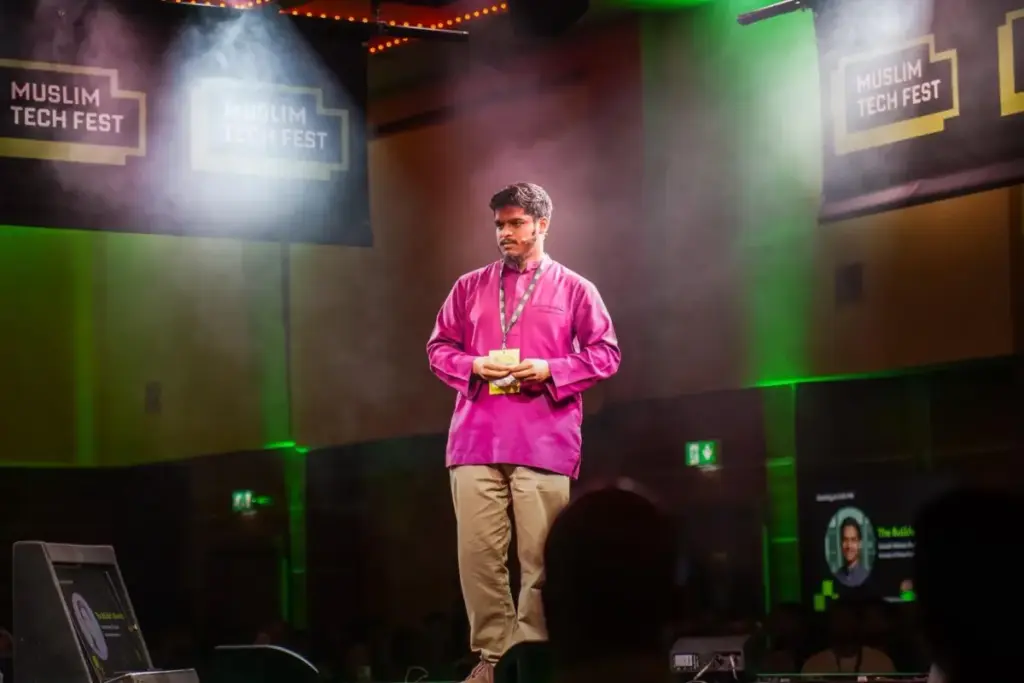
The tone for the entire festival was established early by Ustadh Hisham Abu Yusuf through his compelling keynote address, The Builder’s Mandate. His presentation wove together the concepts of building inwards, exercising excellence, and refusing to rely solely on pre-existing tools, anchoring every modern technological pursuit firmly in Quranic principles. This unique template—one where faith and technology operate in concert rather than in conflict—provided a philosophical foundation for the day’s events.
Providing a vital counterweight to this foundational mandate was Humna Khan’s presentation, titled Stars. Where the mandate focused heavily on obligation, responsibility, and internal discipline, Khan’s session was a masterclass in aspiration. She challenged attendees to lift their sights, cast aside the small and safe ambitions they had too often settled for, and dream on a global scale. Her message served as a timely reminder that the ultimate goal of technological achievement is never to shine in isolation, but rather to construct a pathway and provide a navigational beacon for those who will follow.

These keynote addresses were complemented by a diverse and intellectually stimulating array of workshops and breakout sessions. Highlights included the "Halal Investing Masterclass," which addressed the growing demand for ethically grounded financial technology, and a thought-provoking panel session titled "Can AI help solve the global education crisis?" Together, the curated content proved to be as uniquely inspiring as it was rare for mainstream Muslim conferences, bridging the gap between spiritual values and practical, high-impact applications.
From Finding Answers to Discovering New Questions
Rather than offering easy solutions or sugarcoating the challenges ahead, the festival intentionally leaned into difficult, complex discussions concerning the role technology will play in the future of Muslim communities worldwide. In a high-engagement Town Hall session appropriately named Architects of Amanah, the audience was directly challenged regarding a series of existential choices. Attendees were warned that these hard questions must be confronted head-on, or the community risks squandering the profound latent potential clearly on display throughout the venue.
Discussions during the Town Hall drew sharply varying perspectives from the floor, touching upon critical dilemmas. Participants debated whether the community should prioritize making massive, disruptive technological leaps from scratch or focus instead on building with excellence on top of the established technological rails that already exist. Other pressing debates centered on governance and accountability—specifically, who should regulate emerging technologies within the community, and what grassroots structural changes must be embedded immediately to foster and nurture the next generation of technologists. These robust exchanges generated a collective realization that while significant strides have undeniably been made, the journey has only just begun and a long road lies ahead.
The Greatest Innovation on Show
Attendees spent the day immersed in a dynamic environment surrounded by remarkable technology, visionary individuals, and cutting-edge organizations. The exhibition floor featured live demonstrations, working prototypes, and innovative ideas that undoubtedly deserve broader recognition and support. Yet, despite the impressive hardware and software on display, the single greatest innovation at Muslim Tech Fest 2026 was not running on any screen, sitting inside any exhibition booth, or loaded onto any mobile device.

The true breakthrough of the event was the room itself.
Walking the floor, one could observe a new generation of up-and-coming young professionals who possessed not only the technical skills required to compete toe-to-toe with the world’s most talented software engineers and tech builders, but also a profound, foundational love for the deen and a sincere, altruistic desire to help construct a better Ummah.
Convening the builders of the Ummah in a single physical space to collectively shoulder the heavy mantle of trust—the amanah—represents a monumental breakthrough that no individual could have engineered in isolation. History demonstrates that every great civilization begins not with a machine, but with a meeting; not with a commercial product, but with a collective body of people who decide that the future belongs to them to shape.
Steve Jobs was ultimately right about physical engineering, and his observation applies just as well to the collective potential of a faithful community. There is always more space.
At Muslim Tech Fest 2026, the community found theirs.
By Dr Wajid Akhter (Secretary General, Muslim Council of Britain)