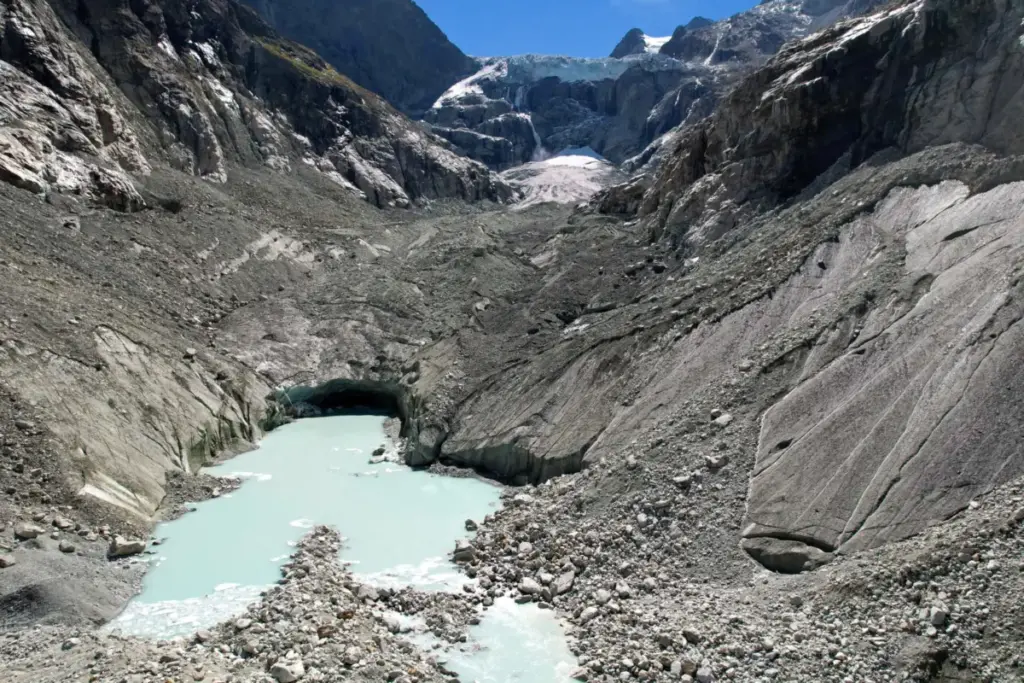
Switzerland’s majestic Alpine glaciers are receding at an alarming and unprecedented pace, driven by a catastrophic combination of winter snowfall deficits and record-shattering summer temperatures across Europe. According to comprehensive new scientific findings, one of the world’s premier winter sports and Alpine tourism destinations has shed nearly one-fifth of its total glacial ice volume in just five years, sending an unmistakable distress signal about the accelerating impacts of human-driven climate change.
The stark reality of this environmental transformation was detailed in a report published jointly by the Swiss Glacier Monitoring Network (GLAMOS) and the Swiss Commission for Cryosphere Observation of the SCNAT (Swiss Academy of Sciences). Researchers revealed that Swiss glaciers shrank by 5.5 percent over the hydrologic year concluding on September 30, 2026. Combined with previous melt seasons, this brings the total loss to nearly 20 percent since 2021—a staggering contraction over such a brief temporal window.
Renowned for its breathtaking Alpine topography, deep-rooted winter sports culture, and status as a central pillar of European tourism, Switzerland now faces profound environmental, economic, and logistical questions about the future of its landscape. As scientists document the rapid disappearance of centuries-old ice fields, the implications extend far beyond national borders, threatening water security, ecosystems, and sea levels worldwide.
What have scientists discovered?
To gauge the health of the nation’s frozen reserves, a dedicated team from GLAMOS conducted field expeditions in September, visiting 23 glaciers spread across Switzerland to record end-of-summer measurements tracking ice melt and snow accumulation.
Among the sites visited was the Scex Rouge glacier in the Western Swiss Alps. In early September, GLAMOS chief Matthias Huss—a prominent glaciologist at ETH Zurich and one of the lead researchers behind the annual report—recounted a telling observation to the Reuters news agency. Back in July, the research team had drilled a measuring pole roughly four meters, or 13 feet, deep into the ice to establish a fixed point of reference for the remainder of the summer.
When the scientists returned just weeks later, the physical reality on the ground was staggering. The pole was protruding three meters, or 10 feet, out of the ice. This meant that over the course of August and September alone—a timeframe that did not even fully account for the severe heatwaves experienced earlier in June and July—the glacier had lost three meters of ice at an elevation sitting at nearly 3,000 meters, or 9,843 feet, above sea level.
Huss emphasized that this localized measurement serves as a broader diagnostic indicator for the entire Alpine region. The environmental parameters observed this summer demonstrate that current climatic conditions are entirely incompatible with the long-term survival of smaller glaciers nestled within the Alps.
Why are glaciers in Switzerland losing ice?
The aggregate data compiled in the report underscore a widespread crisis. The total mean thickness of individual glaciers throughout Switzerland plummeted by between 2.5 and four meters over the course of 2026. At glacier tongues—the sensitive, lower extremities where glacial ice extends from land into bodies of water—the vertical retreat reached as much as 10 meters in certain locations during the summer months alone.
In an interview with Al Jazeera, GLAMOS chief Huss pointed directly to the root cause of the phenomenon. The massive ice loss can be unequivocally attributed to atmospheric warming and, by extension, anthropogenic climate change. The summer of 2026 brought the hottest temperatures ever recorded in Switzerland. Compounding this thermal pressure was a winter characterized by exceptionally low snowfall, leaving the glaciers vulnerable, exposed, and entirely lacking a protective insulating blanket when the intense summer heat took hold.
While monitoring data confirms that the relentless melting has impacted virtually all Swiss glaciers regardless of size, the visual and physical consequences are most dramatic among smaller formations. These compact ice masses shrink at an exponential rate and are prone to vanishing completely. Meanwhile, while massive glaciers have also hemorrhaged colossal quantities of ice, their sheer scale still maintains an imposing presence, though their ultimate trajectory remains deeply concerning.
The ecological and hydrological fallout is similarly quantifiable. Researchers calculated that Swiss glaciers relinquished an estimated 2.2 trillion liters of water—equivalent to roughly 581 billion gallons—between July and September alone. To put that staggering volume into perspective, the report noted that this single three-month melt exceeded the total annual drinking water consumption of all Swiss households combined by more than four times, raising serious long-term concerns regarding the nation’s future water security.

What does this mean for Switzerland?
For generations, Switzerland’s identity has been inextricably linked to its Alpine geography, winter tourism, and pristine mountain landscapes. The tourism sector alone accounts for approximately 4 percent of the country’s total workforce, driving local economies across mountainous cantons.
The physical transition of the landscape is altering not only the economy but the very aesthetic and cultural perception of the region. Where gleaming expanses of white ice once dominated the horizon, the landscape is increasingly characterized by exposed rock, debris, and barren grey and black slopes.
Beyond tourism, the economic value of glacial runoff is immense. Meltwater is systematically captured to fill hydropower reservoirs that generate clean, renewable energy, while also feeding several of the largest river systems in the European continent. Although the immediate threat of water scarcity has not fully materialized because retreating glaciers continue to shed water, experts warn that this buffer is rapidly disappearing as the underlying ice reserves shrink toward exhaustion.
Harry Zekollari, a glaciologist and associate research professor at the Department of Water and Climate at the Vrije Universiteit Brussel, echoed these concerns. He emphasized that glaciers historically act as nature’s water towers, storing winter precipitation and releasing it precisely when society needs it most—during hot, dry summer months.
Under normal climatic conditions, initial stages of glacier retreat can temporarily increase summer runoff due to accelerated melting. However, Zekollari explained that once glaciers cross a certain threshold of mass loss, the available ice diminishes, leading to an inevitable reduction in summer water supplies. According to scientific assessments, this peak in water yield has already been surpassed for glaciers throughout the European Alps, signaling that downstream communities can expect declining water availability in the decades ahead.
Furthermore, rapid glacial changes frequently trigger localized natural hazards such as rockfalls, slope instabilities, and glacial lake outburst floods. Because the vast majority of the melted ice eventually finds its way into the world’s oceans, the cumulative consequences of glacial recession in regions like Switzerland will ultimately reverberate along coastlines across the globe.
Is there a solution?
Addressing the crisis requires urgent, large-scale intervention focused on climate stabilization. According to Zekollari, mitigating the worst-case outcomes and preserving whatever fraction of glacial ice remains in Switzerland depends entirely on the global community’s ability to curb greenhouse gas emissions and stabilize rising global temperatures as rapidly as possible.
Projections modeled for the European Alps and Swiss glaciers indicate that aggressive and immediate emissions reductions could allow humanity to salvage roughly one-third of the region’s remaining ice mass. Conversely, under a high-emissions, strong-warming scenario, these same glaciers face the grim prospect of losing more than 90 percent of their total volume by the year 2100.
While the outlook for low-altitude Alpine glaciers is exceptionally severe, the global picture varies, with certain ice formations in colder or higher-altitude regions exhibiting greater resilience. Nevertheless, future emissions pathways will dictate whether global glacier mass experiences a more manageable reduction of roughly 25 percent by the end of the century under low-warming scenarios, or a catastrophic 50 percent loss under higher-emissions trajectories.
Scientists stress that the temporal scale of glacial response is long, meaning that the consequences of current emissions policies will continue to unfold well beyond 2100. In this context, every single fraction of a degree Celsius in avoided warming carries profound significance for the future of the world’s remaining ice.