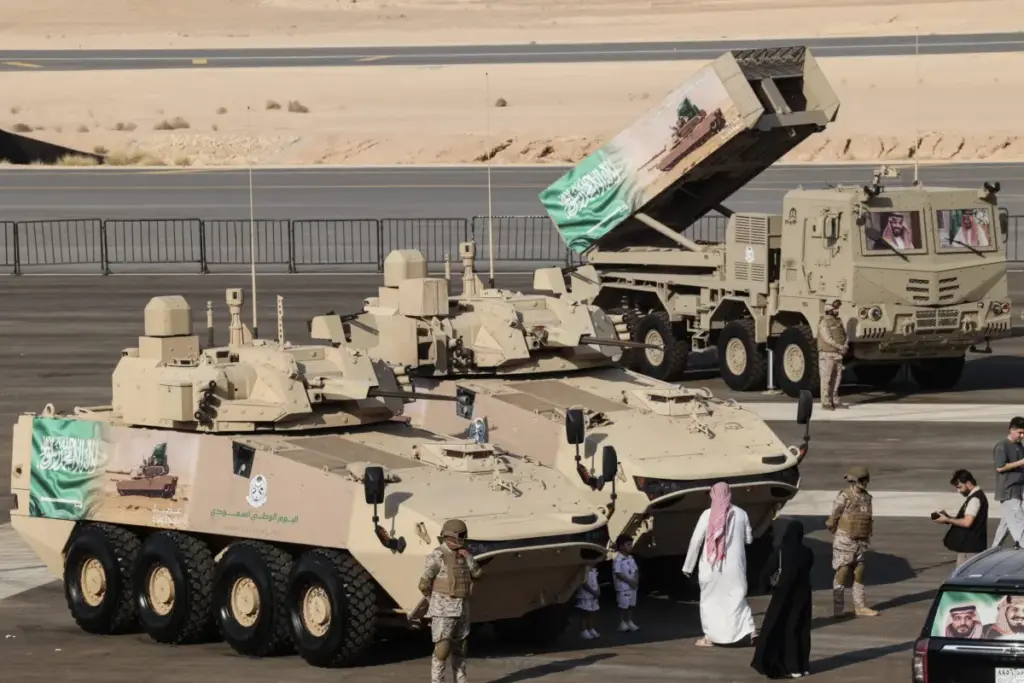
The United Kingdom has announced that it will provide targeted military support to Saudi Arabia in response to the kingdom’s escalating conflict with Yemen’s Iran-backed Houthi group. The intervention, confirmed by the British government this week, comes as Riyadh seeks urgent air-defense assistance to counter a renewed and aggressive campaign by the insurgent forces that threatens regional stability and vital global trade corridors.
Speaking on his way to the United Nations General Assembly in New York, UK Prime Minister Andy Burnham told reporters that London had accepted a formal request from the Saudi government for defensive air-to-air refuelling. To execute this mission, the British government will deploy a single Royal Air Force (RAF) Voyager tanker aircraft to the region in the coming days. The decision, Burnham noted, was made following formal consultations and on the advice of both his defence and foreign secretaries.
While the agreement represents a tangible deepening of British involvement, Prime Minister Burnham emphasized that the UK will not directly join Riyadh’s renewed military campaign against the Houthis. The conflict between the Saudi-led coalition and the Yemeni group initially erupted in 2014 when the Houthis seized Yemen’s capital, Sanaa, alongside vast territories across northwest Yemen, forcing the internationally recognized government to retreat to Aden.
Although the two opposing sides managed to secure a United Nations-mediated ceasefire in 2022, hostilities broke out once again this year, fueled by broader regional tensions stemming from the ongoing conflict involving the United States, Israel, and Iran. The situation deteriorated sharply two weeks ago as heavy fighting erupted along Yemen’s Red Sea coast. Houthi forces advanced aggressively against Yemeni government positions, capturing the strategic port city of Mocha as well as Mayyun Island, which sits directly in the middle of the Bab al-Mandeb—the critical southern entry point for international shipping transiting into the Red Sea.
In the wake of these territorial gains, the Houthi movement has significantly expanded its target parameters, launching direct attacks against Riyadh and critical Saudi energy infrastructure. Most notably, a series of strikes successfully disabled a section of the vital East-West Pipeline. This pipeline has served as a critical economic lifeline for Saudi Arabia, allowing the kingdom to maintain petroleum exports despite severe disruptions in the Strait of Hormuz caused by the wider war involving Iran.
Before this latest wave of violence broke out, the Houthis had already declared an effective blockade on Saudi-linked shipping traversing the Bab al-Mandeb Strait and the broader Red Sea—a maritime artery through which roughly 12 percent of global trade passes daily. Faced with mounting pressure on its territory and economic infrastructure, Riyadh formally turned to its international allies for assistance, prompting the recent British response.
What Has the UK Announced?
Detailing the scope of the deployment, Prime Minister Burnham explained that the UK has agreed to provide what he explicitly termed "defensive air-to-air refuelling" to support Saudi combat missions. The arrangement relies on the deployment of an RAF Voyager tanker, which will operate in the region over the coming period.
Burnham stressed that the initiative is intended to be strictly time-limited and subject to continuous review by British authorities, although the UK Ministry of Defence (MoD) has not yet published a definitive timetable for how long the operation will last. Framing the intervention around national and international security imperatives, Burnham stated that London was acting proactively to secure the economic interests of both Britain and the wider region, drawing a direct line between the military assistance and the absolute necessity of keeping global energy and trade routes open.
In a formal statement provided to Al Jazeera, the MoD elaborated that the decision to supply refuelling support builds naturally upon the UK’s existing military contributions to Saudi Arabia’s broader air-defense architecture. This pre-existing support already includes the deployment of advanced air-defense equipment and specialized British military personnel on the ground to help protect the kingdom against incoming missile and drone attacks.
"Saudi Arabia and Yemen are long-standing partners of the United Kingdom, and play a vital role in regional stability," the MoD statement read. "It is in the UK’s interest to protect regional stability, protecting vital trade and energy supplies and encouraging a diplomatic resolution to the conflict in Yemen."
What Is Air-to-Air Refuelling?
Air-to-air refuelling is a specialized military aviation maneuver involving the transfer of aviation fuel from a tanker aircraft to a receiver aircraft while both are in mid-air. By extending the operational flight time of Saudi fighter jets beyond their standard internal fuel limits, this capability allows aircraft to remain airborne for significantly longer durations.

This extended endurance is particularly crucial for Saudi forces tasked with maintaining continuous combat air patrols across vast geographic expanses or reacting swiftly to incoming aerial threats. Saudi Arabia encompasses a massive landmass, requiring defensive measures to cover major cities, remote military installations, and sprawling energy infrastructure distributed across vast distances.
While the Houthis have historically concentrated their missile and drone attacks on Saudi population centers located in the southern regions of the country near the Yemeni border, they have also demonstrated the capability to strike targets deep within the nation’s interior, including the capital city of Riyadh. Furthermore, during the height of Israel’s military campaign in Gaza, the Houthis demonstrated an expanded long-range strike capability by launching missiles directly toward Israel.
What Is the UK-Saudi Arabia Military Relationship?
The announcement underscores a deep and long-standing military and industrial partnership between London and Riyadh that stretches back decades. Saudi Arabia remains one of the largest and most lucrative international buyers of British military hardware and defense technology.
During the 1990s under the Conservative government of Prime Minister John Major, and subsequently under the Labour administrations of Tony Blair and Gordon Brown from the late 1990s through 2010, the UK supplied substantial military equipment to the kingdom, including Tornado and Hawk aircraft. These multi-billion-pound defense arrangements heavily involved British aerospace giant BAE Systems.
Over time, the bilateral defense relationship expanded to incorporate the procurement and maintenance of advanced Eurofighter Typhoon combat aircraft. In 2006, the Saudi government formalized an agreement to purchase 72 Typhoon jets in a massive deal valued at approximately $40bn, which also included provisions for technology transfer, comprehensive pilot training, and long-term maintenance support.
Beyond equipment sales, London has consistently provided operational and defensive assistance amid regional flare-ups. Earlier this year, the UK deployed its sophisticated Sky Sabre air-defense system to Saudi Arabia to help shield the country from incoming missile strikes linked to regional spillovers from Iranian actions targeting United States military assets and infrastructure stationed on Saudi territory.
Will This Make a Difference?
While the introduction of British air-to-air refuelling assets will undoubtedly enhance Saudi Arabia’s operational flexibility and defensive posture to some degree, defense analysts note that the scope of the UK’s current commitment remains relatively limited in scale. According to Chris Doyle, director of the Council for Arab-British Understanding, the primary value of the British intervention lies more in its political symbolism than in its immediate tactical weight.
"In military terms, this is not a major change-up," Doyle said, arguing that what matters most for Saudi Arabia at this juncture is securing visible international backing and solidarity as it confronts the resurgent Houthi movement.
Riyadh is acutely motivated to avoid projecting an image of international isolation, especially given that other traditional Western allies have shown extreme reluctance to become directly entangled in the renewed hostilities. Most notably, the administration of US President Donald Trump has already signaled that it has no intention of involving American military forces directly in the Saudi-Houthi fighting, nor will it intervene militarily against Houthi-enforced blockades targeting shipping lanes linked to Saudi Arabia in the Red Sea.
President Trump indicated that the Houthis had provided direct assurances to US officials that they had no intention of targeting American commercial or military shipping operating in the Red Sea. Consequently, as other global powers weigh their options, a broader international coalition has failed to materialize.
"Many are reluctant to get involved," Doyle observed, noting that international capitals view the current escalation as an extension of the wider, complex US-Iran confrontation, leading foreign governments to maintain a cautious and hesitant distance from the localized conflict.