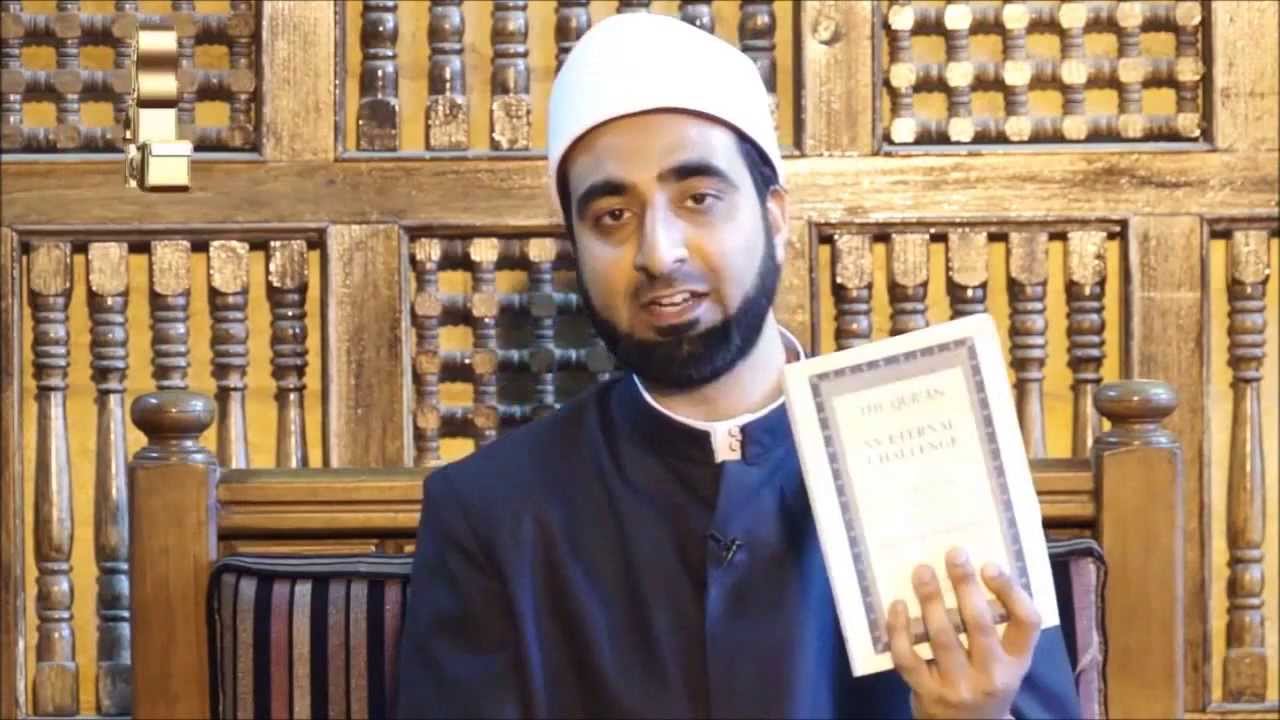
The question of the divine origins of the Quran and the source of Prophet Muhammad’s profound knowledge has remained a subject of theological study, historical inquiry, and interfaith discussion for centuries. In a recent episode of the widely followed educational video series The Eternal Challenge, prominent scholar Sheikh Sohaib Saeed tackles one of the most foundational inquiries regarding Islam’s holy text: Who actually taught Prophet Muhammad the Quran?

Through the ongoing series, Sheikh Saeed addresses longstanding historical allegations and modern criticisms—specifically claims that the Prophet was tutored by contemporary religious clergymen or that he merely compiled and quoted material from previous biblical and ancient scriptures. By breaking down the historical context, linguistic barriers, and the nature of the revelations themselves, the episode offers viewers a detailed look at the orthodox Islamic understanding of how the Quran was delivered to humanity.
Refuting Allegations of Human Authorship and Tutoring
Addressing the core allegations head-on, Sheikh Saeed evaluates the claim that Prophet Muhammad learned the sophisticated theology, narrative histories, and legal frameworks found within the Quran from external human sources, such as Christian or Jewish scholars present in the pre-Islamic Arabian Peninsula.

Historians and Islamic scholars have long noted that pre-Islamic Arabia was largely pagan, polytheistic, and illiterate, with only a small minority of individuals familiar with Judeo-Christian scriptures. The Prophet Muhammad himself was known throughout his community as Al-Ummi—the unlettered—unable to read or write. Critics and skeptics throughout history have occasionally suggested that secret meetings with Christian monks or rabbis provided the foundation for the Quranic text.
However, Sheikh Saeed explains why these theories fail under rigorous historical and textual scrutiny. The Quran introduces perspectives, corrects historical narratives found in earlier texts, and presents theological concepts with a unique linguistic and structural authority that diverged sharply from the sectarian debates of 7th-century Arabia. The video argues that attributing the profound theological depth, moral clarity, and historical precision of the Quran to human instruction ignores both the biographical reality of the Prophet’s life and the unique nature of the text itself. Furthermore, the allegations of human tutoring fail to account for the sudden, piecemeal manner in which the revelations descended over a span of 23 years, often in direct response to immediate, unpredictable real-world events and crises faced by the early Muslim community.

Prophecy and the Proofs of Truthfulness
Beyond refuting external influences, the episode shifts focus to one of the most compelling internal evidences for the divine origin of the Quran: its prophecies.
In religious studies and theological discourse, a true prophecy is defined as foretold news concerning a future event that is entirely beyond human calculation, probability, or logical extrapolation. Sheikh Saeed emphasizes that a genuine prophecy is quite distinct from an educated guess, shrewd political forecasting, or wise sociological observations. Throughout history, true prophecies have served as one of the vital, definitive proofs for the truthfulness or otherwise of a prophet claiming to speak on behalf of the Divine.
The Quran contains numerous specific predictions about future events that were subsequently fulfilled during the lifetime of the Prophet and shortly thereafter. Among the most famous historical examples highlighted in Islamic tradition is the Quranic prophecy regarding the conflict between the Byzantine and Persian Empires. At a time when the Byzantine Empire had suffered catastrophic defeats and was widely predicted by contemporaries to face total collapse, the Quran revealed verses in Surah Ar-Rum declaring that the Byzantines would achieve victory within a few years. Against all geopolitical odds at the time, that prophecy was fulfilled precisely as stated, stunning observers of the era.
By examining these predictive elements, the series encourages viewers to look past superficial skepticism and engage directly with the textual integrity, internal coherence, and miraculous nature of the Quranic discourse.
Continuing The Eternal Challenge Series
The discussion forms a key installment in Sheikh Sohaib Saeed’s broader educational project, The Eternal Challenge, which is designed to explore the miraculous dimensions of the Quran for contemporary audiences. The series systematically dismantles modern doubts and provides clear, well-reasoned answers to complex intellectual questions surrounding Islam’s foundational scripture.
Earlier episodes in the series have explored fundamental inquiries, beginning with the baseline definition and conceptual framework of what the Quran actually is to its first-time readers. Subsequent episodes have investigated the intricate relationship between the Prophet and the Book of Allah, examining whether the Prophet Muhammad could have authored the text himself, or if the profound spiritual and social impact of the Quran points instead to a higher, transcendent origin. Through these structured explorations, the series continues to provide valuable resources for students of Islam, seekers of knowledge, and anyone looking to understand the intellectual arguments underpinning Islamic theology.