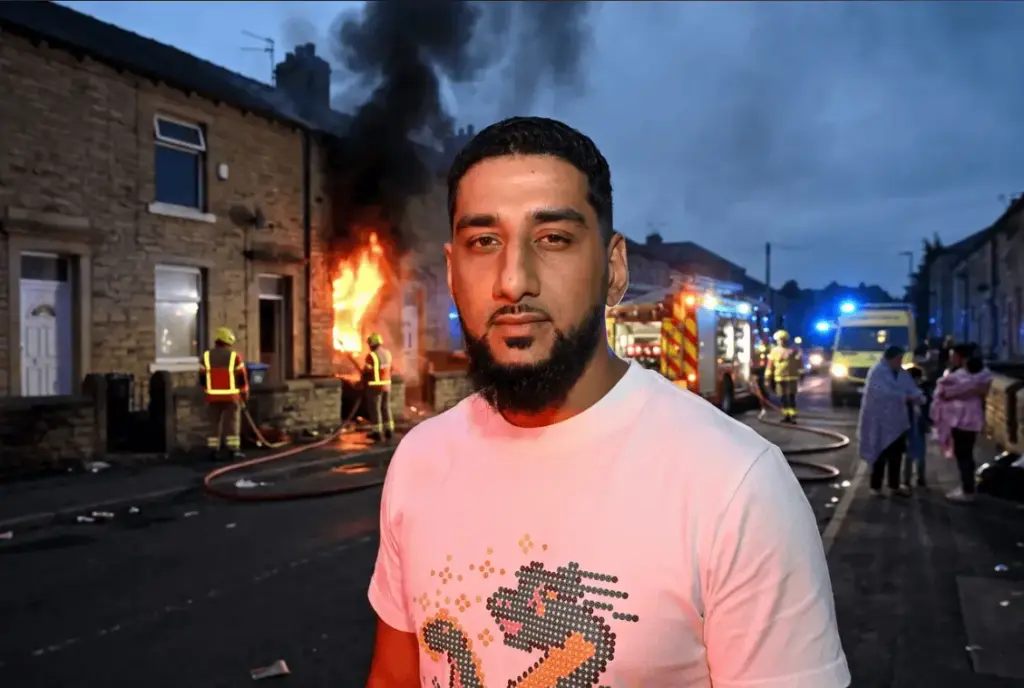
In the quiet, predawn hours when most of the neighborhood was fast asleep, ordinary routines were suddenly upended by a sudden and dangerous emergency. What began as a personal journey to handle a stressful family matter quickly turned into a race against time to save human lives. Amidst the darkness and rising panic, an observant passerby stepped forward, acting decisively to protect strangers from a catastrophic disaster before slipping away without seeking any recognition or praise.
Ans Javid was traveling through an unfamiliar neighborhood during the early hours of the morning, bound for an urgent family matter that required his immediate attention. As he navigated the quiet streets, his routine journey took a dramatic turn when he noticed thick, ominous plumes of black smoke billowing into the night sky. Realizing instantly that something was terribly wrong, Javid scanned the area and pinpointed the source of the smoke coming from a residential property. With no prior connection to the neighborhood, and with his own pressing family emergency waiting for him, he made a split-second decision to intervene.
Without a moment of hesitation, Javid pulled over, immediately contacted the emergency services, and sprang into action. Recognizing that time was of the essence and that every second counted in a residential fire, he rushed toward the endangered property to alert the sleeping occupants. Through quick thinking and urgent efforts, he managed to wake the residents, giving them vital moments to escape the building safely before the thick smoke and flames could spread further throughout the structure.
Emergency responders soon arrived at the scene to manage the blaze and ensure that all residents were accounted for and out of harm’s way. Once it was clear that the situation was under control and that professional help had arrived to secure the area, Javid quietly departed. Rather than waiting around for accolades, media attention, or expressions of gratitude from the community he had protected, he simply resumed his journey, tending first to the original family emergency he had set out for before ultimately heading off to work as if nothing extraordinary had occurred.

Despite the profound impact of his actions, Javid firmly rejects the label of a hero, viewing his response as an instinctive human reaction to a crisis rather than a deliberate act of extraordinary bravery. Reflecting on the intense moments during the incident, he described his state of mind as a primal response to danger.
"It was fight-or-flight mode. I just had to think fast," Javid recalled, explaining the urgency that drove him to take immediate action. Regarding his swift departure from the scene, he added, "I didn’t stay around for a thank you, I just carried on to where I needed to be."
Looking back at the sequence of events, Javid acknowledges the gravity of the situation and the starkly different outcome that could easily have occurred had he not happened to pass by at that exact moment. Residential fires during the sleeping hours carry an exceptionally high risk due to delayed detection, making early intervention critical to survival. Knowing how quickly smoke can incapacitate individuals, Javid remains acutely aware of how narrow the margin was between safety and tragedy.
"If I wasn’t there, I don’t know what could have potentially happened," he noted, reflecting on the fragility of the situation.
Rather than focusing on his own role, Javid hopes that sharing his experience will serve as a broader reminder to the public about the value of human presence, attentiveness, and community responsibility. He believes that ordinary individuals frequently underestimate their own capability to influence situations for the better, often assuming that someone else will handle emergencies or that their individual actions will not matter.

"People don’t value what they’re worth. They don’t realise that their presence can make a huge difference in a situation," Javid observed, emphasizing the profound impact that a single watchful observer can have when disaster strikes.
In a world saturated with continuous streams of distressing and negative news, Javid hopes that his story might inspire a sense of collective accountability and mutual aid among citizens. He advocates for a culture where people look out for one another and feel empowered to step forward when a neighbor or stranger is in distress, noting that the simplest gestures can sometimes alter the course of someone’s life.
"There are so many negative stories around. If this encourages someone to help when somebody needs it, then that’s a good thing. Sometimes just being there can make all the difference," he concluded.