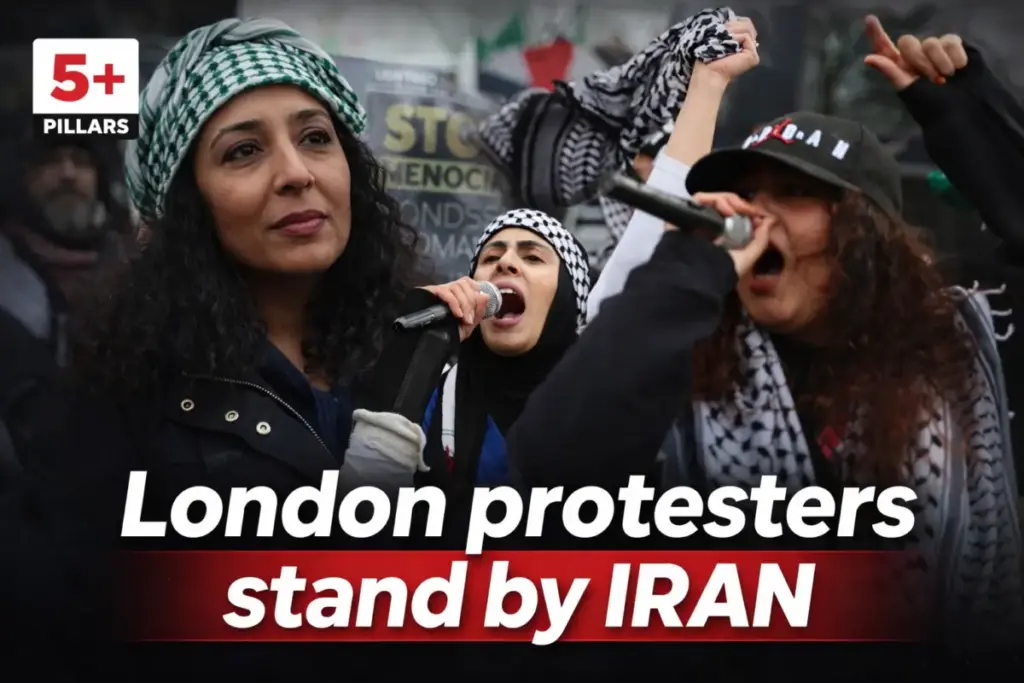
The demonstration served as a focal point for public anger over mounting hostilities, with participants fiercely demanding that the British government maintain a strict policy of non-involvement. Speakers and attendees alike warned that any complicity or military support from the United Kingdom for foreign-led offensives against Iran would drag the country into a devastating and unnecessary conflict with global repercussions.
The atmosphere throughout the march was charged with urgency and defiance as crowds moved through prominent thoroughfares in the British capital. Activists utilized the platform to draw direct lines between ongoing regional escalations and broader patterns of Western foreign policy in the Middle East, highlighting the interconnected struggles of populations affected by military interventions.

A striking visual element of the protest was the diverse array of placards and banners held high by demonstrators, reflecting a broad spectrum of political and humanitarian grievances. Slogans emblazoned across the marchers’ signs directly targeted key international and domestic political figures, reading "Stop Trump’s wars," "Tell Starmer: stop arming Israel," "End nuclear hypocrisy," and "Stop bombing Iran." Alongside these pointed political demands, protesters waved a prominent display of Iranian and Palestinian flags, illustrating solidarity across different national liberation and anti-war movements.
The inclusion of messages directed at Prime Minister Keir Starmer underscored domestic accountability as a central theme of the mobilization. Protesters argued that British diplomatic and material backing for military actions abroad makes the UK government directly complicit in civilian suffering and regional destabilization. By calling on Whitehall to halt arms exports and disengage from aggressive strategic postures, the demonstrators sought to pressure British leadership into adopting a stance centered on diplomacy, de-escalation, and international law rather than military alignment with Washington and Tel Aviv.
Organizers of the London rally emphasized that the threat of a wider war involving Iran poses an existential danger not only to the immediate region but to international peace and security as a whole. They criticized Western leaders for pursuing policies that they argue prioritize geopolitical dominance over human lives and regional stability. The crowd echoed these sentiments with rhythmic chants and speeches condemning foreign intervention, calling instead for immediate ceasefires, the cessation of hostilities, and a fundamental reassessment of Western foreign policy frameworks.

The protest in London is part of a growing wave of international dissent against the actions of the United States and Israel in the Middle East, reflecting deep public anxiety over the trajectory of current geopolitical tensions. As the situation on the ground in the region continues to develop, grassroots movements and anti-war coalitions in the UK have signaled their intention to maintain sustained pressure on policymakers, ensuring that public opposition to military escalation remains visible and vocal across British society.