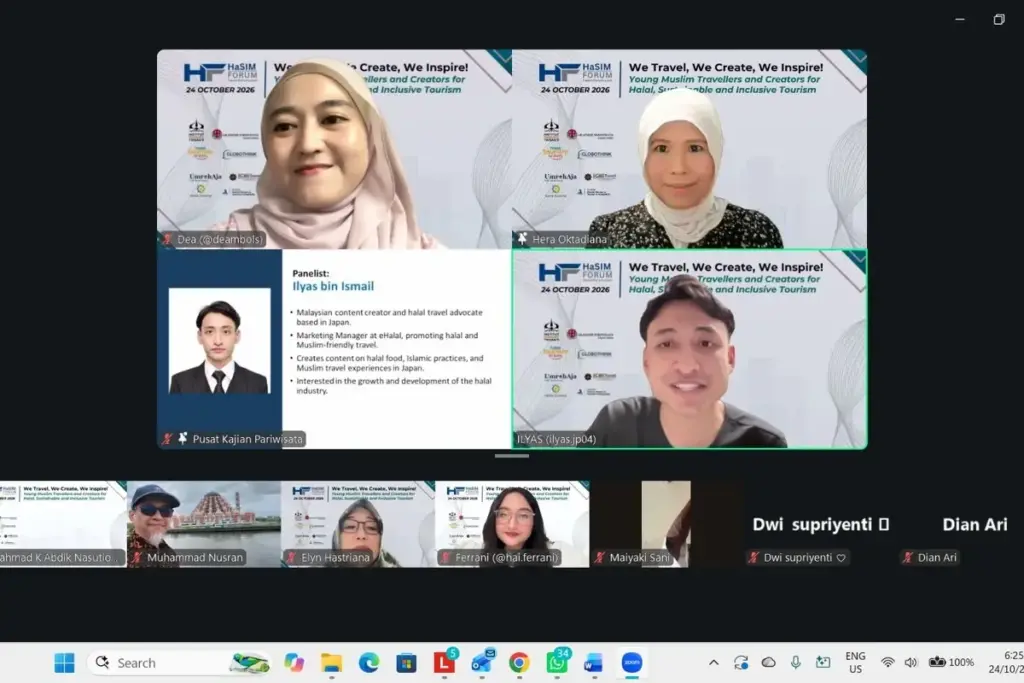
The landscape of global tourism is undergoing a quiet yet profound transformation, led by a new generation of Muslim travellers who view exploration not merely as leisure, but as a purposeful journey. Through compelling stories, striking photographs, and immersive videos, these young digital creators are actively shaping the contemporary and future definitions of Halal travel, moving the conversation far beyond dietary restrictions to embrace sustainability, inclusivity, and cross-cultural connection.
These evolving perspectives took center stage during the bi-monthly dialogue of the HaSIM (Halal, Sustainable and Inclusive Tourism) forum, held on October 24, 2026. Entitled “We Travel, We Create, We Inspire!: Young Muslim Travellers and Creators for Halal, Sustainable and Inclusive,” the virtual and academic event brought together prominent voices in the tourism sector. The session was hosted by Associate Professor Hera Oktadiana of the Trisakti Institute of Tourism Indonesia, who also serves as an adjunct academic at Griffith University and James Cook University in Australia, alongside Elyn Hastriana, Director of the RAMA Group.
The forum highlighted how modern Muslim travellers are leveraging digital platforms to advocate for mindful global citizenship, demonstrating that faith and a commitment to global sustainability go hand in hand.
Insights from Ferrani Investia
Opening the panel discussions, travel content creator and user researcher Ferrani Investia addressed the common misconception that Halal travel is exclusively about identifying and reviewing Halal food options. While dietary compliance remains a fundamental pillar, Ferrani emphasized that comprehensive travel content must also showcase mindful and ethical exploration. This includes sharing practical information and tips on how travellers can actively support local small businesses, treat sacred and historical places with reverence, appreciate local customs and cultures, minimize waste, and promote eco-friendly and inclusive practices. At its core, she argued, modern travel is about building genuine cross-cultural connections.
“In creating content, I love capturing real moments: the cityscapes, the landscapes, and especially the people,” Ferrani shared during the dialogue. “By sharing genuine interactions with locals, we show that travel is all about connecting with different cultures. When we show ourselves listening to local stories, participating in cultural workshops, or respecting local customs, we can inspire our audience to travel with curiosity rather than simply as consumers. Share the story of the local family who runs the restaurant, the history of the neighbourhoods, or how local traditions align with Islamic values such as community, hospitality, and respect.”
Ferrani’s perspective underscores a shift in how travel creators engage with their audiences, moving away from purely aesthetic documentation toward narrative-driven content that fosters mutual understanding.
Insights from Auliya Maimun Merdekawati (Dea)
The dialogue continued with insights from Auliya Maimun Merdekawati, widely known as Dea, who serves as a K-Wander Creator under the Korea Tourism Organisation in Jakarta, Indonesia. Dea spoke passionately about the educational value of travel content, noting that well-crafted media helps Muslim travellers learn about and better understand the diverse traditions found in foreign countries.
Through her work in promoting destinations in South Korea, Dea aims to demonstrate that visitors can experience a host country not merely as temporary tourists passing through, but through an authentic local perspective.
“I received much feedback from audiences that they can enjoy the country like the locals did through my travel content,” Dea explained. “That’s why I keep creating content. As a Muslim traveller, I especially want to encourage Muslims to travel and not hesitate to explore the world they want to know besides their country.”
By bridging cultural divides through digital media, creators like Dea are empowering hesitant travellers to step outside their comfort zones and discover new horizons with confidence.
Insights from Ilyas Bin Ismail
Adding an international perspective on marketing and advocacy, Ilyas Bin Ismail, a halal travel advocate and marketing manager at eHalal, underscored the immense reach and influence of social media in the modern tourism ecosystem. He noted that a single video shared online has the potential to reach thousands or even millions of viewers in an instant, making digital platforms powerful tools for shaping public perception and inspiring positive behavioral change.
Ilyas emphasized that travel content creators carry a distinct responsibility to encourage responsible tourism, urging his peers to look beyond beautiful aesthetics and focus on education.
“As a travel content creator in Japan, I believe our responsibility is not only to show beautiful places, good food, and interesting experiences but also to educate and inspire people on how to travel responsibly through our stories and visuals,” Ilyas remarked.
Connecting this professional ethos to spiritual duties, Ilyas referenced the Qur’anic injunction from Surah Al-A’raf (7:56), which commands humanity: “And do not cause corruption on the earth after it has been set in order.” For Ilyas and many young Muslim creators, environmental stewardship and ethical travel are direct extensions of their religious faith.
Messages for Young People
As the forum drew toward its core takeaways, the three panellists delivered direct messages to young audiences regarding how they can effect meaningful change through travel and the thoughtful use of social media.
Ferrani urged the younger generation to travel with noble intentions and approach content creation with a clear sense of purpose. She reminded attendees that influence is not solely measured by follower counts in the contemporary digital landscape.
“In today’s digital landscape, social media gives everyone a powerful platform,” Ferrani noted. “You don’t need massive followers to make an impact. Every video, photo, or caption you share contributes to how people view different cultures and communities. When you travel, look beyond the surface level or the trends. Seek out meaningful connections, ask questions, and practice mindfulness. And when you post online, focus on authenticity rather than just aesthetics. Use your content to bridge gaps, build empathy, and foster understanding. Every single story you craft has the power to inspire someone else to travel more respectfully, sustainably, and inclusively.”
Echoing the call for courage, Dea encouraged young individuals to take the leap into international travel to broaden their worldviews while maintaining open minds and positive attitudes.
“Be brave to travel and share the positive sides of other countries and the things you have never seen before,” Dea advised. “By travelling, we can gain so much new perspective. If you want to travel but are not brave enough, just do it! If your gut says, ‘Let’s travel!’, that means there are already stories waiting for you in another country. And always keep an open mindset and believe that you can have amazing experiences in every country you visit.”
Ilyas reinforced these sentiments by reminding aspiring creators that impactful content does not require expensive production equipment or vast digital empires. Instead, meaningful engagement begins with localized acts of kindness and responsible sharing.
“You do not have to be famous to make a difference,” Ilyas said. “You just have to start with what you have. We do not need expensive equipment or millions of followers to create an impact. We can start by sharing useful information, supporting local businesses, respecting different cultures, and encouraging responsible travel. We may not change the whole world, but we can change someone’s perspective, and sometimes, that is where positive change begins.”
Ultimately, the panellists converged on the foundational principle that travelling is not solely an exercise in personal enjoyment, but a fulfillment of the human role as khalifah, or stewards of the earth. By harnessing social media to inspire small yet deliberate changes while exploring the globe, young Muslim creators are proving that digital storytelling can drive profound, positive impacts, echoing the prophetic tradition recorded in Sahih Muslim (1893): “Whoever guides someone to good will have a reward like the one who does it.”