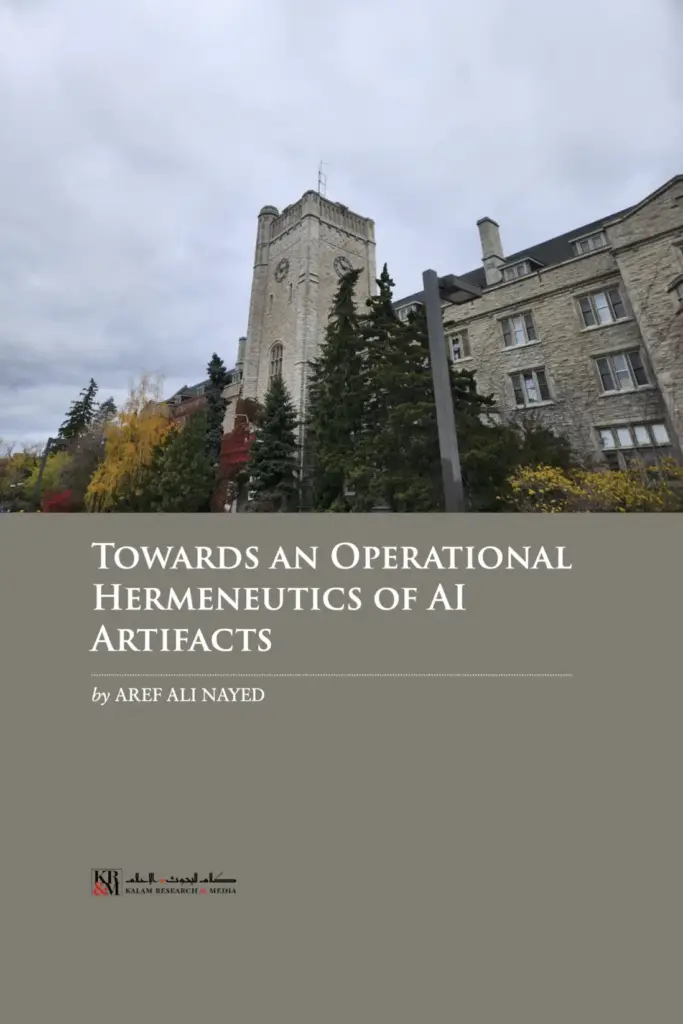
In a significant development bridging classical philosophy and the rapidly evolving frontier of artificial intelligence, prominent scholar Dr. Aref Ali Nayed has released a comprehensive new academic paper. Published in 2025 and spanning 26 pages, the monograph builds directly upon Dr. Nayed’s pioneering work in Operational Hermeneutics, which he initially developed at the University of Guelph during the 1990s. The newly unveiled paper proposes an innovative and much-needed theoretical framework designed for understanding, interpreting, and contextualizing the vast array of outputs generated by modern artificial intelligence systems.
As artificial intelligence continues to infiltrate every facet of modern life—from automated creative writing and digital imagery to complex lines of computer code—scholars and technologists alike have increasingly grappled with how to properly interpret these machine-generated artifacts. Dr. Nayed’s latest research directly addresses this mounting intellectual and practical challenge by extending the principles of Operational Hermeneutics beyond traditional human texts and applying them squarely to AI artifacts. This intellectual leap allows researchers and practitioners to view AI-generated content not merely as passive outputs, but as complex cultural and technical objects that demand rigorous interpretation and ethical stewardship.
To build this robust framework, the paper carefully traces the rich philosophical lineage of "artifacts" across centuries of human thought, moving seamlessly from the foundational insights of Aristotle through to the modern theories of Herbert Simon. By grounding contemporary AI development in deep-rooted philosophical traditions, the monograph demonstrates that the challenges posed by generative artificial intelligence are not entirely unprecedented, but rather represent a modern evolution of long-standing philosophical questions regarding creation, intention, and human agency.
At the core of Dr. Nayed’s new framework are four distinct modes of human engagement with AI artifacts: actuating, manipulating, utilizing, and actualizing. These modes provide a nuanced taxonomy that helps researchers, developers, and users understand the varying degrees of interaction between human intent and machine execution. Rather than treating human-AI interaction as a monolithic block, the framework acknowledges that our relationship with AI outputs shifts dynamically depending on whether we are setting processes into motion, actively altering parameters, applying systems to practical ends, or fully realizing the potential meaning embedded within an artifact.
Furthermore, the paper confronts the pressing domain of AI ethics by examining these technologies through the critical lens of interpretive responsibility. In an era where deepfakes, synthetic text, and automated decisions carry profound societal weight, the burden of interpretation becomes a matter of ethical urgency. Moving beyond standard regulatory compliance, Dr. Nayed introduces the compelling concept of "hermeneutic harm" within AI contexts. This novel concept illuminates the subtle yet damaging ways in which misinterpreted, misleading, or culturally biased AI outputs can distort human understanding, erode trust, and inflict cognitive or cultural injury upon individuals and communities.
Beyond its theoretical contributions, the monograph serves as the launchpad for a major collaborative research initiative uniting prominent academic institutions and specialized organizations across multiple continents. This ambitious interdisciplinary program brings together the University of Guelph in Canada, the Sheikh Mohammed bin Zayed University for the Humanities in Abu Dhabi, the Mohamed bin Zayed University of Artificial Intelligence (MBZUAI), Kalam Research and Media, and Agathon Systems Ltd. By pooling the diverse expertise of these institutions, the collaborative initiative aims to translate the paper’s philosophical insights into concrete, hermeneutically-informed AI design principles and robust governance frameworks that can guide the future development of safe and responsible artificial intelligence technologies.
Those interested in exploring the full scope of Dr. Nayed’s research can access and download the complete 26-page monograph online through the published documentation provided by Kalam Research and Media.