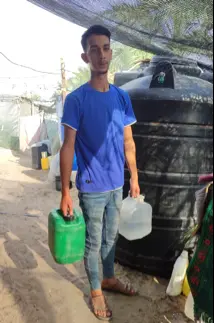
GAZA — Long before the constant rumble of shelling reshaped the landscape of the Gaza Strip, Muhammed’s life was defined by the quiet rhythms of family, schooling, and community. Having lost his father when he was just two years old, Muhammed grew up surrounded by the steady warmth of a close-knit extended family. He spent his days sharing a peaceful home with his maternal grandparents, attending classes with steadfast dedication, and unwinding in the afternoons by swimming and playing football with his friends and cousins. His younger sisters grew up in an environment characterized by care, safety, and routine.
That protective world shattered overnight when the current crisis erupted, plunging the family into a harsh and relentless reality of displacement. Forced to abandon their home with little more than the clothes on their backs, Muhammed and his relatives found themselves navigating an existence stripped of basic comforts. Today, their lives are bounded by the canvas walls of a makeshift tent—a fragile shelter that offers minimal protection against the biting cold and driving rain of the winter months.
Yet, even as he assumes the heavy responsibility of serving as a pillar of strength for his two younger sisters and aging grandfather, Muhammed has steadfastly refused to let displacement dictate the boundaries of his life. While daily survival demands immense physical labor—such as fetching water from distant points and gathering firewood for cooking, tasks that expose them to thick, choking smoke—Muhammed has maintained an unwavering focus on his education. For him, hitting the books is not merely an academic pursuit; it is the ultimate pathway to building an independent future, securing stability for his loved ones, and reclaiming the agency that the conflict tried to strip away.
Determined to Continue His Education
The obstacles standing between Muhammed and a high school diploma would have overwhelmed many. With their neighborhood and school system severely disrupted, studying required an extraordinary exertion of willpower. Every day, Muhammed walked long distances just to find an intermittent internet connection that would allow him to access his coursework and prepare for his high school examinations.
Upon returning to the cramped and freezing tent, he would resume his studies under damp and bitterly cold conditions, seizing every fleeting moment of quiet he could manage amid the chaos of camp life. There were no designated study rooms, no reliable electricity, and no quiet libraries—only the sheer determination of a young man refusing to let his circumstances define his academic potential.
That relentless perseverance ultimately yielded remarkable results. Muhammed graduated from high school with an impressive score of 84 percent. In a peaceful setting, such a score represents a solid academic achievement; set against the backdrop of war, destruction, and homelessness, it stands as a testament to extraordinary resilience.
This academic triumph opened the door to university, bringing a sudden wave of fresh hope to the family. His foundational first semester was provided free of charge, enabling him to embark on a degree in digital marketing. However, the horizon of higher education also brings looming anxieties. Muhammed worries about how he will manage to pay upcoming tuition installments and how he will secure a laptop—an indispensable tool for attending university courses, conducting research, and submitting academic assignments in a modern digital field.
Islamic Relief’s Orphan Sponsorship Provides Vital Support
Navigating these immense financial pressures has been made possible, in part, by external support networks. During this protracted period of hardship, the monthly sponsorship Muhammed receives through Islamic Relief has emerged as a crucial lifeline for his household. The financial assistance helps the family absorb some of the sharpest edges of daily poverty, covering essential needs and alleviating the crushing weight of economic distress. By easing these pressures, the sponsorship affords Muhammed vital breathing room, allowing him to dedicate more of his energy to his university lectures and assignments.
The demand for such humanitarian intervention has grown exponentially as the conflict persists. Before the current crisis unfolded, Islamic Relief was actively supporting approximately 8,700 sponsored orphans across the region. Today, that number has surged to nearly 25,200 orphaned children—representing a staggering 190 percent increase. Thanks to the generosity of global donors and sponsors, the organization has effectively tripled the scale of its support network for vulnerable children in Gaza.
Despite this massive expansion in outreach, the humanitarian landscape remains deeply strained. More than 5,100 orphaned children currently sit on the organization’s waiting list, yearning for the stability and security that a dedicated sponsorship program can provide. For Muhammed, who knows firsthand the compounding vulnerabilities of growing up without a father amidst active conflict, the value of this safety net extends far beyond financial figures; it is a tangible vote of confidence in his potential.
A Family Still in Urgent Need
Despite the emotional boost of entering university and the steady assistance of his sponsorship, daily life inside the tent remains precarious. The changing seasons bring severe weather vulnerabilities that threaten the family’s health and safety. Muhammed and his relatives are in desperate need of sturdier and more secure shelter arrangements to weather the harsh winter storms. A larger tent, reinforced frames, and heavy-duty protective coverings are urgently required to shield the household from relentless rain, wind, and freezing temperatures.
Beyond structural shelter, the family faces acute shortages of basic household provisions. They lack adequate mattresses, warm blankets, storage solutions for their meager clothing and personal belongings, and proper cooking equipment. Furthermore, Muhammed and his sisters urgently need seasonal winter clothing and sturdy shoes to protect them from the elements as temperatures drop.
For Muhammed specifically, academic continuity hinges on material support. Securing a personal laptop is no longer a luxury but an absolute requirement for his digital marketing studies. Assistance with future university tuition fees is equally critical to ensure he remains officially enrolled and capable of carrying his academic journey through to graduation. Addressing these foundational needs would not only secure the family’s immediate physical well-being but would also clear the path for Muhammed to focus entirely on building a sustainable, professional future.
Holding on to Hope
Muhammed’s story is a portrait of profound loss juxtaposed against an equally powerful refusal to surrender one’s ambitions. He has lost his childhood home, the quiet predictability of his daily routine, and the physical safety that every young person deserves. Yet, he has retained an unyielding faith in the transformative power of education.
His journey from walking miles for an internet signal to earning an 84 percent high school average—and stepping proudly onto a university campus while living under a canvas roof—demonstrates the indomitable spirit of a generation striving to rewrite its own narrative. Through targeted humanitarian assistance and sustained community support, young people like Muhammed are given the tools to hold fast to their education, protect their dreams, and maintain hope for a stable tomorrow.
As the humanitarian crisis continues to challenge families across the region, organizations like Islamic Relief remain committed to standing beside Palestine’s orphaned children, offering them a bridge from profound vulnerability toward a self-determined future.