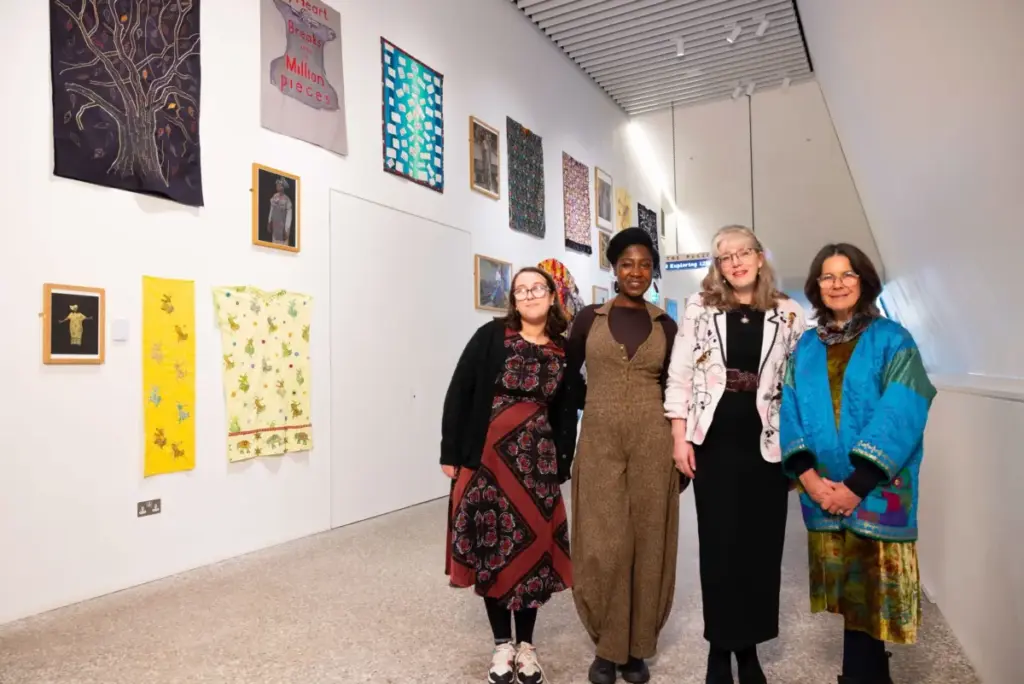
For nearly two decades, East London Textile Arts (ELTA) has operated on a simple yet profound premise: that high-end, ambitious art and deep-rooted community collaboration are not mutually exclusive. Founded in 2007, the Newham-based, artist-led community textile collective has spent the last 18 years bringing together individuals of varying ages, backgrounds, and abilities. By fostering long-term relationships centered around shared creativity, ELTA has consistently challenged traditional boundaries, championing the belief that art should be accessible to everyone, and that everyday people possess extraordinary creative gifts.
This philosophy has now found a prominent new platform. Since the early development stages of V&A East, museum organizers had their sights set on collaborating with ELTA. The collective’s longstanding commitment to the Newham community and its unique approach to using textiles as a medium for personal and collective expression align closely with the museum’s core ambitions.
The result of this mutual admiration is a striking new commission for the second iteration of V&A East’s creative commissions programme, New Work: The Stories of Clothes. Titled What We Love and What We Fear, the installation transforms a public corridor space into a vibrant celebration of collective creativity and the powerful narratives woven into our wardrobes. Featuring a dynamic arrangement of embroidered garments, photography, and a large circular patchwork skirt, the exhibition explores the anxieties, joys, and complexities of modern life through the eyes of East London residents.
To understand the heartbeat behind this major new project, museum representatives sat down with Celia and Sonia, the visionary leaders who guide ELTA’s artistic practice, to discuss their creative process, historical influences, and the powerful human stories stitched into the new commission.
Inside ELTA’s Practice and Community-Centred Vision
ELTA is far from a standard art collective. Its membership is ethnically diverse, predominantly female, older, and largely drawn from low-income households. Many members live with health conditions or disabilities, while a significant portion speak English as an additional language. Furthermore, over a quarter of the collective live with learning disabilities, creating a multigenerational environment where participants range in age from their twenties to their early sixties.
Reflecting on the core values that drive the group, Celia emphasizes that exceptional textiles do not require professional status. Instead, they require a long-term vision and a dedicated community. Rather than treating each initiative as a transient, one-off workshop, ELTA focuses on building lasting creative relationships across Newham.
This distinctive approach was deeply shaped by Celia’s formative experiences abroad, specifically a three-year residency in Bucharest, Romania, during the 1990s. There, she was profoundly influenced by Horia Bernea, the visionary director of the Muzeul Național al Țăranului Român (National Museum of the Romanian Peasant). Following the collapse of communism, Bernea redesigned the museum to focus on the everyday craftwork of ordinary people—labor that was rarely classified as "art" by traditional institutions.

The museum’s deliberate design, featuring hand-painted walls and a strict policy against commercial marketing posters, created a unified purpose: to celebrate the lives and creative gifts of the Romanian people. It carried a distinct political mandate to reconsider what it means to be human in a post-communist society. Alongside this pivotal experience, Celia drew inspiration from non-professional "village" textiles, such as those crafted by the Rabari communities in Gujarat, traditional Romanian village textiles, and various textile NGOs established across India, Pakistan, and Bangladesh to foster hand-crafted embroidery.
When Celia arrived in Newham from Romania in 2005, she was instantly struck by the area’s sensory richness. The vibrant colors of local Asian textile shops, bustling street processions, and diverse cultural festivals presented an overwhelming tapestry of cloth and color that inspired her to pivot away from painting and immerse herself in the local textile culture. Sonia crossed paths with Celia in 2007, drawn in by a shared passion for embroidery. Sonia soon transitioned into teaching, designing alongside groups, and partnering directly with Celia on project development.
Transforming Space: The V&A East Commission
For their V&A East Museum commission, ELTA was tasked with activating a public wall space that could easily have felt sterile or unremarkable. True to form, the collective decided to make an immediate impact upon entry, filling a grey corridor with a dramatic wall installation comprising nine distinct kaftans, one quilt, one scarf, thirteen photographs, and a large crazy patchwork hanging configured as a skirt.
The conceptual framework for the installation emerged from simple yet profound questions posed to six participating community groups: What do you love, and what do you fear? These inquiries directly shaped the resulting costumes, which function simultaneously as wearable garments and dynamic visual artworks. Each piece communicates the specific ideas of a participating group, allowing the collective installation to speak authentically for the wider local community involved in its creation.
Developing the work required a careful balance between individual expression and public resonance. Sonia notes that the primary goal was to provide a structured framework where every participant’s voice could be heard, ensuring that anyone who contributed could visit the finished museum installation and recognize their specific contribution. At the same time, the collective wanted to address universal concerns—feelings shared not just by the makers, but by society at large. The resulting works reflect the hopes, anxieties, and realities of life in East London today, translated into a visual language that is immediately accessible to all visitors.
While ELTA has extensive experience decorating public spaces, including local Newham libraries and major exhibitions at the Art Workers’ Guild, exhibiting within a major national museum has introduced new creative dimensions. Celia notes that the museum environment permits a more critical, unflinching exploration of societal issues than might be appropriate in standard community spaces, where overt negativity can occasionally feel counterproductive. Furthermore, utilizing the V&A collection as a source of historical inspiration allowed the collective to adapt past designs to address contemporary social relevance, opening up exciting avenues for future projects.
The Stories of Clothes: Movement, Symbolism, and Performance
The overarching theme of the exhibition—The Stories of Clothes—presented a unique creative challenge for the collective. Clothing is fundamentally designed to be worn, and ELTA’s previous work relied heavily on displaying garments on mannequins to showcase intricate embroidery. However, restricted to wall space for this commission, the collective had to rethink how to convey the dynamism and movement intrinsic to clothing.

The solution was to craft hangings that function equally as garments and independent artworks. The kaftans act as wearable posters or open pages of a book, voicing the anxieties and modern-day fears articulated by the members. Meanwhile, the large circular patchwork skirt was conceived as an ideal format for displaying individual pieces of embroidery while carrying deep symbolic weight. In art and tradition, the circle represents wholeness, the rhythms and cycles of life, family, friendship, and protection.
ELTA approaches its projects much like an orchestra, relying on careful planning, collaborative design, and the collective expertise built over nearly two decades of continuous operation. The members thrive on reinvention, ensuring that no two projects repeat the same motifs. By incorporating digitally printed cloth and photography alongside hand-stitched elements, they have been able to transform single designs into entirely new visual experiences.
An especially powerful aspect of the project was the photography phase, which featured members—many of whom are over the age of 60—confidently modeling the garments they helped create. By ensuring that the makers were also the models, ELTA produced positive, dignified images of older women wearing clothes explicitly tailored to their identities. Furthermore, the collective maintained its long-standing commitment to inclusivity, ensuring that members with disabilities worked alongside their peers without tokenism, enriching the entire creative process.
A Legacy of Shared Creativity
Reflecting on the most meaningful moments of the project, Sonia highlights the profound personal stories embedded within the embroidery and the supportive study sessions hosted at V&A East Storehouse. Collaborating closely with museum curators and staff gave the collective the confidence to utilize the institution’s vast resources in East London, even using the Storehouse as a dramatic backdrop for their photographic series.
If visitors take away only one core message from encountering ELTA’s practice for the first time, Celia hopes it is the realization that art is not the exclusive domain of professional elites. Instead, it is an accessible medium rooted in daily life that deserves celebration and recognition. By prominently acknowledging every individual and organization involved in the project by name within the installation, ELTA underscores the vital importance of personal validation.
The collective encourages visitors to look closely at the garments, taking time to examine the intricate handmade stitches and heartfelt writings positioned at eye level, while absorbing the bolder slogans and larger imagery placed higher up. Beyond the immediate gallery experience, ELTA hopes What We Love and What We Fear will serve as an inspiring blueprint for other communities, proving what can be achieved when people commit to collaborative art-making over the long term.
New Work: The Stories of Clothes is open to the public from 14 November 2026 to 20 June 2027. The exhibition forms part of V&A East’s ongoing creative commissions programme, which invites artists twice a year to respond to shared themes that connect art and design with everyday life across V&A East Museum and V&A East Storehouse. Following its inaugural theme, Making East London, this second iteration explores the profound storytelling power of clothing through immersive installations, film, displays, and public events.