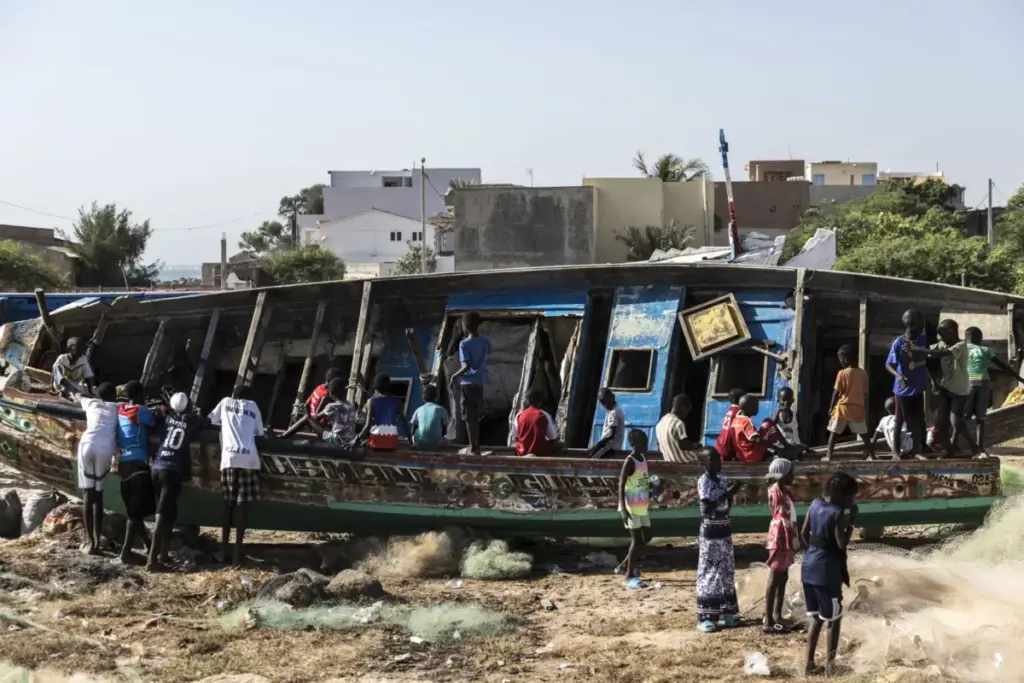
A small, wooden boat carrying roughly 100 migrants and refugees has capsized off the coast of Yenne in western Senegal, resulting in at least one confirmed fatality and leaving numerous others feared dead or missing. The disaster marks yet another grim milestone in West Africa’s escalating migration crisis, coming just ten days after a catastrophic shipwreck in northern Senegal claimed dozens of lives.
Local officials speaking to the AFP news agency reported that the vessel—a traditional flat-bottomed boat commonly known as a pirogue—struck a rocky area and washed ashore during the overnight hours between Tuesday and Wednesday. The impact left the craft in a dilapidated state, shattered against the unforgiving coastline as the rough Atlantic waters battered the wreckage against the beach.
According to testimonies gathered by the local gendarmerie from a survivor of the shipwreck, the vessel had set out with an estimated 100 people on board. The manifest of desperate passengers included at least five women, all seeking to make the perilous Atlantic crossing toward Europe in search of better economic opportunities and safety.
Massamba Mbengue, the Mayor of Yenne, alongside local firefighting units, confirmed that at least one body had been recovered from the site of the wreckage. Meanwhile, two other local sources reported that the death toll had already risen to two, with rescue and recovery operations remaining active as authorities scour the coastline and surrounding waters for further victims.
Oumar Sow, a representative of the local village chief, described the haunting moments leading up to the discovery of the wreck. He noted that the disaster unfolded in the dead of night, leaving a lasting psychological impact on the coastal community. The incident occurred around 2:00 am local time (02:00 GMT), Sow explained, adding that desperate cries echoing from the pirogue could be heard clearly from the shore, piercing the darkness before the boat ultimately struck the rocks.

As the sun rose over the debris-strewn beach, local authorities and law enforcement began the grim task of processing the personal items left behind by the passengers. A gendarmerie commander meticulously sorted through water sachets, scattered clothing, and other belongings recovered from the interior of the wrecked boat. Among the personal effects, investigators discovered eight identity documents, several mobile phones, and a school enrollment document belonging to a high school student hailing from Kabrousse, a locality situated in Senegal’s far south.
Local officials pointed out that the coastal village of Yenne has increasingly transformed into a prominent embarkation point for irregular migration. Smugglers and human traffickers have reportedly targeted the area, visiting the village to recruit boat pilots and organize clandestine voyages under the cover of night, exploiting the desperation of young people facing severe economic hardships at home.
Smugglers and the Escalating Crisis
This latest maritime tragedy underscores a worsening crisis along the West African migration corridor, unfolding just ten days after a devastating shipwreck off the coast of the northwestern town of Thieppe. That disaster, which occurred on November 8, claimed the lives of 43 people, marking one of the single deadliest migration tragedies in modern Senegalese history.
The continuous loss of life has triggered profound outrage and grief across the country, prompting civil society organizations to demand immediate state accountability. In the wake of the Thieppe disaster, the Action for Human Rights and Friendship (ADHA), a prominent human rights group in Senegal, issued a stern public call demanding that the government launch a formal parliamentary inquiry into the handling of the crisis. In their official statement, ADHA harshly denounced what they described as a persistent "lack of lasting results" from state authorities in curbing migrant deaths at sea and dismantling the lucrative smuggling networks operating with virtual impunity along the coastline.
Despite heightened security measures and public warnings regarding the extreme dangers of the Atlantic route, the allure of reaching Europe continues to drive thousands of young West Africans to place their lives in the hands of smugglers. The pirogues used in these crossings are frequently overcrowded, structurally ill-equipped for open-ocean navigation, and entirely vulnerable to the harsh currents and unpredictable weather patterns of the Atlantic.

Record Numbers Reach Spain
The relentless departure of migrant boats from West African shores has translated directly into unprecedented arrivals on European soil, specifically in Spain’s Canary Islands. On November 10, the Spanish government officially declared a migration emergency in the archipelago following a staggering surge of more than 9,000 migrant arrivals recorded in the Atlantic territory since the very beginning of the month.
Spain’s Maritime Rescue Service reported that its teams had successfully rescued 1,488 migrants traveling across 14 separate dinghies and wooden boats during a single intensive period, with the majority arriving on the island of El Hierro from West Africa on November 14. This massive influx broke a grim historical record, surpassing the previous peak of 1,461 people rescued over a similar timeframe in November 2020.
The vast majority of the migrants completing the grueling journey to El Hierro depart directly from West African coastal nations, with Senegal serving as a primary departure hub for individuals determined to reach mainland Europe via the Atlantic route.
The broader pressures on Spain’s migration infrastructure extend beyond its Atlantic territories. Last month, Spanish authorities deported more than a dozen individuals out of a group of approximately 80,000 people who had crossed into the Spanish North African enclave of Ceuta from Morocco over a tumultuous 48-hour period in late July. That mass border crossing proved catastrophic, resulting in at least 100 fatalities as desperate crowds attempted to navigate the perilous entry points into the autonomous city, which spans just 18.5 square kilometers (7.1 square miles) and maintains a population of roughly 80,000 residents.
As investigations into the Yenne shipwreck continue and search teams comb the western Senegalese coastline for survivors, families of the passengers wait anxiously for news, embodying the heavy human cost of a migration crisis that shows no signs of abating.