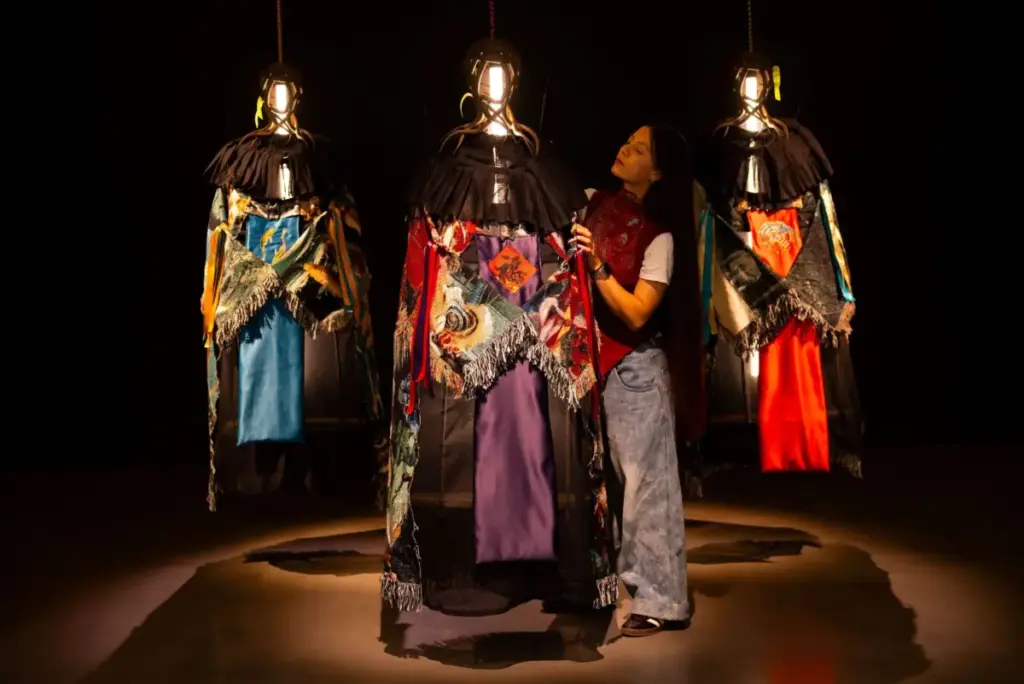
Multidisciplinary artist, contemporary dancer, and aerialist Sian Fan has unveiled her latest artistic creation, a striking new commission titled The Body is a Relic (how the light gets in), currently on display in Gallery 3 of the V&A East Storehouse. The installation marks the culmination of an intensive period of research and travel undertaken following Fan’s selection in the summer of 2025 as a Design Trust Fellow at V&A East.
Supported by Design Trust Hong Kong, the fellowship provided Fan with the unique opportunity to travel for the first time to Hong Kong and the New Territories. Her primary objective was to trace her Hakka family history and comb through the V&A’s extensive collections for historical and cultural objects that resonate with her heritage. Known for an artistic practice that spans sculpture, costume, performance, animation, installation, and new media, Fan frequently uses her work to question and explore her mixed Hakka Chinese and British identity.
Uncovering Archives and Proxy Heirlooms at V&A East Storehouse
Reflecting on the early stages of her project, Fan explains that her research began as an attempt to trace a familial journey marked by the typical gaps, holes, and voids common to many migrant stories. Rather than treating these missing links as dead ends, she sought to use the research process to reframe these absences as opportunities for creating speculative stories.
Like many individuals from migrant families, Fan experienced an absence of tangible heirlooms and historical objects directly connecting her to her family history. To bridge this gap, she embraced the V&A collections as a vast archive of "proxy heirlooms." During her time exploring the museum’s holdings, she drew particular inspiration from traditional artifacts such as the liangmao hat, Chinese embroidery, and Hakka textiles. Hakka textiles are historically noted for their remarkable resourcefulness, demonstrating a careful and attentive use of scraps of available fabrics that mirror the resilience of the communities that made them.
Field Research Across Hong Kong, the New Territories, and Fujian
The fellowship also allowed Fan to embark on deeply personal field research, visiting Hong Kong and mainland China for the very first time. Immersed in the hectic, humid streets of the cityscape, she explored local art organizations and heritage museums to deepen her understanding of the cultural traditions of Hong Kong and the Hakka people.
Venturing into the rural landscape of the New Territories, Fan visited a friend’s Hakka village to attend a vibrant celebration for the reopening of the village temple. The event featured traditional lion dances, firecrackers, and poon choi, a communal celebratory meal. Continuing her journey, she hiked through the rural expanses of the New Territories to reach Kop Tong, her family’s ancestral village. There, she located the abandoned house where her mother grew up before leaving Hong Kong for England as a child.

Piecing together fragments of her mother’s childhood memories in situ proved to be a powerful and surreal experience. Fan also discovered a small museum in the nearby Lai Chi Wo village containing historical information on the area, including references to her family, alongside reconstructions of a traditional Hakka-style home. When she later shared these discoveries with her mother, they served as a catalyst for jogging long-dormant memories.
Continuing her journey into mainland China, Fan traveled to Fujian province to study several tulou buildings. These structures represent a traditional form of Hakka architecture, typically characterized by massive, circular earthen buildings featuring an open courtyard at the center.
Translating Memory and Architecture into Installation Art
The insights, textures, and emotional resonance gathered from this immersive research directly informed Fan’s new commission for V&A East Storehouse, The Body is a Relic (how the light gets in). The installation features an arrangement of three suspended, life-sized, body-like sculptures representing a small family unit. Constructed with rounded bamboo frames, the figures are covered in diverse textured fabrics of varying opacities. Their heads are wrapped in forms resembling branches or vines, designed with a cut-out negative space where the head and neck would conventionally reside. Suspended vertically inside each body is a glowing light bar, casting illumination through the layered materials and revealing hidden shapes within, giving the figures the appearance of luminous lanterns.
The textured fabrics incorporate imagery captured during Fan’s research trip, rendered using embroidery and weaving techniques. These visual elements include cut-out wall features from traditional Hakka architecture, the patterned glass windowpane of her mother’s childhood home, ornamental koi fish from one of the tulou courtyards, and the lion dancers performing at the village celebrations. By layering, distorting, and reconfiguring these elements, Fan creates an abstract tapestry that reimagines real and imagined memories, histories, and stories.
Every structural choice carries symbolic weight. The bamboo frames reference Hong Kong’s famous bamboo scaffolding, while the branch-like structures of the figures’ heads are inspired by the winding branches Fan encountered while hiking to her ancestral village. Furthermore, the negative space within the bodies references both the oculus-like voids found within the tulou houses and the head openings in liangmao hats—examples where empty spaces are continually animated and filled by the human body and life itself.
Conceptually, the work meditates on disjointed histories and speculative storytelling, weaving together real and imagined tales with equal validity. For Fan, this approach serves as a method of asserting agency over one’s historic and cultural identity, fostering a sense of belonging and enabling the creation of new states of self. Ultimately, the installation explores the premise that in the absence of traditional heirlooms and tangible family histories, the body itself serves as a meaningful, physical record—making the body a relic.

Shifting Practices and Future Encounters
The opportunity to conduct extensive research in Hong Kong, China, and the Greater Bay Area has catalyzed profound shifts in Fan’s artistic practice and her overall sense of self. Gaining deeply personal insights into her family history and cultural identity has provided her with an overwhelming sense of grounding and affirmation, while introducing new materials, textures, and emotional resonances to her work.
Through The Body is a Relic (how the light gets in), Fan hopes visitors will come away with a heightened sense of possibility and curiosity. By incorporating intricate details throughout the installation, she encourages audiences to take their time discovering subtle elements while simultaneously experiencing the ambient glow and grand composition of the works.
The installation forms part of V&A East’s ongoing creative commissions programme, New Work, which invites artists twice a year to respond to a shared theme exploring the intersection of art, design, and everyday life across the V&A East Museum and V&A East Storehouse. Following the inaugural theme, Making East London, the second iteration—titled The Stories of Clothes—explores the profound storytelling power of clothing through a diverse array of installations, films, displays, and events.
The Body is a Relic (how the light gets in) is on view in Gallery 3 of the V&A East Storehouse as part of New Work: The Stories of Clothes, which runs from November 14, 2026, through June 20, 2027.