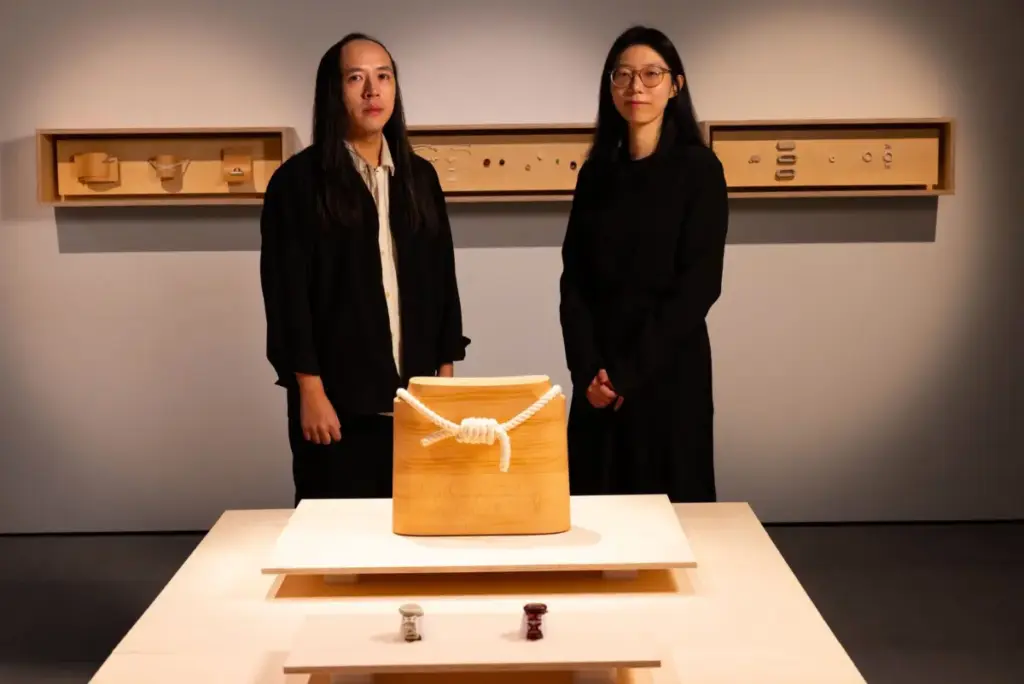
Industrial designers Jimin Jeon and Adam Huxley Khng have built a collaborative practice defined by deep material exploration since first meeting in Tokyo in 2019. Selected as inaugural Design Trust Fellows for 2025, the duo embarked on an extensive research journey exploring garment fasteners within the Victoria and Albert Museum’s collection, alongside field research conducted in Hong Kong, China, and the Greater Bay Area. Their collaborative investigation culminated in a major commissioned installation titled Motions and Notions of Fastening, which is on display in Gallery 1 of the V&A East Storehouse as part of the museum’s creative commissions programme, New Work: The Stories of Clothes.
The Research Journey and Reverse Design
Adam and Jimin’s research into garment fastenings moved far beyond surface-level aesthetics, focusing instead on the recurring gestures and physical forms that have accompanied fastening technologies from prehistory to the present day. Rather than treating fastenings as mere functional mechanisms or decorative afterthoughts, the designers approached them as foundational elements that dictate the entire architecture and construction of clothing. Drawing heavily on their industrial design backgrounds, they sought to understand how these critical components have been conceived, developed, and manufactured over time, while speculating on how they might continue to evolve.
A central methodology of their fellowship involved what they describe as an investigative process of reverse design. When encountering historical artifacts in a museum archive, researchers are typically provided with standard catalog data such as materials, dimensions, and estimated dates of origin. However, vital experiential qualities—such as how an object felt to handle, the acoustic feedback it produced, or its role in daily life—frequently remain absent. For Jeon and Khng, this lack of documentation became a productive tool that actively invited speculation and critical reflection.

Rather than using design exclusively to produce new objects, the duo utilized design as a method of reading existing objects. The opportunity to physically handle items during their research residency at the V&A East Storehouse proved vital to this approach. Examining a jade belt hook in person, for instance, offered sensory revelations that static photographs and catalogue records could never capture. The sudden realization of its weight, the distinct temperature of the jade, and the subtle sound made when its components connected revealed practical and aesthetic dimensions that can only be understood through direct, tactile experience.
Manufacturing Networks and Continuity in Greater Bay Area
The fellowship also took the designers to Hong Kong, China, and the broader Greater Bay Area, radically expanding their understanding of production ecosystems. Rather than isolating individual products for study, Adam and Jimin sought to trace the complete lifecycle of an object, following its journey from initial manufacture and distribution through to commercial sale and eventual use. Visiting massive manufacturing centers where industrial fasteners are produced in immense quantities illuminated the staggering local and global economic significance of seemingly minute components.
Interactions with local manufacturers highlighted an industry driven by remarkable immediacy, openness, and personal trust. Knowledge and expertise moved fluidly through personal networks, where an impromptu introduction could instantly open access to an entirely new phase of production.
One of the most striking discoveries of the field research was the profound continuity bridging ancient history and contemporary industry. While the designers expected to uncover dramatic technological transformations, they discovered that many foundational principles of fastening have remained remarkably consistent over thousands of years. Instead of the core mechanics changing, the primary shifts have occurred in the methods of production, the operational contexts of the objects, and the vast distribution networks through which they circulate.

A New Taxonomy of Fastening
To make sense of the hundreds of objects examined during their research, Jeon and Khng discarded traditional systems of categorization based on historical periods or visual appearances. Instead, they developed a novel classification system rooted entirely in physical action and human movement, yielding three primary categories.
The first category is piercing, which encompasses materials joined through direct penetration, including pins, brooches, and other devices that hold fabrics together by passing directly through them. The second category is tensioning, involving dynamic actions such as tying, lacing, binding, and pulling. The third category is holding, which covers buttons, clasps, clamps, toggles, and related mechanisms that rely on containment or mechanical engagement. This functional taxonomy allowed the designers to draw meaningful connections between objects that would otherwise appear entirely unrelated across history and culture.
Translating Research into the V&A East Commission
This rigorous classification framework directly informed their final commissioned installation for V&A East Storehouse, Motions and Notions of Fastening. Rather than simply replicating historical artifacts, the installation features a series of speculative objects that translate garment fastenings into new contexts through deliberate shifts in scale, material, and assembly. Alongside these finished pieces, the exhibition presents vital elements of the research process itself, including study models, collected fastenings, industrial prototypes, and sculptural investigations exploring the three core actions of piercing, tensioning, and holding.
The overarching theme of the exhibition, The Stories of Clothes, shaped the project in two fundamental ways. First, it emphasized that fastenings represent universal everyday interactions. Almost everyone possesses personal experience of buttoning a shirt, tying a lace, or securing a clasp. Though seemingly mundane, these routine physical actions are deeply embedded in daily life, serving as gateways to broader questions regarding material culture, international trade, and technological development.

Second, the theme resonated with their encounters inside the V&A collection, where they frequently discovered fastenings that had become completely detached from their original garments. Existing as isolated artifacts stripped of their original context, these objects encouraged the designers to investigate how material culture is interpreted when historical narratives become fragmented. Design became a vital tool for imagining potential narratives, asking not only what an object was, but how it was used, what kind of life it sustained, and what relationships it once formed.
Influential Artifacts Within the Collection
Throughout their residency, several specific objects from the V&A collection left a lasting mark on the designers’ creative direction. A collection of ceramic buttons crafted by Lucie Rie demonstrated how physical gestures of pressing and shaping clay could remain permanently embedded within an object, prompting deeper reflections on manufacture and tactile human interaction over time.
Similarly, a traditional silk drawstring bag illustrated that fastenings are not always separate components fashioned from hard materials; instead, the cord, loops, and fabric can function seamlessly as a single integrated textile system. Meanwhile, a clock housed inside a bag, designed by Daniel Weil, revealed surprising structural parallels when viewed through the lens of fastening, echoing the exact intersections of hard and soft materials identified in historical garments.
Other key references included a self-contained Japanese container that relied entirely on its own structure and weight to fasten itself, challenging the assumption that fastening mechanisms always require external components. Finally, the aforementioned jade belt hook provided endless insight, prompting the designers to focus heavily on the reverse sides of objects—the hidden areas that often reveal the most about mechanical function and ergonomic adaptation to the human body.

A Speculative Approach to Design
Reflecting on the making process, Adam and Jimin noted that the commission differed fundamentally from their typical commercial practice. While much of their everyday work involves creating products for clients, manufacturers, and start-ups within a problem-solving framework directed toward commercial distribution, this museum fellowship carried a distinct purpose centered on communication, reflection, and the sharing of ideas.
Rather than seeking to solve a concrete design problem, the resulting installation is deliberately speculative. The objects do not offer definitive answers; instead, they pose questions about what might happen if contemporary culture reevaluated everyday fasteners and extended their mechanical principles into entirely new contexts.
By engaging in a sustained dialogue with a major museum collection for the first time, the designers discovered an immense reservoir of historical knowledge capable of informing contemporary and future-facing design thinking. Ultimately, Jeon and Khng hope visitors leave the exhibition viewing routine physical interactions with a renewed perspective. Drawing on a parallel by architect Juhani Pallasmaa, who described a door handle as the handshake of a building, the designers view fastenings as the vital handshake between a person and their clothing—the small, tactile point where human interaction with material culture truly begins.
Motions and Notions of Fastening is on display in Gallery 1 of the V&A East Storehouse. The Design Trust Fellowship at V&A East was generously supported by Design Trust Hong Kong. The installation forms part of the wider New Work: The Stories of Clothes creative commissions programme, running from 14 November 2026 to 20 June 2027 across V&A East Museum and V&A East Storehouse, exploring the storytelling power of clothing through dynamic installations, films, displays, and public events.