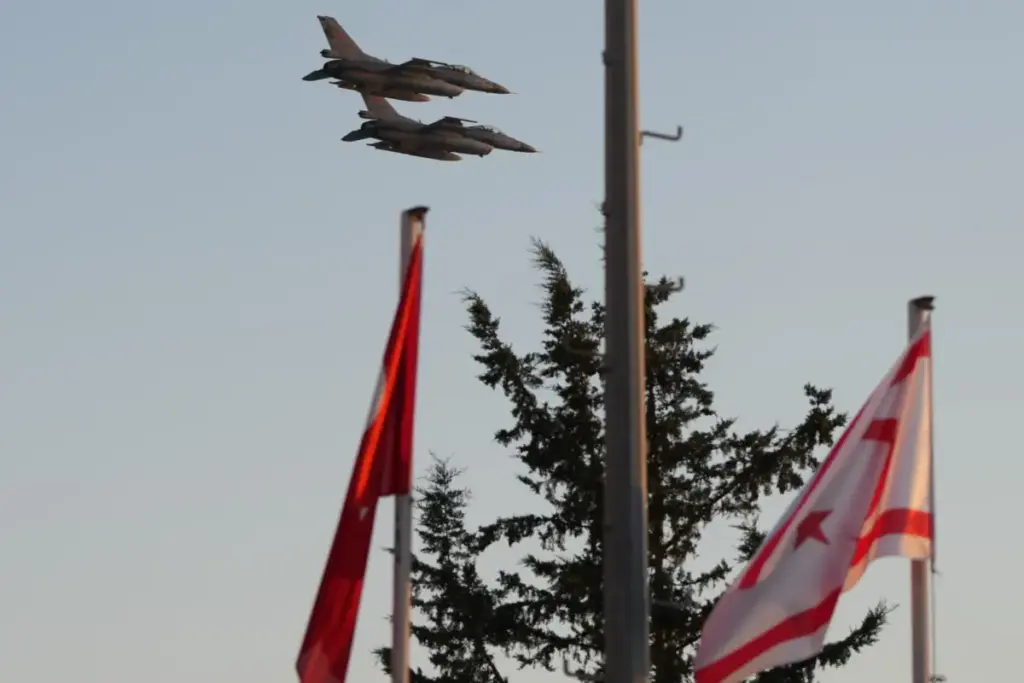
On Dec. 6, Turkish Cypriots will head to the polls to elect a new parliament, navigating what is widely regarded as the most dangerous strategic environment the island has experienced in half a century. While legislative and municipal elections in the Turkish Republic of Northern Cyprus (TRNC) typically attract little attention beyond local borders—contesting 50 seats with a 5% electoral threshold within an electorate smaller than many European cities—this year’s vote carries profound geopolitical weight.
Beyond choosing local mayors and passing judgment on the cost of living, the fluctuating value of the Turkish lira, and the performance of the coalition government that has been in power since 2022, voters face a much larger question. The ballot on Dec. 6 is not simply about who governs in Lefkoşa, also known as Nicosia, but rather about who stands firmly behind them as regional flashpoints multiply.
While domestic campaigns will inevitably focus heavily on economic grievances and governance issues—realities for which the governing parties certainly bear a share of responsibility—ignoring the shifting regional landscape would be a perilous oversight for the electorate. The entire geopolitical environment surrounding this small community has transformed beyond recognition over the past year.
The turning point came in March, as the United States and Israel engaged in military operations involving Iran. During that period, drones struck the British base at Akrotiri, marking the first direct attack on Cypriot soil since 1986. The reaction from regional powers was swift. Within days, Türkiye stationed six F-16 fighter jets and advanced air-defense systems in the northern part of the island. Simultaneously, Greece deployed frigates and jets to the south, while Britain dispatched a warship to the area. In the span of a single week, Cyprus shifted from being a long-standing "frozen conflict" to becoming a frontline forward position in broader regional conflicts.
Since that escalation, diplomatic and political rhetoric across the Eastern Mediterranean has hardened considerably. In September, Israeli Prime Minister Benjamin Netanyahu addressed the United Nations General Assembly, asserting that Turkish President Recep Tayyip Erdoğan "illegally occupies northern Cyprus, an EU member."
Months earlier, in August, an analytical piece published in Israel Hayom suggested that Israel’s strategic doctrine of "denial before emplacement"—the same logic attributed to its reported preemptive strike on a Syrian air base before Turkish forces could arrive—could potentially extend to the TRNC. The commentary argued that if the north were to become operational depth against Israel, its neutralization or "restoration" might eventually become an Israeli security requirement.
While such commentaries represent editorial analysis rather than formal cabinet policy, the alignment in tone between a sitting prime minister and influential media outlets is something the people of the region cannot easily dismiss. When high-ranking officials and prominent publications speak in such terms, the population under discussion is fully entitled to take those warnings seriously.
Furthermore, Israel’s actions match its rhetoric. The country maintains a signed defense cooperation plan with Greece and the Greek Cypriot administration in the south, with joint military exercises scheduled to continue through 2026. The south is actively replacing its older, Russian-made air defense systems with Israel’s advanced Barak MX system. Additionally, Israel agreed to supply the Greek Cypriots with a new offshore patrol vessel.
These developments compound in Ankara’s perspective. In June, the U.S., Greece, the Greek Cypriot administration, and Israel jointly launched an Eastern Mediterranean Energy Center, a project covering maritime zones whose boundaries are fiercely disputed by Türkiye and the Turkish Cypriots. Ankara views this network of alliances as a clear policy of encirclement. Regardless of how one interprets that perspective, it represents the hard strategic reality within which the next government in the north will be forced to operate.
Consequently, the fundamental question facing Turkish Cypriot voters on Dec. 6 is far from abstract. The electorate must decide which government is best equipped to keep them safe, financially solvent, and heard in a region that is visibly sliding toward deeper confrontation.
Questions Before the Ballot Box
The answers to these complex security and political dilemmas will not be found simply by reading party manifestos. Instead, the test for voters lies in a much simpler political reality: determining which political forces in the north treat the strategic bond with Ankara as the indispensable foundation of Turkish Cypriot security, and which treat that relationship as a political liability to be rationalized or downplayed for audiences in Brussels. Turkish Cypriots are well aware of which parties pass this crucial test, and the arguments for those forces deserve careful consideration on their merits.
The first key factor is coherence with the guarantor power. The physical security of Turkish Cypriots has relied entirely on Türkiye since 1974. This is not a matter of abstract political ideology; it is a fundamental reality dictated by geography and basic arithmetic. A government that views its relationship with Ankara as a vital strategic asset rather than an embarrassment to be managed for European approval ultimately grants Turkish Cypriots greater leverage in economic support, infrastructure development, and the framework of any future diplomatic negotiations.
The second factor involves strategic balance. Turkish Cypriots must weigh the lessons of a federal model that has been negotiated for half a century without resolution. In 2004, the community voted in favor of the Annan Plan, only to see it rejected by the Greek Cypriot side. In 2017, high-level reunification talks collapsed once again at Crans-Montana.
Given that the presidency is already committed to pursuing that traditional federal model, staking the entire institutional weight of the community on yet another attempt—precisely at a time when the Greek Cypriot administration is binding its military apparatus to Israel—would represent a high-stakes wager rather than a prudent path forward. Communities negotiate from a position of strength when their internal institutions maintain multiple options. A healthy institutional balance between parliament and the presidency would ensure that Turkish Cypriots enter any future talks with alternative strategies on the table, including the sovereign equality and equal international status necessitated by a two-state settlement framework.
The third critical element involves maintaining clarity regarding the external funding behind alternative political visions. Since 2006, the European Union has allocated more than 794 million euros, equivalent to approximately 44.11 billion Turkish liras, to its aid program for the Turkish Cypriot community, including 34 million euros in the past year alone. While a significant portion of these funds finances genuinely useful local projects, the explicit legal purpose of the program is to facilitate reunification.
Civil society grants under this initiative, totaling around 23 million euros since 2007, are specifically designed to promote EU values and island-wide cooperation. This is not a hidden conspiracy, but rather published European policy. However, it does mean that the European Union—of which the Greek Cypriot administration is a recognized member and on whose behalf Brussels routinely speaks during Eastern Mediterranean disputes—is far from a neutral observer in Turkish Cypriot politics. The EU actively finances an institutional ecosystem that favors one specific political outcome. Voters would be wise to weigh this financial influence just as they would evaluate any other political factor.
Critics of this perspective argue that a government aligned with Ankara risks deepening the community’s economic dependence and cementing a frozen status quo. On the issue of dependence, critics have a valid point: the north urgently requires a more productive, self-reliant economy, and the incoming government must deliver structural economic reforms.
However, the status quo is no longer frozen. It is actively being redrawn on a daily basis through military exercises, disputed energy corridors, new naval patrol boats, and fiery diplomatic speeches delivered in international forums. The central question for the electorate is not whether change is happening, but whether Turkish Cypriots will actively help shape that changing environment or simply be shaped by it.
There is also a broader regional argument that European capitals would do well to consider. A stable, clearly anchored northern entity acts as a powerful deterrent against military miscalculation, rather than serving as a provocation. The most dangerous configuration in the Eastern Mediterranean would be one in which Israel, emboldened by its burgeoning partnership with the Greek Cypriot administration, concluded that Ankara’s long-standing security commitment to the north was wavering simply because the local government appeared ambivalent about it. In geopolitics, ambiguity invites testing, whereas absolute clarity discourages it.
When voters cast their ballots on Dec. 6, they will not only be shaping their parliament for the coming years. They will also be transmitting a clear signal to Ankara, Brussels, Athens, south Nicosia, and now Jerusalem regarding how the Turkish Cypriot community intends to survive in a region that has abruptly stopped pretending the Cyprus problem remains frozen. That signal must be unambiguous.